
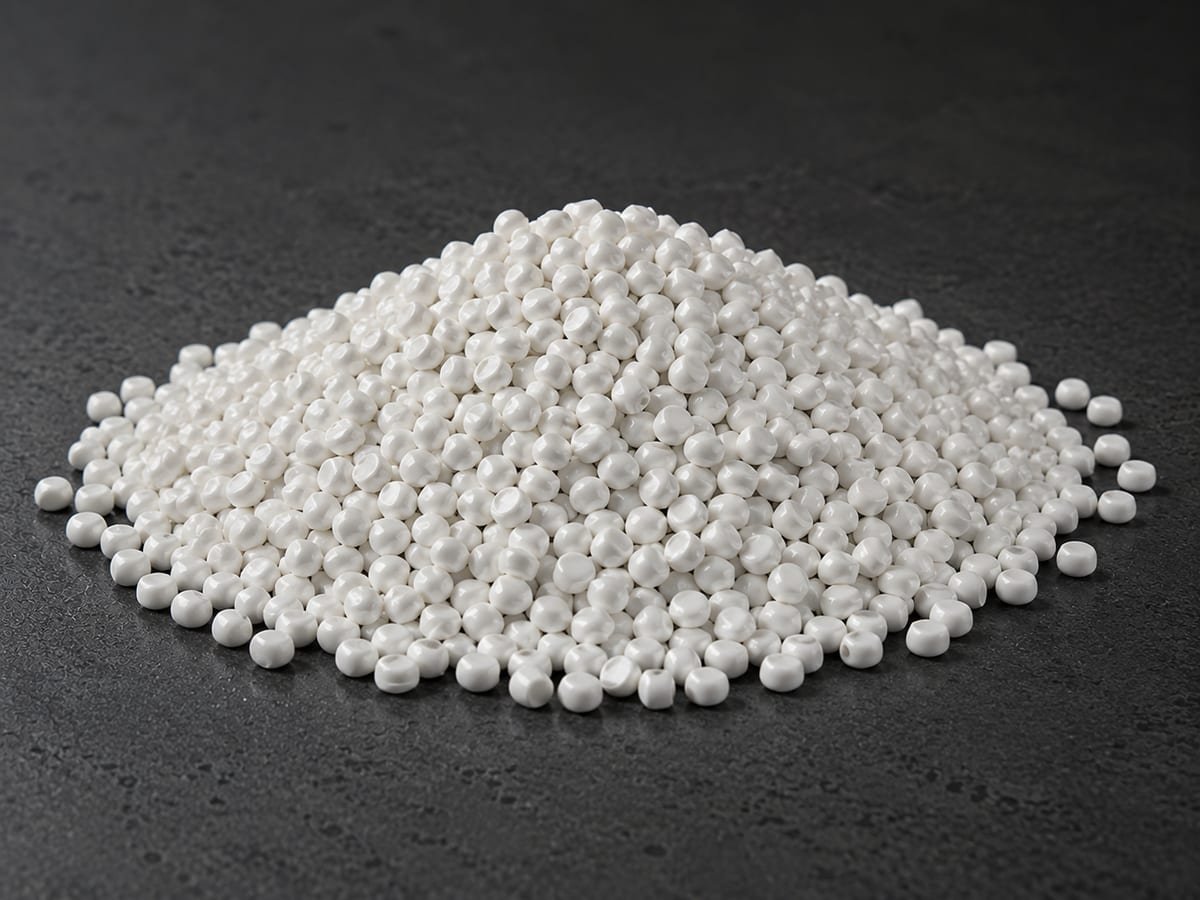
Filler Masterbatch
Choose calcium carbonate filler masterbatch for PE film, bags and PP raffia. Compare dosage, accepted-unit cost, trial quality and Saudi or Gulf enquiry requirements.
Overview
Filler masterbatch is a pelletised concentrate containing mineral filler dispersed in a polymer carrier. Calcium carbonate grades contain CaCO3 and are diluted into the base polymer during processing. Select by application, carrier compatibility, dispersion and finished-product requirements before comparing price.
This guide supports factory qualification and enquiries for Saudi Arabia and the Gulf. The PR codes below are illustrative reference codes pending confirmation, not evidence of stock, certified specifications or commercial availability.
Choosing a PE or PP filler grade by application
| Process | Check before choosing a grade | Qualify in the finished product |
|---|---|---|
| PE blown film and bags | LDPE or LLDPE compatibility, dispersion, moisture and target thickness | Bubble stability, holes and specks, tensile and tear performance, sealing and opacity |
| PP raffia tapes and woven sacks | Supplier recommendation for tape drawing, carrier compatibility and processing requirements | Tape breaks, draw behaviour, tape and fabric strength, weight and scrap |
| Injection moulding or extrusion | Compatibility with the base polymer, flow, density and dimensional requirements | Mould filling or extrusion stability, surface, dimensions and specified properties |
Consult the blown-film guide and the base resin references for LDPE, LLDPE and polypropylene PP. The carrier contributes to the formulation. Pellet colour or the word “filler” alone does not establish suitability.
Mineral loading versus masterbatch dosage
Mineral loading describes the CaCO3 fraction inside the concentrate. Letdown or dosage describes the concentrate fraction in the final blend. These percentages are different; a general percentage is not a bag-production recipe.
Arithmetic example only: a 100 kg final blend containing 20 kg of an assumed 80% CaCO3 concentrate receives 16 kg of mineral and 4 kg of carrier plus other additives from that concentrate. Mineral contributed by it is therefore 16% of the blend, rather than 20% or 80%. These assumptions illustrate the calculation, not a product specification or dosage recommendation.
Adding 20 kg of concentrate to 100 kg of resin instead produces 120 kg of blend: concentrate dosage is 20 ÷ 120, approximately 16.7%. Agree whether percentages refer to the final blend or additions relative to resin weight.
Comparing filler price and production cost
There is no universal price per tonne for all grades and delivery schedules. Compare offers with an identified carrier, mineral loading, intended application, documentation, quantity and delivery terms. Calculate blend material cost per kilogram as the sum of each component’s mass fraction × its price per kilogram, including colours and other additives.
Then calculate material cost per accepted unit = material expenditure during the trial ÷ accepted units. Record actual weight, scrap and rejected output; include processing costs when evaluating total cost. Density or unit-weight changes can offset a cheaper blend, and higher throughput is not a benefit if quality fails. A savings percentage needs a comparable production trial.
Documents and specifications to request
- Grade-specific TDS: carrier, mineral content and measurement method, density and melt flow index with test temperature and load. Do not directly compare MFI values obtained under different conditions.
- Mineral and dispersion data: particle-size distribution such as D50 and D97 when provided; clarify whether it describes the mineral or pellets. Request surface treatment, moisture limits and relevant dispersion or filter pressure value (FPV) data where applicable.
- Batch COA: agreed test results and batch identification. A general technical data sheet is not a batch certificate of analysis.
- SDS and storage: packaging, handling and storage instructions. Assess drying against the data sheet and actual condition rather than assuming every filler needs it.
- Regulated uses: appropriate food-contact or other compliance documents for the specific application and destination where required. Calcium carbonate content does not establish food-contact approval of the finished article.
A factory trial before purchasing at production scale
- Record the current blend baseline: resin, additives, thickness and weight, line settings, quality and rejection rate.
- Select a grade recommended for the process. Keep other variables as consistent as possible and test incremental dosages within supplier guidance and product requirements.
- Record actual dosage and batch identity for each run. Monitor agglomerates, holes, moisture or gas-related defects, stability and scrap.
- Test the properties controlling customer acceptance: tensile, tear and seal performance for film, tape strength for raffia, or surface, dimensions and required properties for moulded products.
- Compare accepted-unit cost and quality against the baseline. Confirm the result in a further run before approving a production change.
When defects occur, investigate grade, dosage, dispersion, moisture and processing conditions rather than increasing filler for theoretical savings.
Filler, white masterbatch, transparent filler and raw powder
Filler introduces mineral into the polymer. White masterbatch targets colour and opacity, commonly with titanium dioxide; colour masterbatch and functional additives serve other roles. Filler may affect whiteness and opacity but is not an equivalent replacement for an identified white grade.
“Transparent filler” does not establish the mineral chemistry or optical result. Request composition and relevant haze or transparency data, then test at the actual thickness.
Compared with raw calcium carbonate powder, masterbatch supplies the mineral in carrier pellets to facilitate handling and dosing. Direct powder compounding requires suitable feeding, mixing and dispersion equipment. Its economics depend on equipment, production volume and processing cost; neither route is automatically cheaper for every factory. See coated versus uncoated calcium carbonate for polymers for mineral and surface-treatment selection context.
Saudi Arabia and Gulf filler masterbatch enquiries
For an enquiry covering Saudi Arabia, the UAE, Kuwait, Qatar, Bahrain or Oman, provide the process, polymer and grade, quantity, delivery city, product dimensions or thickness, quality requirements and requested schedule. A city such as Riyadh, Jeddah or Dammam identifies the delivery requirement, not a claim of local warehousing.
Grade requirements, documentation and delivery terms need review before an offer is confirmed. Specify whether you require a sample, TDS or batch COA so availability can be checked. Reference codes do not confirm stock or a shipping date.
Send your filler requirements for quotation review. Select “Other” in the product field and include “filler masterbatch”, application, quantity and delivery city in the additional details.
Technical references and their scope
Omya’s polyolefin masterbatch guide illustrates differing carrier and application choices. The Omyalene 2012 A-LN data sheet shows how specifications and recommendations belong to an identified grade. These references explain selection; they are not PLAXRAW product specifications or evidence of a supply relationship. Reviewed on 7 October 2026.
Content updated:
Key Applications
The material's role changes by industry — click any industry to see its full page.

Physical Properties
| Property | Typical Value | Note |
|---|---|---|
| Mineral filler | Calcium carbonate in CaCO3 grades | Check grade-specific loading in the TDS; no universal filler specification |
| Carrier | Grade and application dependent | Verify PE or PP compatibility and supplier guidance |
| Dosage | Qualified by trial and grade recommendation | Concentrate dosage differs from mineral loading inside the pellets |
These are typical published values for the material in general, not a certificate of analysis (COA) for a specific shipment. Actual per-batch values are set by the COA accompanying supply.
Grades
Grade and Specification Guide
These reference codes illustrate grade categories and specifications for comparison and selection. The commercial grade and final specification are determined by your application requirements, the technical data sheet and the batch certificate of analysis.
Standards & Technical References
Every claim on this page traces back to a verifiable reference:
- Tier 1Manufacturer sourceOmya — Polyolefin masterbatch; selection reference, not PLAXRAW supply specifications
- Tier 1Manufacturer TDSOmya — Omyalene 2012 A-LN; https://products.omya.com/products/omyalene-2012-a-ln
Frequently Asked Questions
How does filler masterbatch differ from white masterbatch?
Filler masterbatch introduces mineral filler; white masterbatch targets colour and opacity, commonly using titanium dioxide. Filler can also affect whiteness and opacity, but is not an equivalent replacement for every white grade.
What filler dosage should I use in plastic bags?
There is no universal dosage. Grade, resin, thickness, tear and sealing requirements determine the acceptable level. Start from the supplier recommendation and qualify incremental trials while recording scrap, weight and product quality.
Can a PE-carrier filler grade be used in PP products?
Blendability alone is insufficient. Check carrier compatibility with PP, the supplier recommendation for the exact process and finished-product performance. Do not assume a PE film grade is suitable for raffia tapes or injection moulding.
Is transparent filler always calcium carbonate?
No. A commercial name does not establish mineral chemistry or optical performance. Request composition, carrier and relevant transparency or haze data, then test at the required thickness.
Does a lower filler price per tonne guarantee savings?
No. Compare material cost per accepted unit, actual weight, scrap, productivity and processing costs. A lower blend price per kilogram can be offset by heavier units or higher rejection.
What is needed for a Saudi or Gulf filler masterbatch enquiry?
Send the process, polymer and grade, quantity, delivery city, product dimensions or thickness, quality requirements and requested delivery schedule. Grade, documents and delivery terms require review before an offer is confirmed; reference codes on this page do not establish availability.


