
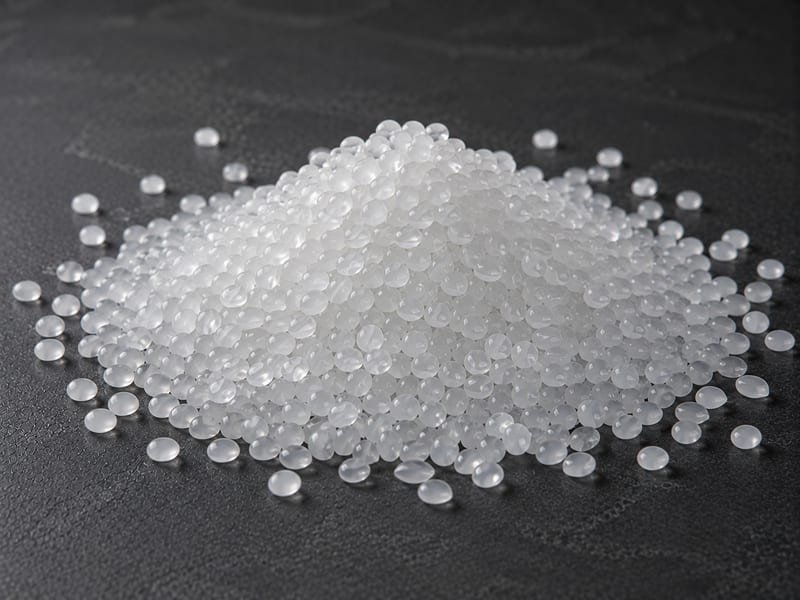
LDPE (Low-Density Polyethylene)
What LDPE is used for in plastics processing, how it compares to HDPE, and what buyers need to know about grade selection and recyclability.
Overview
LDPE is a resin used across plastics processing — mainly for films and packaging. This page covers what it actually does and how it compares to HDPE.
What is it?
LDPE is polyethylene with a highly branched molecular structure — long-chain branching, per ASTM D883’s terminology — unlike the predominantly linear structure of HDPE (ASTM D4976). For film applications specifically, ASTM D4635 specifies a density range of 0.910–0.925 g/cm³ — well below HDPE’s more linear, less-branched grade (see Limitations).
Why should I use it?
- Higher branching means higher flexibility and clarity — the opposite trade-off from HDPE’s stiffness (see Limitations for how that plays out).
- Widely used, but a real recycling gap exists. LDPE film is common in packaging, but actual recycling rates for that category remain low in practice — see the breakdown below.
How it’s used
In Plastics & Polymers, LDPE is used mainly for films — general-use and packaging film, qualified under ASTM D4635. In the US, plastic bag, sack, and wrap waste (predominantly LDPE/LLDPE film) totaled 4.2 million tons generated in 2018, of which only 10% was recycled (EPA) — film recycling in practice lags well behind the material’s actual usage volume.
Limitations — when it isn’t the right choice
- Where stiffness or chemical resistance is the priority instead of flexibility, HDPE is the better fit. Same polyethylene family, but HDPE’s more linear structure and higher density (ASTM D4976/D1248) give it the rigidity LDPE doesn’t have. (A dedicated comparison article — HDPE vs. LDPE — is planned.)
- The low recycling rate isn’t a reason to assume the material can’t be recycled — it reflects real-world collection and processing gaps rather than a property of LDPE itself, and it’s a genuine factor to weigh in sustainability-sensitive packaging decisions.
Key Applications
The material's role changes by industry — click any industry to see its full page.

Physical Properties
| Property | Typical Value | Note |
|---|---|---|
| Density, film grade | ≈ 0.9215 g/cm³ (ASTM D1505) | Typical published value — Transam Polymers LD02GP datasheet |
| Melt Flow Index (MFI) | ≈ 0.3-20 g/10min (190°C/2.16kg, ASTM D1238) | Typical published range — ExxonMobil LDPE Product Guide |
| Tensile Strength at Break (MD) | ≈ 25-28 MPa (ASTM D882) | Typical published range — Transam Polymers LD02GP / ExxonMobil LD 123.LN datasheets |
| Elongation at Break (MD) | ≈ 270-417% (ASTM D882) | Typical published range — Transam Polymers LD02GP / ExxonMobil LD 123.LN datasheets |
These are typical published values for the material in general, not a certificate of analysis (COA) for a specific shipment. Actual per-batch values are set by the COA accompanying supply.
Grades
Grade and Specification Guide
These reference codes illustrate grade categories and specifications for comparison and selection. The commercial grade and final specification are determined by your application requirements, the technical data sheet and the batch certificate of analysis.
Standards & Technical References
Every claim on this page traces back to a verifiable reference:
- Tier 1StandardASTM D4635 — Standard Specification for Plastic Films Made from Low-Density Polyethylene and Linear Low-Density Polyethylene for General Use and Packaging Applications
- Tier 1StandardASTM D883-20a — Standard Terminology Relating to Plastics
- Tier 1StandardASTM D4976-12a(2020) — Standard Specification for Polyethylene Plastics Molding and Extrusion Materials
- Tier 1StandardASTM D1248-16 — Standard Specification for Polyethylene Plastics Extrusion Materials for Wire and Cable
- Tier 1Government PublicationUS EPA — Plastics: Material-Specific Data
- Tier 3Global SupplierTransam Polymers — TDS LDPE LD02GP datasheet (density, melt index per ASTM D1238, tensile/elongation per ASTM D882)
- Tier 3Global SupplierExxonMobil — LDPE LD 123.LN Low Density Polyethylene Resin datasheet (tensile/elongation per ASTM D882)
Frequently Asked Questions
What is LDPE?
LDPE is polyethylene with a highly branched molecular structure — long-chain branching, per ASTM D883's terminology — unlike the predominantly linear structure of HDPE (ASTM D4976). For film applications specifically, ASTM D4635 specifies a density range of 0.910–0.925 g/cm³.
What structural difference sets LDPE apart from HDPE?
LDPE has a highly branched molecular structure with long-chain branching, per ASTM D883's terminology — unlike HDPE's predominantly linear structure (ASTM D4976).
What density range does ASTM D4635 specify for LDPE film?
0.910-0.925 g/cm³ — well below HDPE's more linear, less-branched grade.
What is LDPE mainly used for?
It's used mainly for films — general-use and packaging film, qualified under ASTM D4635.
What is LDPE film's recycling rate in the US?
Of the 4.2 million tons of plastic bag, sack, and wrap waste (predominantly LDPE/LLDPE film) generated in 2018, only 10% was recycled (EPA).
When is HDPE the better choice instead of LDPE?
When stiffness or chemical resistance is the priority instead of flexibility — HDPE's more linear structure and higher density give it the rigidity LDPE doesn't have.


