
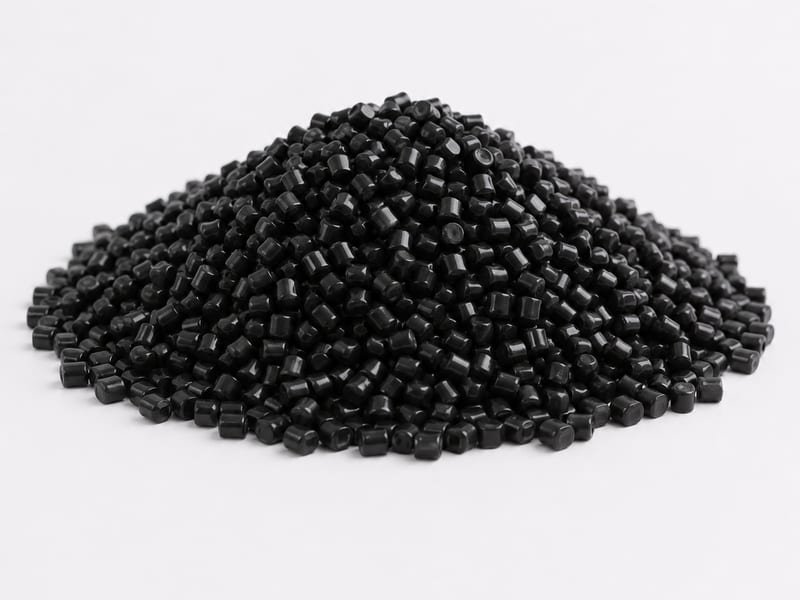
Black Masterbatch
How carbon black masterbatch protects polyolefins from UV degradation, and what research shows about the specific dispersion-defect threshold where structural integrity drops sharply.
Overview
Carbon black masterbatch is added to polyolefins mainly for long-term UV protection, and research measuring poorly-dispersed “window” defects in polyethylene pipe found a specific threshold above which structural performance drops off sharply. This page covers that threshold and how carbon black dispersion quality is assessed.
What is it?
Black masterbatch is a carbon black concentrate used to color and UV-stabilize polyolefins. Per ASTM D5596, a standard for microscopically evaluating carbon black dispersion in polyolefin geosynthetics, carbon black is added to many polymers specifically to provide long-term resistance to UV-induced degradation, and it needs to be dispersed uniformly throughout the finished material to do so effectively.
Why should I use it?
- It provides documented, standard-recognized long-term protection against UV-induced degradation in polyolefins — see “What is it?” above.
- Dispersion quality can be objectively assessed and rated, rather than relying on visual impression alone — see Limitations.
How it’s used
In plastics and polymer applications, carbon black masterbatch is compounded into polyolefins such as polyethylene to provide UV protection, with dispersion quality typically rated visually against the ISO 18553 scale referenced in carbon black dispersion research.
Limitations — when it isn’t the right choice
- Poor carbon black dispersion creates measurable defects, and above a specific defect threshold, structural performance drops sharply. A 2022 peer-reviewed study examined polyethylene pipes containing “windows” — regions with little or no carbon black due to poor dispersion — rated against the ISO 18553 scale. The study measured window area fractions of 0% (a well-dispersed reference sample), 1.5%, 7.5%, and 16.5% across different pipe samples, and identified a critical limit: above a window area fraction of 4.0%, fracture strain dropped as much as four times lower compared to a window-free specimen. This means dispersion quality isn’t just a cosmetic or color-consistency issue — it has a documented, threshold-based effect on mechanical performance. These findings are specific to polyethylene pipe and the ISO 18553 rating method used in this study, and shouldn’t be assumed to apply directly to other black masterbatch applications like films or injection-molded parts without separate verification.
Key Applications
The material's role changes by industry — click any industry to see its full page.

Physical Properties
| Property | Typical Value | Note |
|---|---|---|
| Carbon Black Loading (conventional) | ≈ 25-40% by weight | Typical published value — industry masterbatch formulation references |
| Carbon Black Loading (high-loading pipe grade) | > 40% by weight | Typical published value — pressure pipe masterbatch patent literature |
| Preferred Carrier Resin | LDPE (highest carbon-black carrying capacity) | Typical published value — industry technical references |
| Letdown Ratio (dosing) | ≈ 1-4% | Typical published value — industry masterbatch formulation references |
| Dispersion Quality (ASTM D5596) | Agglomerate size < 10 µm for optimal dispersion | Typical published value — ASTM D5596 testing references |
These are typical published values for the material in general, not a certificate of analysis (COA) for a specific shipment. Actual per-batch values are set by the COA accompanying supply.
Grades
Grade and Specification Guide
These reference codes illustrate grade categories and specifications for comparison and selection. The commercial grade and final specification are determined by your application requirements, the technical data sheet and the batch certificate of analysis.
Standards & Technical References
Every claim on this page traces back to a verifiable reference:
- Tier 1StandardASTM D5596 — Standard Test Method for Microscopic Evaluation of the Dispersion of Carbon Black in Polyolefin Geosynthetics
- Tier 2University/ResearchVisual, Non-Destructive, and Destructive Investigations of Polyethylene Pipes with Inhomogeneous Carbon Black Distribution for Assessing Degradation of Structural Integrity, Polymers (MDPI), 2022, Vol. 14, Issue 5, Article 1067
- Tier 3Industry Technical Referencejinhetec.com; mascomglobal.com — Black masterbatch carrier resin selection (LDPE carbon-black carrying capacity)
- Tier 3Testing Equipment Referencegeocomp.com; ahp-makina.com — ASTM D5596 dispersion evaluation (agglomerate size threshold)
Frequently Asked Questions
Why is carbon black masterbatch added to polyolefins?
Mainly to give them long-term resistance to UV-induced degradation, and it needs to be dispersed uniformly throughout the finished material to do so effectively.
How is carbon black dispersion quality assessed?
Per ASTM D5596, a standard for microscopically evaluating carbon black dispersion in polyolefin products, typically rated visually against the ISO 18553 scale.
At what dispersion-defect ('window') fraction does structural performance drop off?
Above a window area fraction of 4.0%, a 2022 peer-reviewed study found that fracture strain in polyethylene pipe dropped to less than a quarter of its level compared to a window-free specimen.
Do the polyethylene pipe study's findings apply to every black masterbatch application?
No. These findings are specific to polyethylene pipe and the ISO 18553 rating method used in this study, and shouldn't be assumed to apply directly to other applications like films or injection-molded parts without separate verification.


