
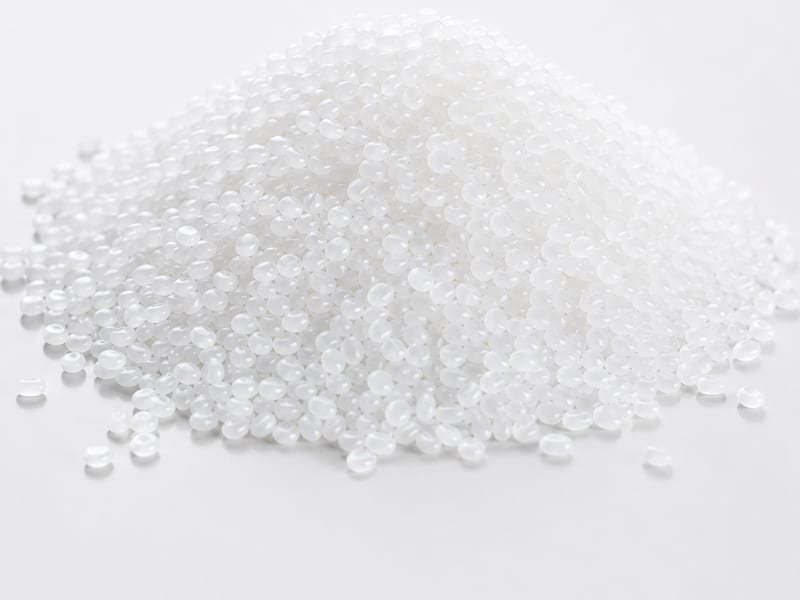
LLDPE (Linear Low-Density Polyethylene)
Choose LLDPE for blown or cast film: compare LDPE and mLLDPE, read density and melt index, plan a factory trial and prepare a Saudi or Gulf sourcing enquiry.
Overview
LLDPE is linear low-density polyethylene: a family of polyethylene resins with short-chain branching. Suitable grades are used in flexible packaging, stretch wrap and agricultural films. The useful buying question is which grade, additive package and processing route meet your film requirements—not simply whether a resin is called LLDPE.
Start with the end product, thickness, extrusion method and acceptance tests. A resin that runs well on one line may need different conditions on another. This guide supports selection; it does not establish stock availability or approve a finished product for food contact.
What is LLDPE used for?
Manufacturers distinguish grades by application. Sumitomo Chemical’s portfolio, for example, separates blown-film and cast-film options and identifies additive differences.
| Application | Selection questions |
|---|---|
| Blown-film bags and liners | Is the bubble stable at target output? Does the film pass tear and impact tests at the required thickness? |
| Cast stretch film | Is the grade recommended for cast extrusion? Check stretch, puncture, cling and unwinding on the intended wrapping system. |
| Agricultural film | Specify exposure, intended service life and stabilizers; the resin family alone does not establish outdoor durability. |
| Multilayer packaging | State the layer’s job, such as toughness or sealing. Assess the complete structure and its documentation. |
| Molding | Select a documented molding grade. A film grade is not an automatic substitute for injection or rotational molding. |
For line-related selection, see our blown-film processing guide.
Reading an LLDPE technical data sheet
Density and melt index narrow the shortlist; they do not prove that two grades are interchangeable. Read the test conditions, additives, application recommendation and document revision.
- Density: use the value and method for the specific grade, rather than treating one product as a specification for every LLDPE resin.
- Melt index / MFR: compare measurements at the same temperature and load. A value without conditions is incomplete.
- Film properties: record thickness, manufacturing conditions and machine/transverse direction, shown as MD/TD. Different specimen thicknesses can give misleading comparisons.
- Additives: establish whether slip or antiblock is already present before choosing an additive masterbatch.
- Quality documents: distinguish typical TDS values from agreed specifications and the actual lot’s certificate of analysis.
Documented example: equal density, different melt index
These OQ grades illustrate reading a TDS. They are manufacturer examples, not PLAXRAW stock offers or a recommended substitution.
| Manufacturer example | Density | Melt index at 190°C / 2.16 kg |
|---|---|---|
| Luban LL-F1801 | 0.918 g/cm³ | 1 g/10 min |
| Luban LL-F1802 | 0.918 g/cm³ | 2 g/10 min |
Their published film results use different specimen thicknesses: 30 μm and 25.4 μm respectively. Both documents describe typical values and require users to check suitability. Equal density is not enough to predict equivalent processing or film performance.
LLDPE vs LDPE, HDPE and mLLDPE
| Family | Approach to selection |
|---|---|
| LDPE | Consider its different branching and processing behavior when assessing bubble stability or blending. Verify optics and strength on the actual formulation. |
| LLDPE | Test process-compatible grades against the required balance of toughness, extrusion behavior and film properties. |
| HDPE | Consider higher-density grades when stiffness matters, while testing the finished product’s other requirements. |
| mLLDPE | Metallocene describes the catalyst route. Specify the grade and target performance rather than treating the name as a guarantee of better film. |
C4, C6 and C8 identify comonomer families; this is a different classification from metallocene. Ask for both where relevant. Do not assume every C8 resin is mLLDPE or all metallocene grades process alike. Davis-Standard’s resin guide connects selection with the line and layer function.
Melting point is not an extrusion setting
A DSC melting peak describes a thermal measurement. It does not prescribe barrel, die or cooling settings. NETZSCH’s PE-LLD characterization illustrates the influence of thermal history on the measured curve. Begin with the supplier’s grade-specific guidance and equipment limits, then qualify stable conditions on your line.
A controlled factory trial
- Record the current resin, formulation, line, output, thickness and rejection rate as the baseline.
- Set acceptance limits before the trial: thickness variation, MD/TD tear, puncture/impact, optics, sealing and unwinding as relevant.
- Keep other inputs stable where possible. Record changes to additives, cooling or settings so the result can be interpreted.
- Compare accepted output under documented test conditions. Assess several production samples and lot consistency before routine use.
- Calculate resin and additive cost per accepted kilogram or finished unit, including scrap and throughput effects. A lower purchase price alone does not prove a saving.
When evaluating filler masterbatch, qualify the formulation again; selecting LLDPE does not validate a universal filler percentage.
| Observed problem | Trial checks |
|---|---|
| Unstable bubble or uneven thickness | Grade recommendation, melt behavior, output, cooling and line settings |
| Film tears in one direction | MD/TD results, thickness distribution and orientation conditions |
| Blocking or difficult opening | Existing slip/antiblock package, conditioning time and measured friction |
| Gels or haze | Resin lot, contamination, filtration, thermal history and additive compatibility |
These checks organize diagnosis; they do not establish a cause without testing. Follow the grade’s SDS and handling guidance, preserve lot traceability and protect material from contamination.
LLDPE sourcing for Saudi Arabia and the Gulf
Specify the delivery city, quantity, timing, extrusion route, thickness, current grade and required documents. State whether you require prime material or are evaluating off-grade or recycled material. Request lot identity and agreed acceptance limits; these categories are not automatically interchangeable.
For food-contact packaging, obtain the exact grade’s declaration covering the intended use and assess the finished formulation. A general “food grade” statement about LLDPE is insufficient.
Use Request a quote, select Other, and write LLDPE in the details with these requirements. Availability, origin, price and delivery terms are confirmed for the enquiry; reference examples do not establish them.
Common selection questions
Can LLDPE replace LDPE directly?
Qualify the change on your line. Matching a family name or one data-sheet value does not demonstrate matching extrusion, sealing or finished-film performance.
Does a higher melt index always make a better film?
Choose melt behavior for the process and grade recommendation. Judge the film against acceptance tests rather than ranking resins by one number.
What is the price of LLDPE in Saudi Arabia?
Request a dated offer for a named grade, quantity and delivery location. Compare delivered terms and accepted output; this guide does not publish an unverified current market price.
Can mLLDPE reduce film thickness?
Treat thickness reduction as a separate trial with defined strength, sealing and handling limits. No fixed reduction follows from the resin name.
Content updated:
Key Applications
The material's role changes by industry — click any industry to see its full page.

Standards & Technical References
Every claim on this page traces back to a verifiable reference:
- Tier 1Manufacturer TDSOQ — Luban LL-F1801 and LL-F1802, August 2025
- Tier 1ManufacturerSumitomo Chemical Europe — Linear Low Density Polyethylene grade portfolio
- Tier 1Equipment ManufacturerDavis-Standard — Blown Film Series, Part II
- Tier 1Testing Equipment ManufacturerNETZSCH — PE-LLD thermal characterization


