
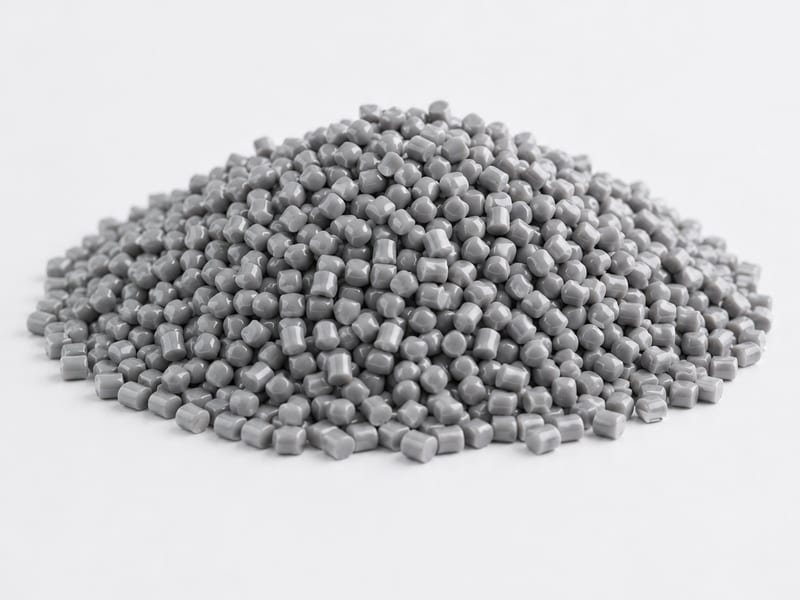
Additive Masterbatch for Slip and Antiblock Control
Compare slip and antiblock functions in plastic film. Review resin compatibility, friction testing and trial requirements when selecting an additive masterbatch.
Overview
Slip and antiblock masterbatches solve different film-handling problems. Slip additives reduce resistance to sliding, while antiblock additives help adjacent film surfaces separate. Selection depends on the resin, film structure and the behaviour needed during conversion; a final choice should be supported by grade-specific data and a production trial.
Slip vs. antiblock: which problem are you solving?
If film does not slide as required over itself or converting equipment, investigate friction. If adjacent layers are difficult to separate, investigate blocking. A formulation may need both functions, but they are not interchangeable. Ampacet’s slip guide explains the role of slip and coefficient of friction (COF); its film guide distinguishes slip/antiblock grades.
How do you select an additive masterbatch for film?
Start with a record of the problem and the production conditions:
- Identify the polymer and proposed carrier resin, film structure and thickness.
- Describe whether the issue is sliding friction, layer separation or both.
- Record downstream requirements such as printing, sealing and other converting operations.
- Ask for the proposed grade’s TDS, recommended trial conditions and applicable regulatory documentation.
- Compare a trial film against a reference made under the same recorded conditions.
A published masterbatch loading is not a universal dosing instruction. The reference values and reference codes elsewhere on this page do not certify a particular batch or establish suitability for every film.
How should slip performance be measured?
COF provides a measured comparison instead of judging film by touch. ASTM D1894 is a test-method reference for static and kinetic friction of plastic film and sheeting; use the method and conditioning appropriate to the specification. Record the age and storage conditions of the film when comparing results.
Does every slip additive migrate?
No. Ampacet describes migratory and non-migratory options. The mechanism and application depend on the grade, so a migration result from one formulation should not be presented as a guarantee for another. A supplier’s study is evidence for its tested system, not a universal ranking of all antiblock materials.
What information helps diagnose the issue?
Bring the resin, film structure, processing conditions, observed defect and any measured friction data. Compare the masterbatch types before choosing a function; for a specific case, describe your film-handling problem.
Content updated:
Key Applications
The material's role changes by industry — click any industry to see its full page.

Physical Properties
| Property | Typical Value | Note |
|---|---|---|
| Carrier Resin | LDPE / LLDPE | Definitional |
| Erucamide (slip agent) content | ≈ 5-10% | Typical published value — Kerke Extruder |
| Synthetic silica (anti-block) content | ≈ 10-20% | Typical published value — Kerke Extruder |
| Letdown Ratio (dosing) | ≈ 1-5% | Typical published value — Kerke Extruder; ESD Plastics |
| Carrier Resin Melt Flow Index | ≈ 2-10 g/10min | Typical published value — industry process references |
These are typical published values for the material in general, not a certificate of analysis (COA) for a specific shipment. Actual per-batch values are set by the COA accompanying supply.
Grades
Grade and Specification Guide
These reference codes illustrate grade categories and specifications for comparison and selection. The commercial grade and final specification are determined by your application requirements, the technical data sheet and the batch certificate of analysis.
Standards & Technical References
Every claim on this page traces back to a verifiable reference:
- Tier 1StandardASTM D1894-24 — Standard Test Method for Static and Kinetic Coefficients of Friction of Plastic Film and Sheeting
- Tier 2University/ResearchStudy of inorganic based anti-blocks as migration control of slip additive on surface polyethylene monolayer film, Acta Chimica Asiana, 2024, Vol. 7, Issue 1
- Tier 3Industry Technical GuideKerke Extruder — Slip Anti-blocking Masterbatch: Complete Guide (composition, carrier MFI)
- Tier 3Industry Technical GuideESD Plastics — Optimizing Slip Antiblock Masterbatch Usage Tips (letdown ratio)
Frequently Asked Questions
What is the difference between slip and antiblock?
Slip reduces resistance to sliding; antiblock helps adjacent film layers separate. The functions are not interchangeable.
Are all slip additives migratory?
No. Migratory and non-migratory options exist; review the proposed grade’s mechanism in supplier data.
How should film performance be assessed?
Compare a documented trial with the reference, recording measurement conditions, film age, appropriate friction data and process requirements.


