
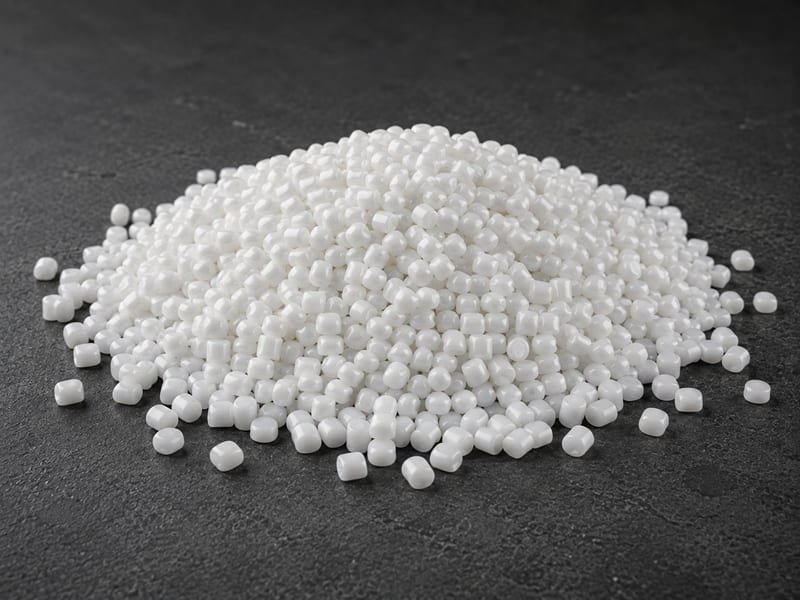
White Masterbatch
How white masterbatch's TiO2 dispersion quality is measured and what research shows about the real trade-off between better opacity and increased UV yellowing.
Overview
White masterbatch’s performance comes down to how well its TiO2 is dispersed in the carrier resin, and research comparing dispersion methods shows a genuine trade-off: the same improved dispersion that gives better opacity also makes the pigment more photocatalytically active, leading to more yellowing under UV exposure. This page covers that research and how masterbatch color quality is measured.
What is it?
White masterbatch is a titanium dioxide (TiO2) concentrate used to whiten and opacify plastics. Color quality — including the yellowness that signals degradation or poor pigment performance — is measured instrumentally using ASTM D6290, a standard test method for determining the degree of yellowness of nearly-colorless or white plastics using a spectrophotometer, reporting results as Yellowness Index or CIE/Hunter L, a, b color values.
Why should I use it?
- Better TiO2 dispersion in the carrier resin gives measurably better covering power (opacity) — see “How it’s used.”
- Its color and yellowness can be objectively tracked over time using a standard instrumental method, not just visual judgment — see “What is it?” above.
How it’s used
In plastics and polymer applications, white masterbatch is diluted into a carrier resin to whiten and opacify films and other products. A 2020 peer-reviewed study compared conventional melt-extrusion against variable-frequency ultrasound-assisted extrusion for producing a 7 wt% TiO2 masterbatch in LLDPE film: conventional extrusion left “clusters of particles from one micron,” while the ultrasound-assisted method achieved better TiO2 dispersion and stronger covering power.
Limitations — when it isn’t the right choice
- Better TiO2 dispersion comes with a real trade-off: it also increases the pigment’s photocatalytic activity, which can accelerate yellowing under UV exposure. The same 2020 study found that “the deagglomeration process using variable ultrasound frequency increased the photocatalytic activity” of the TiO2. Both the ultrasound-processed and conventionally extruded films reached a similar yellowness index of about 1.5% at 400 hours of accelerated UV aging, but by 500 hours the better-dispersed, ultrasound-processed film’s yellowness index climbed further to 2.3%, exceeding the conventionally extruded film with its coarser dispersion. This means a white masterbatch optimized purely for maximum opacity through fine TiO2 dispersion may not automatically be the best choice for products facing long-term outdoor UV exposure; these figures are specific to this study’s LLDPE system, 7 wt% TiO2 loading, and UV aging test, and shouldn’t be assumed to hold at every loading level or exposure duration.
Key Applications
The material's role changes by industry — click any industry to see its full page.

Physical Properties
| Property | Typical Value | Note |
|---|---|---|
| TiO₂ Loading (standard grade) | ≈ 70-80% by weight | Typical published value — Kerke Extruder guide |
| TiO₂ Loading (lower-loading grade) | ≈ 40% by weight | Typical published value — Nuosen Masterbatch product data |
| Preferred TiO₂ Crystal Form | Rutile (better opacity than Anatase) | Typical published value — perfectcolourants.com |
| Letdown Ratio (dosing) | ≈ 1-5% (commonly 2-4%) | Typical published value — industry masterbatch dosing references |
These are typical published values for the material in general, not a certificate of analysis (COA) for a specific shipment. Actual per-batch values are set by the COA accompanying supply.
Grades
Grade and Specification Guide
These reference codes illustrate grade categories and specifications for comparison and selection. The commercial grade and final specification are determined by your application requirements, the technical data sheet and the batch certificate of analysis.
Standards & Technical References
Every claim on this page traces back to a verifiable reference:
- Tier 1StandardASTM D6290-19 — Standard Test Method for Color Determination of Plastic Pellets
- Tier 2University/ResearchPigmentation and Degradative Activity of TiO2 on Polyethylene Films Using Masterbatches Fabricated Using Variable-Frequency Ultrasound-Assisted Melt-Extrusion, Materials (MDPI), 2020, Vol. 13, Issue 17, Article 3855
- Tier 3Industry Technical GuideKerke Extruder — Comprehensive Guide to White Masterbatch (TiO2 Based) (loading ranges)
- Tier 3Global SupplierNuosen Masterbatch — 40% TiO2 White Masterbatch for PP Injection product data
- Tier 3Industry Technical Referenceperfectcolourants.com — Rutile vs Anatase TiO2 for White Masterbatch Opacity
Frequently Asked Questions
How is white masterbatch's color and yellowness measured?
Instrumentally using ASTM D6290, a standard test method for determining the degree of yellowness of nearly-colorless or white plastics using a spectrophotometer, reporting results as Yellowness Index or CIE/Hunter L, a, b color values.
How does better TiO2 dispersion improve masterbatch performance?
Better TiO2 dispersion in the carrier resin gives measurably better covering power (opacity), compared to the coarse particle clusters left by conventional extrusion.
What is the real trade-off tied to improving TiO2 dispersion?
Better dispersion also increases the pigment's photocatalytic activity, which can accelerate yellowing under UV exposure — a 2020 peer-reviewed study found the better-dispersed film reached a yellowness index of 2.3% after 500 hours of aging, exceeding the film with coarser dispersion.
Is the masterbatch optimized for maximum opacity always the best choice?
Not necessarily. It may not automatically be the best choice for products facing long-term outdoor UV exposure, because of the yellowing trade-off tied to fine dispersion.


