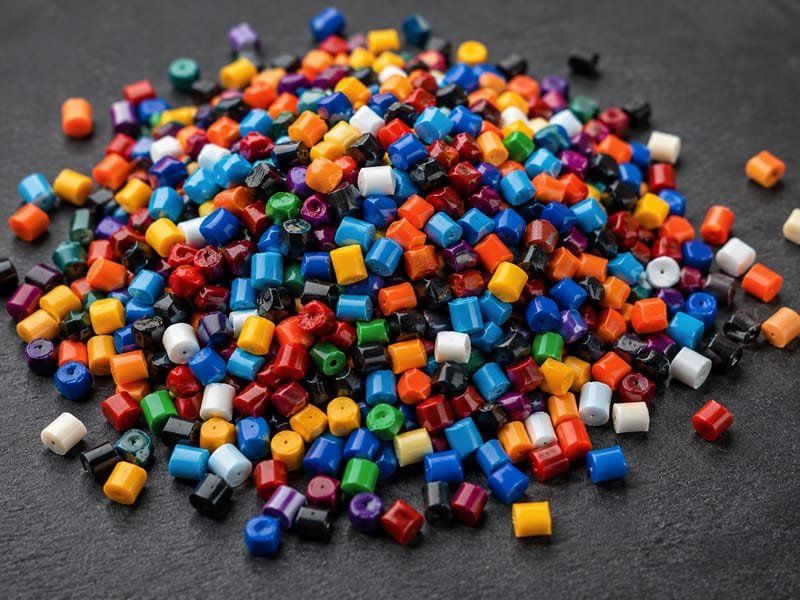
Choose calcium carbonate by the polymer system, manufacturing process and finished-product specification. A surface-treated powder and an untreated powder with a similar median particle size are not automatically interchangeable. The treatment is one variable alongside particle distribution, purity, moisture and the way the filler is introduced into the polymer.
This guide compares the two purchasing options for polymer applications. The calcium carbonate material reference covers the material category. This page does not prescribe a filler loading, approve a commercial grade or establish that every treated product is suitable for film, pipe or food-contact packaging.
Separate particle origin from surface treatment
Ground calcium carbonate (GCC) and precipitated calcium carbonate (PCC) describe different production routes. Coated and uncoated describe surface treatment. These are separate questions: request both the production category and the treatment description instead of using “coated” as a complete grade specification.
Suppliers offer mineral products with different particle sizes and treatments for polymer processing. Omya’s polymer-packaging guidance, for example, distinguishes treated fine-ground products for film applications. That supports checking the application-specific supplier recommendation; it does not prove that an arbitrary coating will give the same result.
Ask what treatment is present, how its amount is specified and whether the supplier provides a compatibility recommendation for the intended resin. Stearate treatment is a familiar example, but the commercial product’s actual documentation must establish its chemistry. Do not infer the treatment from powder appearance or an informal product name.
A published study by Deshmukh and colleagues compared untreated and stearic-acid-treated calcium carbonate in PBT composites. Its public abstract reports improved mechanical properties in the treated systems under that study’s conditions. This is evidence of a treatment effect in a particular polymer system, not a universal rule for PE film or PVC pipe. Only the public abstract was reviewed here; the full experimental paper was not accessible.
Build a fair comparison
The table is an editorial screening checklist. It identifies what to hold constant or measure, rather than declaring a universal winner.
| Variable | Document or measurement | Why it affects the comparison |
|---|---|---|
| Polymer and process | Resin grade, carrier and conversion route | A recommendation for one compound is not an approval for another. |
| Particle distribution | D50, upper-size information such as D97, and the measurement method | Similar median sizes can hide different coarse fractions. |
| Surface treatment | Chemistry, declared treatment level and supplier guidance | “Coated” alone does not describe the complete product. |
| Moisture and handling | Supplier specification, storage instructions and sample condition | Storage history can confound a processing comparison. |
| Composition and appearance | Purity, relevant impurities and agreed color measurements | Color or contamination differences can be mistaken for treatment effects. |
| Finished product | Dispersion observations and application-specific acceptance tests | The powder datasheet cannot establish final product performance. |
If both particle size and treatment change at once, report the result as a comparison of two products. Do not attribute every difference to the coating. A matched untreated/treated pair from the supplier, where available, makes the treatment question easier to investigate.
Film and filler-masterbatch decisions
For polyolefin film, define the resin blend, masterbatch carrier, film thickness and intended packaging use. Review visible defects, dispersion, mechanical performance, sealing and other requirements from the customer’s specification. A candidate that compounds smoothly may still fail the film acceptance tests.
Track how the mineral is incorporated. Comparing powder addition with a finished filler masterbatch also changes the carrier, additive package and compounding history. Record those differences, or compare masterbatches with a matched carrier and mineral concentration. Confirm the actual filler content rather than assuming equal addition rates mean equal mineral loading.
Use the blown-film application guide to define the production brief. Keep this comparison separate from choosing LDPE, LLDPE or HDPE for the base film. Do not adopt a loading percentage from a different product solely because its polymer family is similar.
PVC pipe and profile decisions
For PVC compounds, evaluate treatment within the complete formulation and processing method. Record stabilizer, lubricant and other additive changes during trials. Compare dry-blend handling, processing behavior, surface appearance, dimensions and the required mechanical tests using the same formulation basis.
Omya’s pipe guidance includes mineral use in non-pressure PVC pipe applications. It is not evidence that a filler-containing formulation meets a pressure-pipe requirement. A result in a profile or non-pressure pipe must not be transferred to a qualified pressure-pipe compound without the required specification and approval work.
The pipe and profile guide separates PE pressure compounds from PVC formulation questions. For pressure service, determine the governing standard, complete compound qualification and application requirements before evaluating any material substitution.
Run a controlled trial
- Write the intended application, mandatory limits and current control material before selecting samples.
- Obtain current TDS and SDS documents, identify each sample and record the storage condition. Request shipment-specific evidence where needed.
- Set a comparison basis: matched polymer, carrier, actual mineral loading, additives and processing conditions wherever practical.
- Record mixing or compounding observations and resulting dispersion. Keep retained samples of the control and each candidate.
- Convert the compound into the intended finished product and apply its specified tests. Record all departures from the test method.
- Repeat any promising comparison before approval. A single successful sample does not establish consistent supply performance.
This sequence is a proposed evaluation workflow. The manufacturer must define operating settings and acceptance limits using the equipment, resin guidance and relevant product specification. Surface treatment is not a substitute for appropriate moisture control or a guarantee of compatibility with every polymer.
What to include in a material enquiry
Send the resin and process, end-product requirements, current mineral specification and the reason for considering a change. Include particle-distribution data, intended treatment, actual loading basis and any restrictions on additives. State whether the enquiry is for a powder or a masterbatch.
Request the supplier’s application recommendation, treatment declaration, TDS, SDS and any required regulatory documentation for the actual grade and intended market. Food-contact suitability is a document- and use-specific question; “coated calcium carbonate” does not establish it. Compare cost on an accepted finished-product basis, including processing and rejection costs, rather than powder price alone.
Discuss the application and documents needed. PLAXRAW must confirm the actual commercial grade, availability and specifications separately from this reference comparison.
Sources and editorial scope
Prepared by the PLAXRAW editorial team on 5 October 2026. The comparison matrix and trial workflow are editorial guidance, not results of PLAXRAW laboratory testing.
- Omya — polymer packaging and application-specific mineral products.
- Omya — minerals for pipe applications.
- Deshmukh et al. — treated and untreated calcium carbonate in PBT composites, Bulletin of Materials Science (2010), public abstract.
- IMA-Europe — mineral factsheets, calcium carbonate production and applications.
Read the current supplier documents for the selected product. Public application summaries do not replace a current TDS, a shipment certificate or finished-product qualification.
Content updated: