
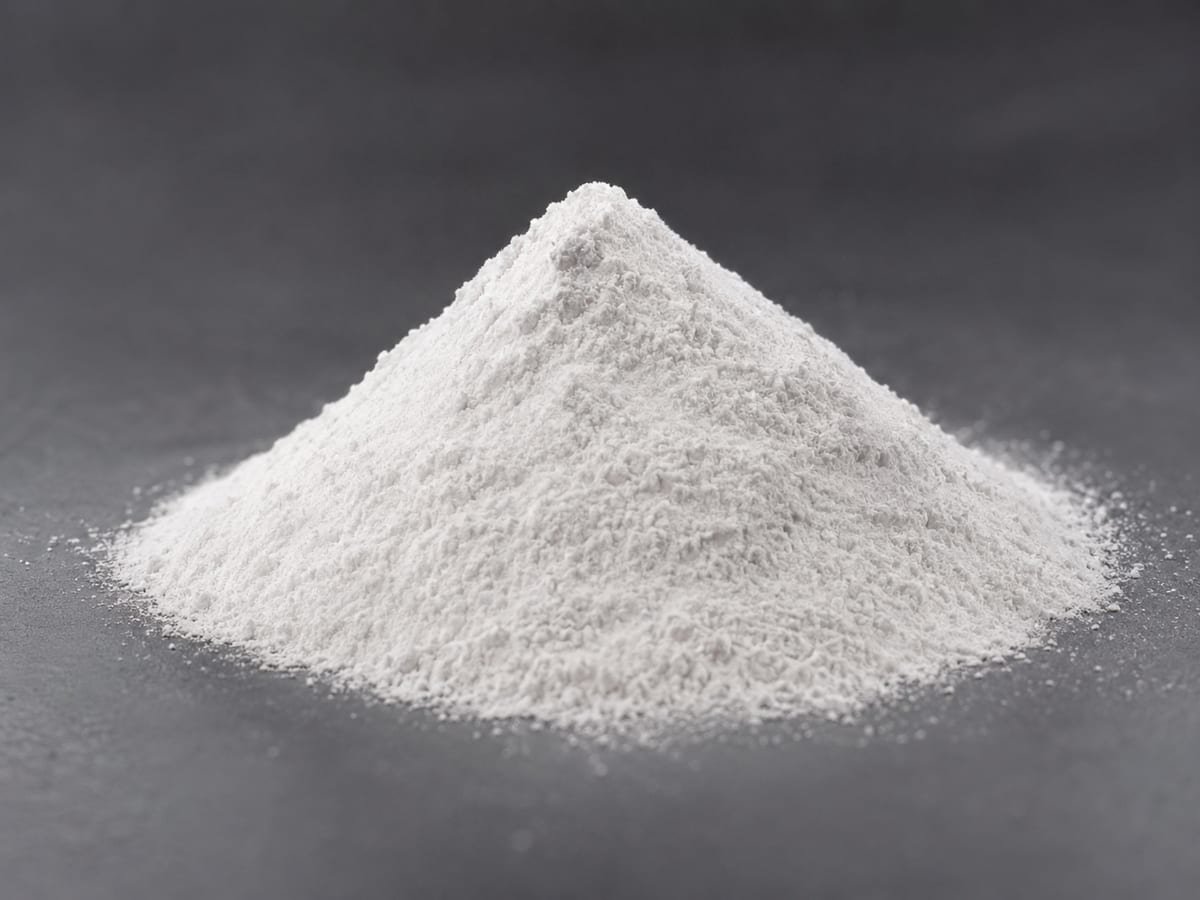
Talc
What Talc is used for across plastics, paints, ceramics, cosmetics and pharmaceuticals, how it compares to Calcium Carbonate, and what buyers need to know about sourcing and certification.
Overview
Talc is a mineral used across several industries — plastics, paints, ceramics, cosmetics, pharmaceuticals, and printing inks — for a different reason in each. The breakdown below covers what it actually does in each industry.
What is it?
Talc is a hydrous magnesium silicate (Mg₃Si₄O₁₀(OH)₂) with a platy, lamellar crystal structure. Its platelets are held together by weak bonds that let them slide past each other — which is why talc is the softest mineral on the Mohs hardness scale, rated 1 (geology.com).
ASTM D605 sets a specification for talc processed to pigment/filler quality, covering combined magnesium/calcium silicate content, iron and aluminum oxide levels, moisture, color, and other purity parameters.
Why should I use it?
- Distinct technical roles. Its platy crystal structure gives it real mechanical value as a reinforcing/nucleating filler in plastics — a function Calcium Carbonate doesn’t provide in the same way (see breakdown below).
- Versatility. The same platy, soft structure gives it a completely different role elsewhere — smoothing texture and controlling sheen in paints and cosmetics.
How its role changes by industry
- Plastics & Polymers: a reinforcement/nucleating agent, particularly in Polypropylene — its platy structure gives higher stiffness and better heat resistance than Calcium Carbonate, and it accelerates polymer crystallization. Where cost alone is the priority, without a need for mechanical or thermal improvement, Calcium Carbonate is the more economical choice instead.
- Paints & Coatings: an extender in specialty/industrial coatings, contributing surface smoothness, mechanical durability, and sheen control. For bulk/decorative paints where coverage and cost are the priority, Calcium Carbonate is the more suitable choice instead.
- Ceramics: a core technical component, used for its thermal and insulating properties.
- Cosmetics & Personal Care: a slip agent, valued for the soft, matte texture its platy structure gives (see Limitations for sourcing considerations relevant to this use).
- Pharmaceuticals: an excipient (glidant/lubricant), valued for its chemical inertness and smoothness — used only when it meets USP-NF pharmaceutical-grade requirements (see Limitations).
- Printing Inks: used in flexographic inks to improve ink transfer — a secondary role there, not a core ingredient.
Limitations — when it isn’t the right choice
- It isn’t a universal substitute for Calcium Carbonate, and vice versa. The two are direct competitors in Plastics and Paints, but the deciding factor differs by industry — mechanical/thermal properties in Plastics, surface smoothness and durability versus coverage and cost in Paints — not one material being categorically better than the other.
- Sourcing and certification carry real weight for cosmetic and pharmaceutical use. Talc contaminated with asbestos has been classified by IARC as a Group 1 carcinogen since 1987, which is why regulators require asbestos testing on cosmetic- and pharmaceutical-grade talc. Separately, in July 2024 IARC reclassified talc generally — regardless of asbestos content — as Group 2A (“probably carcinogenic to humans”), based on limited evidence in humans. There is currently no single standardized US federal testing rule in force for asbestos in cosmetic talc: a proposed rule under the US Modernization of Cosmetics Regulation Act was withdrawn by the FDA in November 2025 for further review. (FDA’s own 2023 testing found no asbestos in the 50 cosmetic talc samples checked.)
- For pharmaceutical use specifically, only talc meeting the USP-NF monograph’s requirements — including confirmation of being asbestos-free by its revised testing methods (implementation extended to June 2026) — is acceptable. Industrial-grade material is not a substitute, regardless of price.
Key Applications
The material's role changes by industry — click any industry to see its full page.






Physical Properties
| Property | Typical Value | Note |
|---|---|---|
| Chemical Formula | Mg₃Si₄O₁₀(OH)₂ | Definitional |
| Hardness (Mohs) | 1 (reference mineral for hardness 1 on the scale) | Typical published value — geology.com |
| Specific Gravity | 2.7–2.8 | Typical published value — ScienceDirect / ChemicalBook |
| Particle Size | D50 ≈ 2–45+ µm (optimum platy aspect ratio below 45 µm / -325 mesh) | Typical published value — industry technical data sheets |
| Whiteness/Brightness | ≈ 85–98%, cosmetic grade typically ≥ 90% | Typical published value — commercial talc technical data sheets; CIR Safety Assessment |
These are typical published values for the material in general, not a certificate of analysis (COA) for a specific shipment. Actual per-batch values are set by the COA accompanying supply.
Grades
Grade and Specification Guide
These reference codes illustrate grade categories and specifications for comparison and selection. The commercial grade and final specification are determined by your application requirements, the technical data sheet and the batch certificate of analysis.
Standards & Technical References
Every claim on this page traces back to a verifiable reference:
- Tier 1StandardASTM D605-82(2019) — Standard Specification for Magnesium Silicate Pigment (Talc)
- Tier 1Government PublicationUSGS — Talc and Pyrophyllite Statistics and Information / Mineral Commodity Summaries 2025
- Tier 1Government PublicationUSGS Fact Sheet FS-0065-00 — U.S. Talc: Baby Powder and Much More
- Tier 1Pharmacopeial StandardUSP-NF — Talc monograph (revised, implementation extended to June 2026)
- Tier 1Government/RegulatoryUS FDA — Talc (Cosmetic Ingredients); 2023 asbestos testing results; withdrawal of standardized testing proposed rule (Nov 2025)
- Tier 1International Health AgencyIARC (WHO) — Monograph Volume 136, Talc and Acrylonitrile (July 2024)
- Tier 2University/ResearchTalc as a Nucleating Agent and Reinforcing Filler in Poly(lactic acid) Composites — peer-reviewed (ResearchGate)
- Tier 3Educational Referencegeology.com — The Mineral Talc: Uses, Properties
- Tier 3Global Supplier/IndustryTalc vs. Calcium Carbonate: Choosing the Right Filler (nbinno.com); Talc Alternatives for Innovative Cosmetic Formulations (letsmakebeauty.com)
- Tier 2Scientific Safety PanelCosmetic Ingredient Review (CIR) — Safety Assessment of Talc as Used in Cosmetics, Final Report
- Tier 3Global Supplier/IndustryCommercial talc technical data sheets — whiteness/brightness grading by industrial and cosmetic grade
Frequently Asked Questions
Why is talc the softest known mineral?
Because its platelets are held together by weak bonds that let them slide past each other, which is why it's rated 1 on the Mohs hardness scale — the softest known mineral.
What does talc do in plastics?
It works as a reinforcement/nucleating agent, particularly in Polypropylene — its platy structure gives higher stiffness and better heat resistance than Calcium Carbonate, and it accelerates polymer crystallization.
Is commercial talc safe for cosmetic use?
Talc contaminated with asbestos has been classified by IARC as a Group 1 carcinogen since 1987, which is why regulators require asbestos testing on cosmetic-grade talc. In July 2024, IARC reclassified talc generally as Group 2A, based on limited evidence in humans.
Can any grade of talc be used in pharmaceuticals?
No. Only talc meeting the USP-NF monograph's requirements, including confirmation of being asbestos-free by its revised testing methods, is acceptable. Industrial-grade material is not a substitute, regardless of price.
When is calcium carbonate more suitable than talc?
When cost alone is the priority, without a need for mechanical or thermal improvement in plastics, or when coverage and cost are the priority in bulk/decorative paints.


