
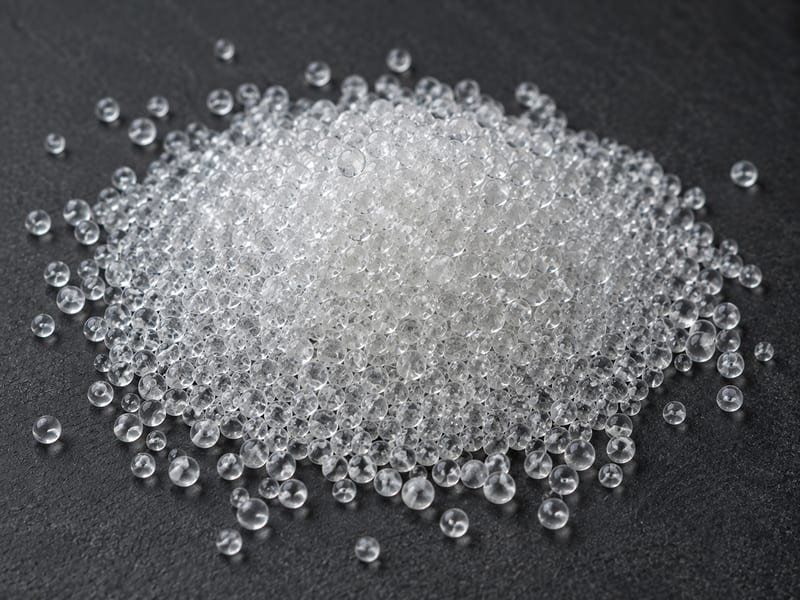
Hollow Glass Microspheres
How hollow glass microspheres reduce composite density, and what US Army and peer-reviewed research shows about the real trade-off with stiffness and how particle size affects specific strength.
Overview
Hollow glass microspheres are a lightweighting filler, and direct testing against solid glass filler in the same epoxy system shows exactly what that lightweighting costs in stiffness — a trade-off worth knowing before choosing a loading level. This page covers that comparison and what particle-size research shows about getting the best strength-to-weight result.
What is it?
Hollow glass microspheres are hollow spherical particles used as a density-reducing filler in polymer composites. Per a U.S. Army Research Laboratory report, at a 0.45 volume fraction filler loading in epoxy, a hollow-glass-filled composite reached a density of 0.83 g/cm³, compared to 1.79 g/cm³ for the same epoxy filled with solid glass spheres at the same loading — roughly less than half the density.
Why should I use it?
- They deliver a large, directly measured density reduction compared to solid glass filler at the same loading — see “What is it?” above.
- Research on particle size shows a specific-strength optimum is achievable, not just a density-strength trade-off — see “How it’s used.”
How it’s used
In epoxy and other polymer composites, hollow glass microspheres are used to reduce composite density for weight-sensitive applications. A 2023 peer-reviewed study of hollow-glass-microsphere-filled epoxy syntactic foam achieved a true density as low as 0.5529 g/cm³ using 50-60 micrometer particles with a 5.99-micrometer wall thickness, while reaching a tensile strength of 55.74 MPa at its optimal formulation — a specific tensile strength 35.1% higher than the study’s lowest-performing formulation, showing particle size and wall thickness matter as much as loading level for getting a good strength-to-weight result.
Limitations — when it isn’t the right choice
- The density reduction comes with a substantial loss of stiffness — hollow glass microspheres are not a “free” weight-saving swap for solid filler. The same U.S. Army Research Laboratory study measured Young’s modulus at the same 0.45 volume fraction loading: approximately 2.7 GPa for the hollow-glass-filled epoxy versus approximately 10.1 GPa for the solid-glass-filled version — roughly a quarter of the stiffness. Interestingly, the coefficient of thermal expansion showed no meaningful difference between the hollow and solid versions at this loading (both around 38.3 × 10⁻⁶/°C), so not every property changes just because the filler is hollow. This means the choice between hollow and solid glass filler—or a blended ratio of the two, which the same study also tested—should be based on which property (density, stiffness, or thermal expansion) matters most for the specific application, not assumed from density alone.
Key Applications
The material's role changes by industry — click any industry to see its full page.

Physical Properties
| Property | Typical Value | Note |
|---|---|---|
| True Density (K1 grade) | ≈ 0.125 g/cc | Typical published value — 3M Glass Bubbles K1 technical data sheet |
| True Density (K20 grade) | ≈ 0.20 g/cm³ | Typical published value — 3M Glass Bubbles K20 technical data sheet |
| True Density (K46 grade) | ≈ 0.46 g/cc | Typical published value — 3M Glass Bubbles K46 technical data sheet |
| Isostatic Crush Strength (K1 → K46) | 250 psi → 6,000 psi across the K series | Typical published value — 3M Glass Bubbles K series technical data sheets |
| Particle Size (K46 grade) | ≈ 40 microns average diameter | Typical published value — 3M Glass Bubbles K46 technical data sheet |
These are typical published values for the material in general, not a certificate of analysis (COA) for a specific shipment. Actual per-batch values are set by the COA accompanying supply.
Grades
Grade and Specification Guide
These reference codes illustrate grade categories and specifications for comparison and selection. The commercial grade and final specification are determined by your application requirements, the technical data sheet and the batch certificate of analysis.
Standards & Technical References
Every claim on this page traces back to a verifiable reference:
- Tier 1Government PublicationCharacterization of Low Density Glass Filled Epoxies, Quesenberry, Madison, Jensen, US Army Research Laboratory, ARL-TR-2938, March 2003
- Tier 2University/ResearchProcessing of Low-Density HGM-Filled Epoxy-Syntactic Foam Composites with High Specific Properties for Marine Applications, Materials (MDPI), 2023, Vol. 16, Issue 4, Article 1732
- Tier 3Global Supplier3M — Glass Bubbles K Series technical data sheets (K1, K20, K46: true density and isostatic crush strength)
Frequently Asked Questions
How much lower is hollow microsphere density compared to solid?
Per a US Army Research Laboratory report, at a 0.45 volume fraction filler loading, a hollow-glass-filled composite reached a density of 0.83 g/cm³, compared to 1.79 g/cm³ for the same epoxy filled with solid glass spheres — roughly less than half the density.
Is the density reduction free with no cost?
No. It comes with a substantial loss of stiffness — the same study measured Young's modulus at approximately 2.7 GPa for the hollow-glass-filled epoxy versus approximately 10.1 GPa for the solid-glass-filled version, roughly a quarter of the stiffness.
Does particle size affect specific strength?
Yes. A 2023 study achieved a true density as low as 0.5529 g/cm³ using 50-60 micrometer particles with a 5.99-micrometer wall thickness, with a specific tensile strength 35.1% higher than the study's lowest-performing formulation.
Does thermal expansion differ between hollow and solid glass?
No meaningful difference at the same loading — both around 38.3 × 10⁻⁶/°C in the same study, showing not every property changes just because the filler is hollow.


