
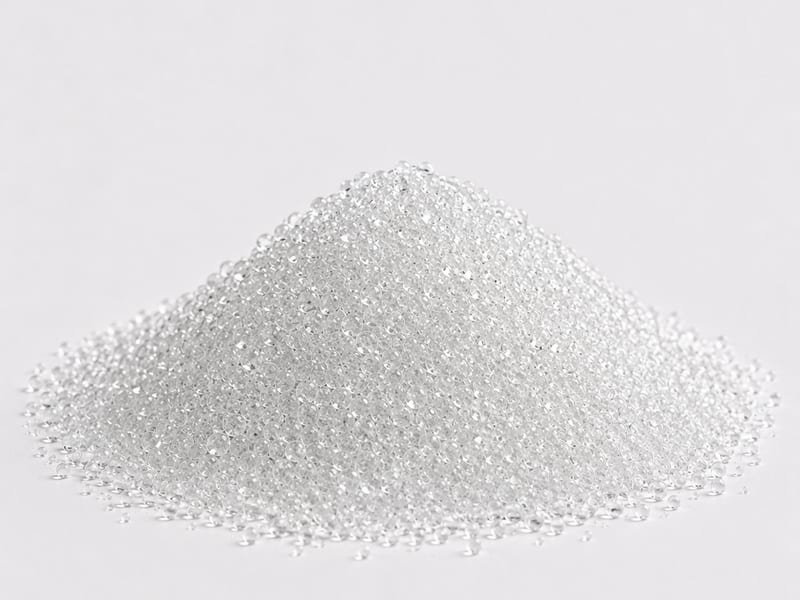
Glass Microspheres (Solid)
How solid glass microspheres are used in retroreflective road markings and as a PLA composite filler, with federal testing data on bead safety and peer-reviewed research on the ideal loading level.
Overview
Solid glass microspheres are best known as the reflective beads embedded in road markings, a use governed by federal safety limits on their recycled-glass feedstock, and research testing them as a plastics filler shows there’s a specific loading level that gives the best mechanical result — more isn’t automatically better. This page covers both of those documented uses.
What is it?
Glass microspheres (solid glass beads) are small spherical particles used mainly as reflective media in road markings and as a filler in polymer composites. Per a Federal Highway Administration (FHWA) report, beads meeting the AASHTO M247 specification are manufactured from reclaimed glass cullet sourced from residential and industrial glass — including window panes, cathode-ray tubes, stained glass, and incandescent bulbs. This recycled feedstock can carry trace arsenic and lead, which led the 2012 MAP-21 federal transportation law to set a 200 ppm limit on both metals in beads used on U.S. roadways.
Why should I use it?
- They’re the current industry-standard reflective medium for pavement markings, with federally tested and regulated safety limits on their recycled-glass feedstock — see “How it’s used.”
- Added to a PLA composite at the right loading, they deliver a measured, double-digit-percentage improvement across several mechanical properties — see Limitations.
How it’s used
In road and pavement markings, glass beads work by reflecting vehicle headlight beams back toward the driver, improving nighttime visibility. FHWA testing of 15 samples drawn from state transportation department inventories found average concentrations of 71 ppm arsenic and 54 ppm lead — both below the 200 ppm federal limit, though with meaningful variability between samples; the report also found that the metals’ extractable, bioaccessible levels were substantially lower than their total concentrations, indicating most of the metal content stays bound within the glass itself. In plastics, glass microspheres are used as a reinforcing filler — for example, in polylactic acid (PLA) filament for material extrusion 3D printing.
Limitations — when it isn’t the right choice
- In a plastics filler role, a higher glass microsphere loading doesn’t automatically mean better performance — the improvement peaks at a specific level and can decline beyond it. A 2023 peer-reviewed study tested solid glass beads as a filler in PLA at 3.0%, 6.0%, and 9.0% by weight. The 3.0% loading gave the best results across several measured properties: flexural strength reached 108.8 MPa, 46.8% higher than unfilled PLA; tensile modulus was 24.3% higher; and flexural toughness was 31.2% higher. But at the highest tested loading, 9.0%, impact strength decreased compared to the lower concentrations. This means the loading level needs to be chosen based on which mechanical property matters most for the application, not maximized by default — these figures are specific to PLA processed by material extrusion and shouldn’t be assumed to transfer directly to other resins or processing methods.
Key Applications
The material's role changes by industry — click any industry to see its full page.


Physical Properties
| Property | Typical Value | Note |
|---|---|---|
| Specific Gravity | ≈ 2.5 | Typical published value — Potters Industries Spheriglass technical data sheet |
| Crush Strength | ≈ 30,000 psi | Typical published value — Potters Industries Spheriglass technical data sheet |
| Particle Size Range | ≈ 5–850 microns depending on grade | Typical published value — commercial glass microsphere technical data sheets |
| Hardness (Mohs) | ≈ 6–6.5 | Typical published value — Potters Industries technical literature |
These are typical published values for the material in general, not a certificate of analysis (COA) for a specific shipment. Actual per-batch values are set by the COA accompanying supply.
Grades
Grade and Specification Guide
These reference codes illustrate grade categories and specifications for comparison and selection. The commercial grade and final specification are determined by your application requirements, the technical data sheet and the batch certificate of analysis.
Standards & Technical References
Every claim on this page traces back to a verifiable reference:
- Tier 1Government PublicationScreening Level Assessment of Arsenic and Lead Concentrations in Glass Beads, Federal Highway Administration (FHWA), Publication No. FHWA-HRT-14-021
- Tier 2University/ResearchGlass Fillers in Three Different Forms Used as Reinforcement Agents of Polylactic Acid in Material Extrusion Additive Manufacturing, Applied Sciences (MDPI), 2023, Vol. 13, Issue 11, Article 6471
- Tier 3Global SupplierPotters Industries — Spheriglass® Solid Glass Microspheres technical data sheet (density, crush strength, oil absorption)
Frequently Asked Questions
How do glass microspheres work in road markings?
By reflecting vehicle headlight beams back toward the driver, improving nighttime visibility. Beads meeting the AASHTO M247 specification are manufactured from reclaimed glass cullet sourced from residential and industrial glass.
Are glass microspheres made from recycled glass safe?
FHWA testing of 15 samples found average concentrations of 71 ppm arsenic and 54 ppm lead — both below the 200 ppm federal limit, with most of the metal content staying bound within the glass itself.
What's the optimal loading level for glass microspheres in PLA?
3.0% by weight gave the best results across several measured properties in a 2023 study — 46.8% higher flexural strength, 24.3% higher tensile modulus — while impact strength decreased at the highest tested loading (9.0%).
Does a higher glass microsphere loading always mean better performance?
No. The improvement peaks at a specific level and can decline beyond it, so the loading level needs to be chosen based on which mechanical property matters most for the application, not maximized by default.


