
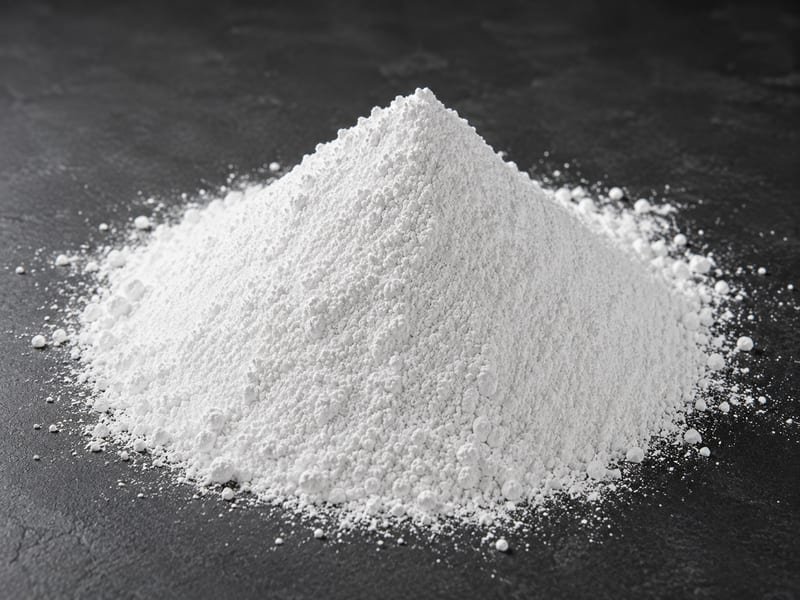
Barium Sulfate: Properties, Uses and Grade Selection
Compare natural barite and precipitated Blanc Fixe, their roles in drilling fluids and coatings, and the data needed to select an industrial barium sulfate grade.
Overview
Barium sulfate (BaSO₄), also spelled barium sulphate, is used as a weighting material and industrial filler. Natural barite is mined and processed; precipitated barium sulfate, often called Blanc Fixe, is produced chemically. Choose between them by the application and the proposed grade’s data, rather than the chemical name alone.
Natural barite or precipitated Blanc Fixe?
Natural barite is relevant when density and the mineral’s characteristics suit the process. In coatings, particle size, colour, dispersion and impurities matter as well. Precipitated grades provide controlled particle characteristics, but properties vary between products: “precipitated” does not guarantee one particle shape or performance level.
Why is barite used in drilling fluids?
Ground barite increases drilling-fluid density. Qualification also requires the specified particle-size and impurity tests; a density figure alone does not establish API compliance or mud performance. Read the barite batch-consistency guide before comparing batches.
Does Blanc Fixe replace titanium dioxide?
Barium sulfate is not a universal replacement for titanium dioxide. Its contribution to coating opacity depends on grade, particle distribution and formulation. Venator describes precipitated grades that support optical performance through pigment spacing; assess hiding power in the actual coating rather than assuming either no opacity contribution or complete TiO₂ replacement.
How should you read density data?
Specific gravity is a ratio to a reference density and has no unit. Particle density is reported in units such as g/cm³; bulk density includes the voids between particles. Compare like measurements, with the stated test method. The reference properties below are not a certificate for an offered shipment.
Industrial material and medical products
Medical barium sulfate products are separately formulated and qualified for diagnostic use. Industrial barite or a coating filler must not be treated as an approved medical product. The MedlinePlus reference explains the medical distinction; this page addresses industrial selection.
What should you check before selecting a grade?
Record the application, required density, particle-size distribution, whiteness or colour, impurity limits and dispersion behaviour. Obtain the grade-specific TDS, SDS and relevant batch analysis, then agree a trial and acceptance criteria. Reference grade examples below illustrate specification language; they do not prove availability or certification.
Sources and scope
- Venator: precipitated barium sulfate and coating performance
- MedlinePlus: medical barium sulfate products
Manufacturer products and research results cited here are reference examples, not specifications or certifications for a PLAXRAW grade.
Content updated:
Key Applications
The material's role changes by industry — click any industry to see its full page.



Physical Properties
| Property | Typical Value | Note |
|---|---|---|
| Chemical Formula | BaSO₄ | Definitional |
| Specific Gravity (Natural Barite) | ≈ 4.3 – 4.5 | Typical published value — geology.com |
| Mohs Hardness | 2.5 – 3.5 | Typical published value — geology.com |
| Refractive Index (Precipitated Blanc Fixe) | ≈ 1.64 | Typical published value — ScienceDirect Topics |
| Whiteness (Precipitated Blanc Fixe) | > 95 | Typical published value — Fillers Minerals |
| Oil Absorption (Precipitated Blanc Fixe) | ≈ 15 – 20 g/100g | Typical published value — Fillers Minerals |
These are typical published values for the material in general, not a certificate of analysis (COA) for a specific shipment. Actual per-batch values are set by the COA accompanying supply.
Grades
Grade and Specification Guide
These reference codes illustrate grade categories and specifications for comparison and selection. The commercial grade and final specification are determined by your application requirements, the technical data sheet and the batch certificate of analysis.
Standards & Technical References
Every claim on this page traces back to a verifiable reference:
- [Primary source] Venator: precipitated barium sulfate and coating performance — https://www.venatorcorp.com/media/media-centre/2022/2022-04-20
- [Primary source] MedlinePlus: medical barium sulfate products — https://medlineplus.gov/druginfo/meds/a606010.html
- Tier 1Industry StandardAPI Spec 13A — Drilling Fluid Materials
- Tier 1Government PublicationUSGS — Mineral Commodity Summaries 2025, Barite
- Tier 1Government/Health AgencyMedlinePlus (US National Library of Medicine/NIH) — Barium Sulfate Drug Information
- Tier 3Academic ReferenceScienceDirect Topics — Barium Sulfate overview
- Tier 3Educational Referencegeology.com — Barite Mineral | Uses and Properties
- Tier 3Global SupplierFillers Minerals — Blanc Fixe (Precipitated Barium Sulphate) Technical Overview
Frequently Asked Questions
What is the difference between barite and Blanc Fixe?
Barite is a natural mineral; Blanc Fixe is precipitated barium sulfate. Compare grade-specific purity, particle size and application performance.
Does specific gravity have a unit?
No. Specific gravity is a dimensionless ratio; particle density and bulk density are different measurements with units.
Does Blanc Fixe contribute to coating opacity?
Some grades can support optical performance through formulation and pigment spacing. Test the actual coating; it is not a universal TiO₂ replacement.


