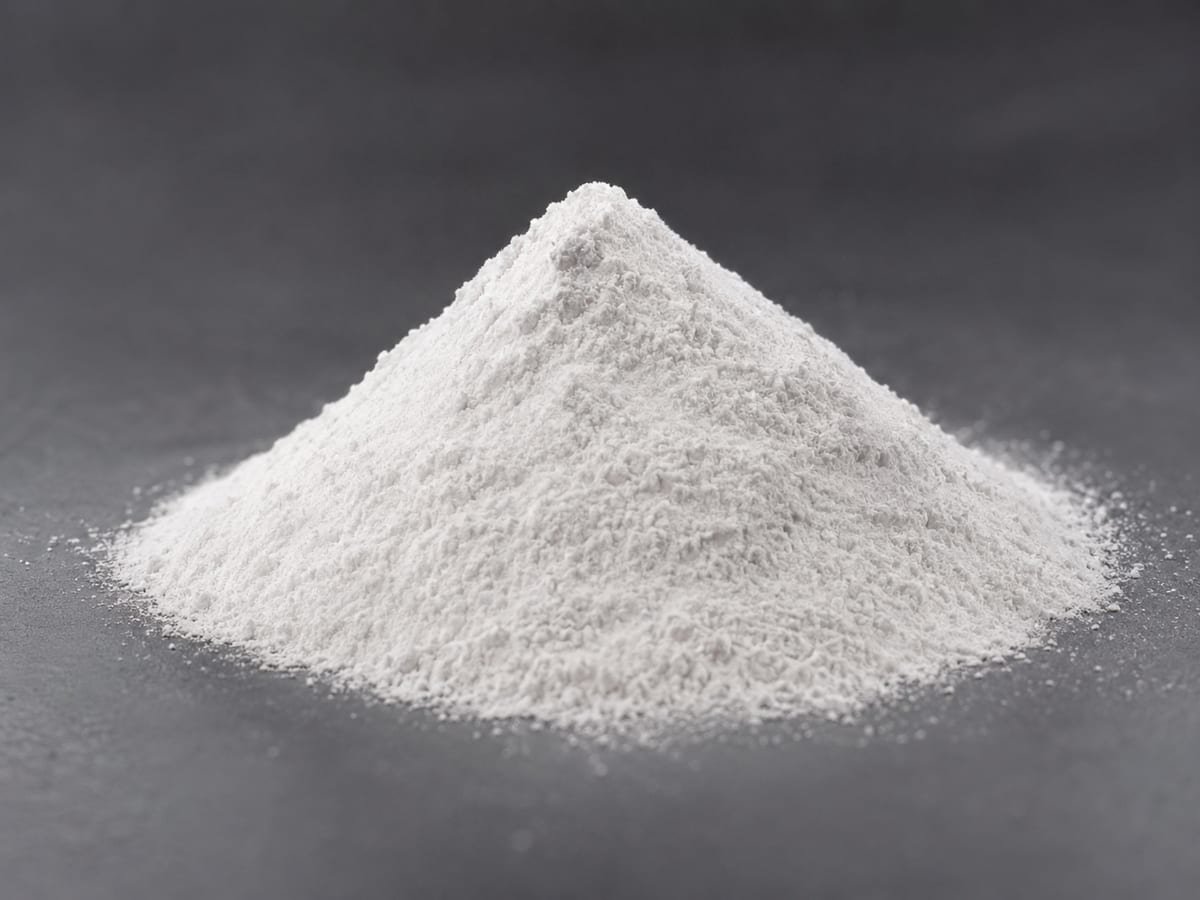
A calcium carbonate or talc blend that flows cleanly at the moment it leaves the mill can still arrive at a tablet press caked or clumped weeks later, because the moisture damage that causes caking happens gradually during storage and transport, not at the point of manufacture.
Root Causes
Humidity-driven caking occurs when a powder is exposed to moist air and picks up water at its particle surfaces and, for porous materials, within its internal pore structure. For calcium carbonate specifically, documented moisture-sorption studies show that initial water uptake is governed by how permeable and porous the particle structure is, while longer-term equilibrium moisture pickup at a given humidity level involves both surface adsorption and capillary condensation within the pore network — meaning two lots with different processing histories (and therefore different pore structures) can pick up meaningfully different amounts of moisture under identical storage humidity. Once enough moisture has been absorbed, individual particles develop liquid bridges or partially dissolve and recrystallize at contact points, which is the physical mechanism that turns a free-flowing powder into a caked or clumped mass — and this process can continue well after the material has left controlled manufacturing conditions, during warehousing or transport where humidity is less tightly managed.
This is a documented, general risk for hygroscopic and deliquescent powder ingredients, not one unique to pharmaceutical excipients, but the consequence is more consequential in this application because caked or clumped material feeding a tablet press directly disrupts die fill and dosing uniformity rather than simply being an inconvenience to handle. Published research on anti-caking measures for deliquescent powder ingredients has found that anti-caking agents differ meaningfully in effectiveness: in comparative testing, agents such as calcium stearate, silicon dioxide, and calcium silicate were shown to measurably reduce hygroscopicity and raise the critical relative humidity threshold at which caking begins, with calcium stearate performing best at reducing moisture sorption, delaying the onset of deliquescence, and preserving flowability under humid conditions across the ingredients tested.
What This Means for Raw Material Selection
Request moisture-sorption or hygroscopicity data for calcium carbonate and talc lots intended for humid climates or long storage/transport durations, rather than relying on a dry-basis specification that only describes the material’s condition at the point of testing. Where anti-caking performance matters for a given formulation, confirm which anti-caking measure (if any) is applied and at what level, since published comparative data shows meaningful differences in effectiveness between agents rather than all anti-caking treatments performing equivalently. Specify moisture-resistant packaging and storage conditions for bulk mineral excipient shipments explicitly, since hygroscopicity testing is documented as the basis for selecting suitable packaging materials in the first place — a packaging choice made without reference to the specific lot’s moisture-sorption behavior is effectively a guess. Finally, treat caking risk as a storage-duration and humidity-exposure variable, not a fixed material property: the same lot can perform acceptably in a short, climate-controlled supply chain and cake in a longer or more humid one.
Sources: ScienceDirect, “Moisture pickup in calcium carbonate coating structures: Role of surface and pore structure geometry”; ScienceDirect / Food Hydrocolloids research, “Effects of anticaking agents and storage conditions on the moisture sorption, caking, and flowability of deliquescent ingredients”; Absortech technical guidance, “Effective prevention against caking damage”; BOC Sciences technical overview, “Hygroscopicity Testing.”