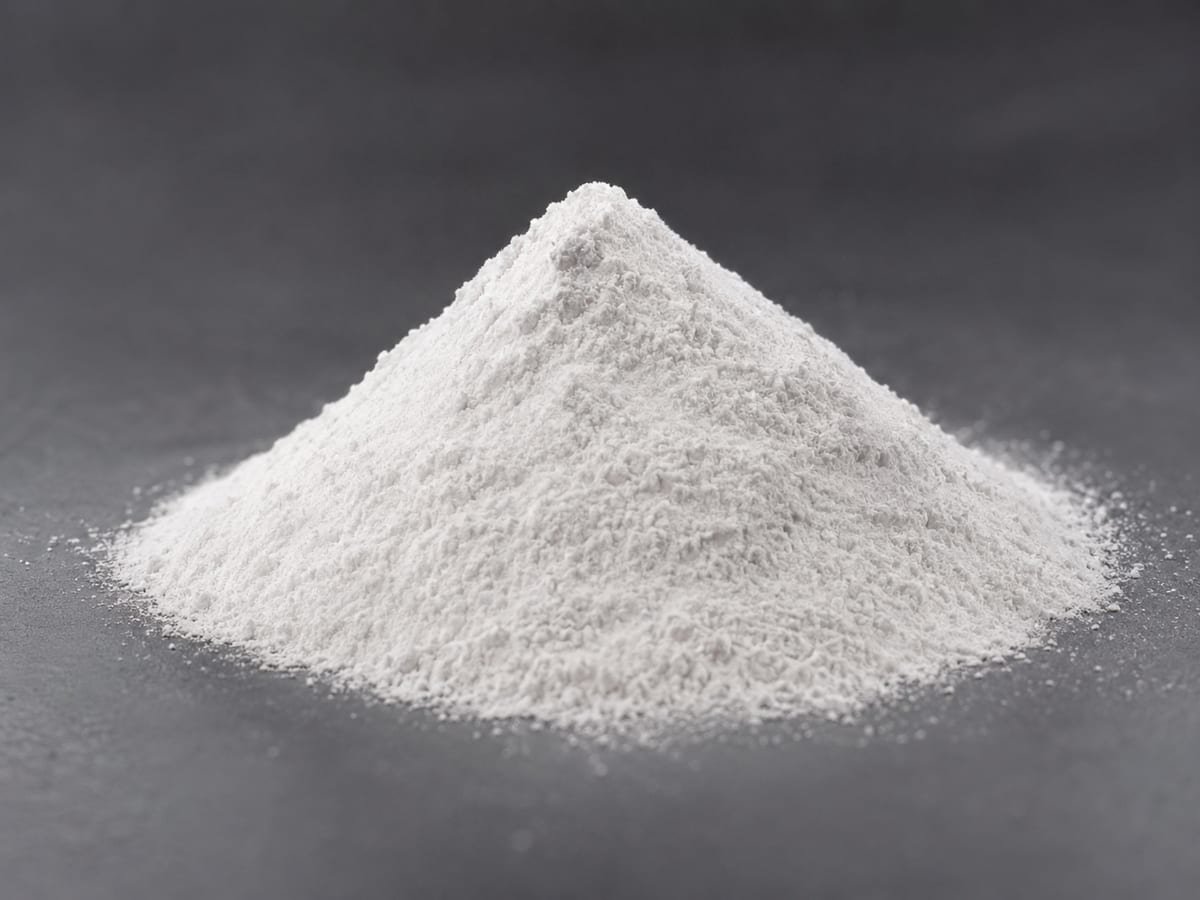
A compound can hit its target filler loading exactly and still fail on the shop floor — because the mechanical and cosmetic properties of a filled plastic depend on how evenly the filler is distributed through the resin, not just on how much of it is in the formula.
Root Causes
Poor calcium carbonate dispersion is documented as producing small clumps within the resin, which show up as visible surface defects — white streaks, spots, or rough texture — along with reduced strength in the finished part. Talc behaves differently under the same failure mode: excessive loading or poor mixing leads to filler agglomeration, and those concentrated regions of undispersed talc particles act as stress concentration points that accelerate crack initiation and propagation under load, a mechanism documented as reducing elongation at break and toughness in talc-filled polypropylene.
The two fillers also diverge on their baseline mechanical impact even when well dispersed: calcium carbonate is documented as not adversely affecting impact strength, and in some cases improving it at higher loading levels, while talc’s reinforcing benefit (higher stiffness, heat resistance, dimensional stability) comes with more sensitivity to dispersion quality because of its platy particle geometry. This is why compounds using talc are typically processed on a twin-screw extruder specifically to ensure adequate dispersion, and why lubricants or coupling agents are commonly added to mineral fillers to improve dispersion and strengthen the filler-polymer bond.
What This Means for Raw Material Selection
Because dispersion quality, not loading percentage alone, determines whether a filled compound performs as specified, a formulation that passes on paper (correct filler percentage per the recipe) can still fail in production if the mixing equipment or process doesn’t achieve adequate dispersion — and the two fillers fail in visibly different ways, which is diagnostically useful: streaking or spotting points toward calcium carbonate dispersion, while unexpected brittleness or reduced elongation points toward talc agglomeration.
The practical points for a buyer are: specify processing equipment (twin-screw extrusion is the documented standard for talc-filled compounds) rather than assuming any mixing setup achieves equivalent dispersion regardless of filler type; consider a coupling agent or dispersion aid specifically when talc loading is pushed toward the higher end of the typical range, since agglomeration risk and its mechanical consequences scale with loading; and diagnose surface or mechanical defects by filler type first, since calcium carbonate and talc dispersion failures have different visible signatures and require different process corrections.
Sources: Vichem and Xufeng Talc technical guides on common processing issues with calcium carbonate and talc fillers in plastics; Datson BM technical reference on calcium carbonate as an economical filler in polymer and rubber; Avient knowledge base comparing fillers and reinforcements; Impact Plastics technical comparison of calcium carbonate versus talc-filled polypropylene sheet.