
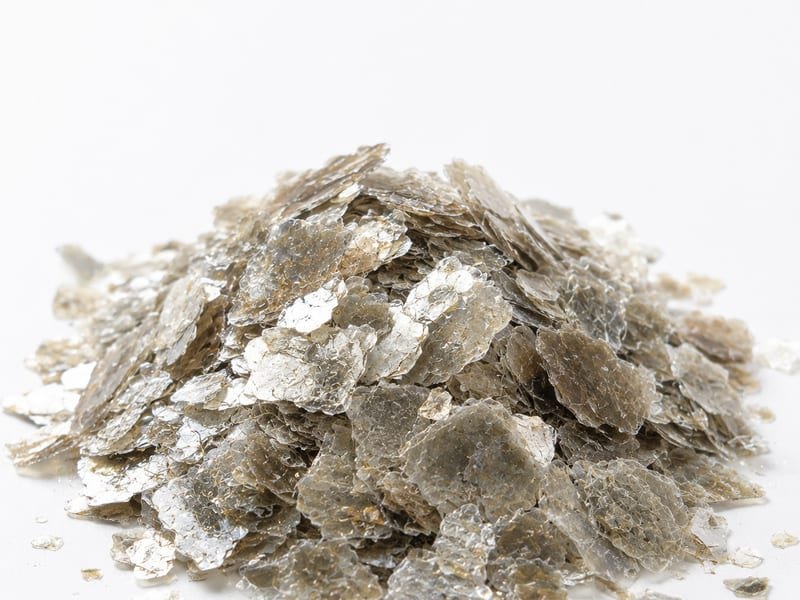
Mica
How wet ground mica pigments are specified under ASTM D607, and what research shows about the trade-offs of different mica loading levels in rigid PVC foam composites.
Overview
Mica, as a wet ground pigment, is specified for use in protective coatings under its own ASTM standard. This page covers that specification and a documented finding on how mica loading level affects rigid PVC foam performance — improving some properties while working against others.
What is it?
Mica, in wet ground muscovite form, is specified under ASTM D607 in two types for use in protective coatings, with requirements covering density, moisture, grit, coarse particles, residue, ignition loss, and color.
Why should I use it?
- Its pigment-grade properties are defined by a dedicated specification — see “What is it?” above.
- Research has directly quantified its effect on PVC foam performance, including a real trade-off with loading level — see Limitations.
How it’s used
In Plastics & Polymers, Mica is used as a filler, most directly documented as a reinforcement in rigid PVC foam.
Limitations — when it isn’t the right choice
- Adding mica to PVC foam is a genuine trade-off, not a straightforward improvement — and it doesn’t help every property equally. A 2015 peer-reviewed study on rigid PVC foam filled with high-aspect-ratio phlogopite mica at loadings of 0%, 5%, 10%, 15%, and 20% by weight found that at 20% mica, dimensional stability improved by 44% (shrinkage at 82°C dropped from 3.4% to 1.9%), and storage modulus rose from 225 MPa to 480 MPa at a 15% loading. However, flexural strength did not improve at any loading level tested, and impact strength deteriorated by more than 25% at 20% loading, as particle agglomeration in the foam’s cell walls became a factor above 15%. This was documented for one specific PVC foam and mica grade; it should not be assumed that every commercial formulation responds identically at the same loading levels without its own test data.
Key Applications
The material's role changes by industry — click any industry to see its full page.

Physical Properties
| Property | Typical Value | Note |
|---|---|---|
| Chemical Formula (muscovite) | KAl₂(AlSi₃O₁₀)(OH)₂ | Definitional |
| Specific Gravity | 2.76-3.00 (commercial grades ≈ 2.85) | Typical published value — huayuanmica.com |
| Aspect Ratio | ≈ 10-100 (high-aspect-ratio grades up to ≈ 30:1) | Typical published value — HPF Minerals |
| Coefficient of Thermal Expansion | ≈ 7 × 10⁻⁶/K | Typical published value — huayuanmica.com |
| Thermal Stability | Stable up to ≈ 1000°C after calcination at ≈ 900°C | Typical published value — huayuanmica.com |
| Particle Size (average diameter, filler grades) | ≈ 30-300 microns | Typical published value — HPF Minerals |
These are typical published values for the material in general, not a certificate of analysis (COA) for a specific shipment. Actual per-batch values are set by the COA accompanying supply.
Grades
Grade and Specification Guide
These reference codes illustrate grade categories and specifications for comparison and selection. The commercial grade and final specification are determined by your application requirements, the technical data sheet and the batch certificate of analysis.
Standards & Technical References
Every claim on this page traces back to a verifiable reference:
- Tier 1StandardASTM D607-82(2019) — Standard Specification for Wet Ground Mica Pigments
- Tier 2University/ResearchMechanical Properties and Dimensional Stability of Rigid PVC Foam Composites Filled with High Aspect Ratio Phlogopite Mica, Journal of Minerals and Materials Characterization and Engineering, 2015, Vol. 3, No. 4
- Tier 3Global Supplierhuayuanmica.com — Physical and Chemical Properties of Muscovite Mica
- Tier 3Global SupplierHPF Minerals — Mica: High-Performance Temperature-Resistant Filler
Frequently Asked Questions
What form of mica is specified under ASTM D607?
Wet ground muscovite mica, in two types for use in protective coatings.
What requirements does ASTM D607 cover for mica pigments?
Density, moisture, grit, coarse particles, residue, ignition loss, and color.
What type of mica did the 2015 PVC foam study use, and at what loadings?
High-aspect-ratio phlogopite mica, at loadings of 0%, 5%, 10%, 15%, and 20% by weight.
Does adding mica to PVC foam improve every property?
No. At 20% loading, dimensional stability improved by 44%, and storage modulus rose from 225 to 480 MPa at 15% loading, but flexural strength did not improve at any loading level, and impact strength deteriorated by more than 25% at 20% loading.
What causes the impact-strength drop at higher mica loading?
Particle agglomeration in the foam's cell walls, which becomes a factor above 15% loading.


