
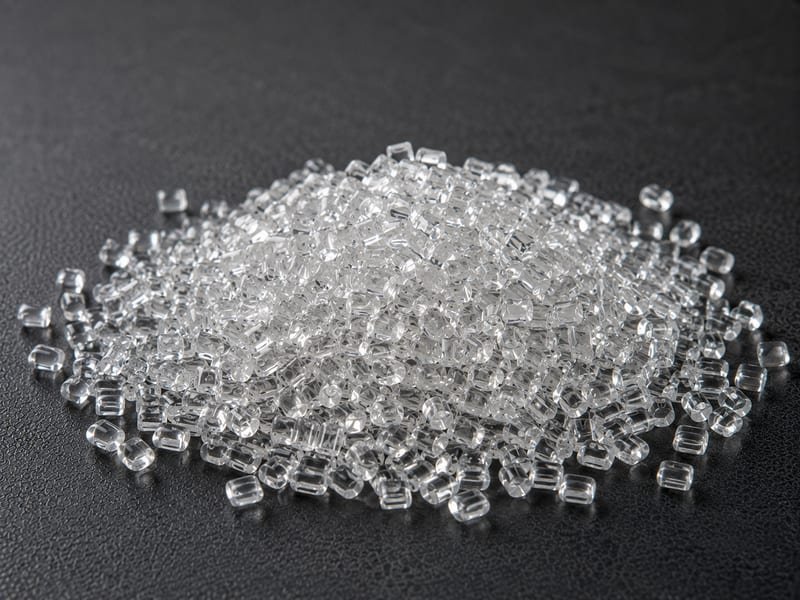
Polycarbonate Grades: Types and Selection Guide
Compare polycarbonate grade types and learn which processing, optical, impact and compliance data to review when choosing PC resin for an application.
Overview
Polycarbonate (PC) is a thermoplastic used where impact performance, dimensional behaviour or optical clarity matter. Polycarbonate grades differ in flow, additives, reinforcement and intended processing. A useful selection starts with the part and its service conditions, then checks the exact grade’s technical data.
Which polycarbonate grade types should you compare?
| Grade category | Main selection question |
|---|---|
| General-purpose, unfilled | Does the grade suit the process, geometry and required impact behaviour? |
| Optical or transparent | Which transmission, haze and colour data apply to the required thickness? |
| Reinforced | What stiffness, shrinkage and directional properties are documented? |
| Flame-retardant | Which rating is certified for this grade, colour and tested thickness? |
| UV-stabilised or specialty | What exposure or application-specific evidence supports the intended use? |
These are market categories, not a list of certified PLAXRAW grades. Manufacturer guides from Covestro and SABIC show why application and grade data must be considered together.
Injection moulding or extrusion: what changes?
Check the manufacturer’s intended process and flow-test conditions. A melt-flow result measured under one load or temperature cannot be compared directly with a result measured differently. Review drying, moisture limits and processing guidance in the TDS; do not transfer a drying or temperature recipe between all PC grades.
Why do impact-test conditions matter?
Notch geometry, specimen thickness, temperature and test method affect interpretation of impact results. Research on a particular specimen or notch radius does not set a design limit for every PC grade. Compare results under the same conditions, then validate the real part. Compare ABS only against the same application requirements.
What does ASTM D3935 tell you?
ASTM D3935 provides a classification system for polycarbonate materials used in moulding and extrusion. Classification helps describe material requirements; it does not replace application testing, a current TDS or evidence of regulatory compliance.
A practical grade-selection checklist
Specify the process, part thickness, clarity and colour, service temperature and exposure, mechanical targets and applicable compliance needs. Ask for the proposed grade’s TDS, SDS, test conditions and any grade-specific approvals. Use a documented trial with agreed acceptance criteria before approving a substitute.
Sources and scope
- Covestro: Makrolon polycarbonate applications
- ASTM D3935: public classification scope
- SABIC: LEXAN material families
Manufacturer products and research results cited here are reference examples, not specifications or certifications for a PLAXRAW grade.
Content updated:
Key Applications
The material's role changes by industry — click any industry to see its full page.

Standards & Technical References
Every claim on this page traces back to a verifiable reference:
- [Primary source] Covestro: Makrolon polycarbonate applications — https://solutions.covestro.com/en/brands/makrolon
- [Primary source] ASTM D3935: public classification scope — https://store.astm.org/d3935-21.html
- [Primary source] SABIC: LEXAN material families — https://www.sabic.com/ar/industries/automotive/polymers/materials/lexan
- Tier 1StandardASTM D3935-21 — Standard Classification System and Basis for Specification for Polycarbonate (PC) Unfilled and Reinforced Material
- Tier 2University/ResearchThe Effect of Notch and Molecular Weight on the Impact Fracture Behavior of Polycarbonate, Polymers (MDPI), 2024, 16(8):1072
Frequently Asked Questions
Are all polycarbonate grades interchangeable?
No. Compare processing, optical and mechanical data, additives and any required grade-specific approvals.
Does ASTM D3935 select the best PC grade for my part?
No. It classifies materials; the application still requires grade data and validation.


