
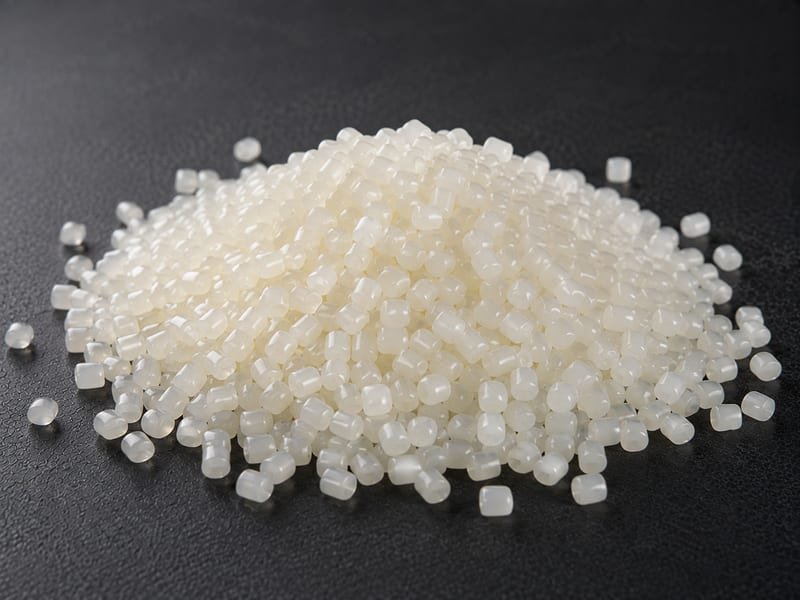
Nylon (PA)
How nylon (PA) grades are classified for injection molding and extrusion, and a documented moisture-absorption effect on stiffness worth knowing before you specify it.
Overview
Nylon (PA) is a resin used in plastics processing, classified into groups, classes, and grades for injection molding and extrusion. This page covers that classification system and a documented moisture-absorption effect on stiffness worth weighing before specifying it.
What is it?
Nylon (PA) is classified under ASTM D4066 for injection molding and extrusion materials. Compositions are grouped, then further classified into classes and grades, with each grade identified by a letter indicating the reinforcement or filler used and a number indicating its nominal weight percentage.
Why should I use it?
- A single classification system covers many grades, including reinforced and filled variants — see “What is it?” above.
- Its stiffness under moisture exposure has been directly measured — see Limitations.
How it’s used
In Plastics & Polymers, nylon (PA) is used for injection-molded and extruded parts, across the range of grades and classes covered by ASTM D4066.
Limitations — when it isn’t the right choice
- Sustained moisture exposure without a compensating design is a real, measured weakness. A 2023 peer-reviewed study on one specific unreinforced PA66 commercial grade (BASF Ultramid A3K) found that Young’s modulus dropped from 2.885 GPa dry to 1.235 GPa at 3.0% moisture content, and to 0.598 GPa at 8.2% moisture (saturation in 60°C water) — a reduction of more than four times at saturation. In a separate conditioning test on the same grade, the glass transition temperature shifted from 58°C dry to -24°C at 8.1% moisture (saturation in 80°C water), a drop of more than 80°C. This was documented for one specific unreinforced grade; it should not be assumed to apply identically across every nylon grade, including glass-fiber-reinforced compositions.
Key Applications
The material's role changes by industry — click any industry to see its full page.

Standards & Technical References
Every claim on this page traces back to a verifiable reference:
- Tier 1StandardASTM D4066-13(R25) — Standard Classification System for Nylon Injection and Extrusion Materials (PA)
- Tier 2University/ResearchHygromechanical Behavior of Polyamide 6.6: Experiments and Modeling, Polymers (MDPI), 2023, 15(16):3387


