
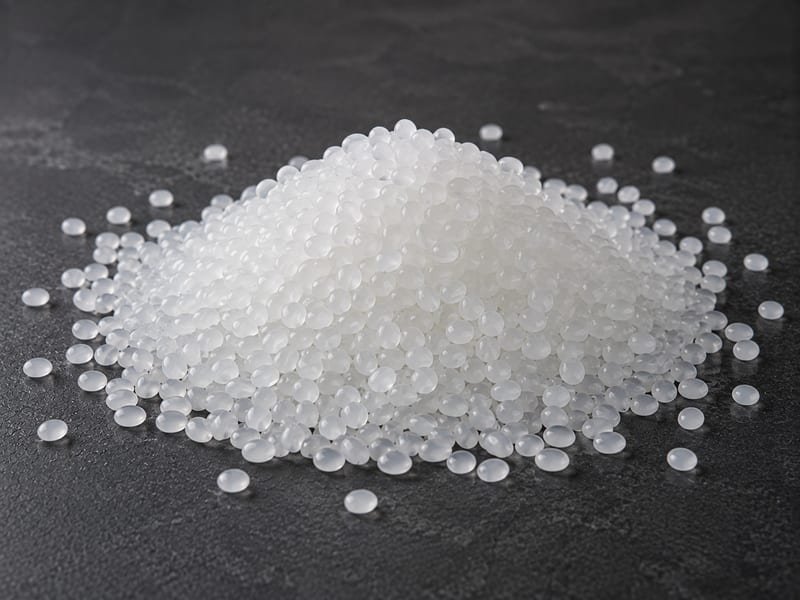
EVA (Ethylene Vinyl Acetate)
How EVA's vinyl acetate content is measured and graded, what happens when it's blended with LDPE, and a real trade-off buyers should weigh.
Overview
EVA is a copolymer of ethylene and vinyl acetate used in plastics processing. This page covers how its vinyl acetate (VA) content is measured and what a documented LDPE blend study shows about the trade-offs of adding EVA.
What is it?
EVA is a copolymer of ethylene and vinyl acetate. Its vinyl acetate content — the property that differentiates one EVA grade from another — is measured using ASTM D5594, a standardized Fourier Transform Infrared Spectroscopy (FT-IR) test method.
Why should I use it?
- Its grade-defining property has a standardized test method — see “What is it?” above.
- Blending it into LDPE measurably changes mechanical behavior — see Limitations.
How it’s used
In Plastics & Polymers, EVA (at a 28 wt.% vinyl acetate content, EVA-28) has been studied as a blend component with LDPE, at blend ratios ranging from 2.5% to 12.5%.
Limitations — when it isn’t the right choice
- Adding more EVA to an LDPE blend is a trade-off, not a straightforward improvement. A 2021 peer-reviewed study on LDPE blended with EVA-28 found that as EVA-28 content increased across the 2.5%–12.5% range, tensile strength and flexural strength decreased, and hardness decreased progressively. Elongation at break was highest at the 10% EVA-28 blend ratio, not at the highest EVA content tested. This is documented for one specific VA content (28%) and one blend partner (LDPE); it should not be assumed to hold for every EVA grade or every blend polymer.
Key Applications
The material's role changes by industry — click any industry to see its full page.

Standards & Technical References
Every claim on this page traces back to a verifiable reference:
- Tier 1StandardASTM D5594-18a — Standard Test Method for Determination of the Vinyl Acetate Content of Ethylene-Vinyl Acetate (EVA) Copolymers by Fourier Transform Infrared Spectroscopy (FT-IR)
- Tier 2University/ResearchCharacterization of LDPE and LDPE/EVA blends with medium vinyl acetate content, Polymers (MDPI), 2021


