
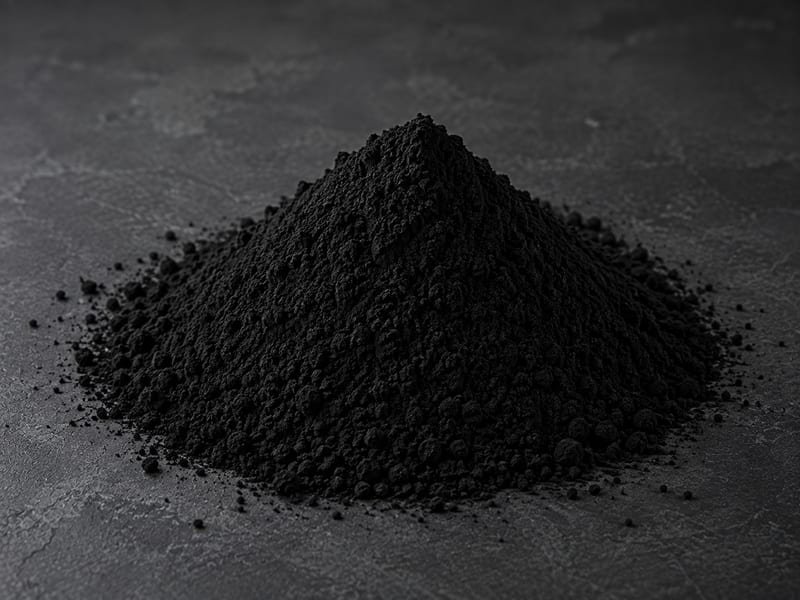
Carbon Black
What Carbon Black is used for across rubber, printing inks, and battery electrodes, how it compares to Silica, and what buyers need to know.
Overview
Carbon Black is a pigment used across several industries — rubber, printing inks, and battery electrodes — for a different reason in each. The breakdown below covers what it actually does in each industry.
What is it?
Carbon Black is a form of nearly pure elemental carbon (typically over 97%). More than 98% of world production uses the furnace black process. The resulting particles are extremely fine — primary particle diameters range from about 10 to 400 nanometers — and cluster into grape-like (aciniform) aggregates, with a paracrystalline structure that’s neither fully amorphous nor fully crystalline (ScienceDirect Topics).
ASTM D1765 sets a four-character classification system for rubber-grade carbon blacks, where the first character relates to its effect on cure rate and the second to surface area.
Why should I use it?
- Distinct technical roles. Its particle structure and surface chemistry make it useful in very different ways — as a reinforcing filler in rubber, as a pigment in ink, and as a conductive additive in specialized battery-grade forms — see the breakdown below.
- A long, well-documented track record, particularly in rubber reinforcement and as a black pigment in printing inks.
How its role changes by industry
- Rubber: the primary reinforcing filler, especially in tire tread compounds, valued for well-documented resistance to abrasion and wear. Where the priority is lower rolling resistance and better wet-grip performance instead, Silica — used together with a silane coupling agent — is the newer alternative, though the two are often combined rather than one fully replacing the other.
- Printing Inks: the primary black pigment — there’s effectively no other pigment used commercially for black ink at scale.
- Battery & Energy Materials: specialized conductive grades (such as Super P or acetylene black) are used as a conductive additive in lithium-ion and sodium-ion battery electrodes, where their chain-like particle structure forms an efficient conductive network. Ordinary rubber- or ink-grade Carbon Black isn’t a substitute here — conductivity at this level is a property of specific specialized grades, not a general property of the material.
Limitations — when it isn’t the right choice
- In “green tire” applications specifically, Silica is the newer alternative (see the Rubber entry above for how the two are actually used together in practice). (A dedicated comparison article — Carbon Black vs. Silica in tire manufacturing — is planned.)
- Handling the dust generated during production and processing is a genuine occupational consideration. IARC’s 2006 Working Group evaluation (published as Monograph Volume 93 in 2010) classifies Carbon Black itself (not just extracts made from it) as Group 2B — “possibly carcinogenic to humans” — based on sufficient evidence in animal studies but inadequate evidence in humans, with occupational exposure at production sites being the most relevant context considered. This is a workplace-handling consideration for producers and processors, not a property of Carbon Black once it’s incorporated into a finished rubber, ink, or battery product.
Key Applications
The material's role changes by industry — click any industry to see its full page.



Physical Properties
| Property | Typical Value | Note |
|---|---|---|
| Elemental Carbon Content | > 97% | Definitional |
| Specific Gravity | ≈ 1.8-1.9 | Typical published value — carbon black density references (McCrone; patent literature) |
| Primary Particle Diameter | ≈ 10-400 nm | Typical published value — ScienceDirect Topics |
| DBP Absorption (structure) | ≈ 70-125 cm³/100g across ASTM rubber grades | Typical published value — ASTM D1765 |
| Nitrogen Surface Area (N2SA) | ≈ 30-124 m²/g across ASTM rubber grades | Typical published value — ASTM D1765 |
These are typical published values for the material in general, not a certificate of analysis (COA) for a specific shipment. Actual per-batch values are set by the COA accompanying supply.
Grades
Grade and Specification Guide
These reference codes illustrate grade categories and specifications for comparison and selection. The commercial grade and final specification are determined by your application requirements, the technical data sheet and the batch certificate of analysis.
Standards & Technical References
Every claim on this page traces back to a verifiable reference:
- Tier 1StandardASTM D1765-21 — Standard Classification System for Carbon Blacks Used in Rubber Products
- Tier 1International Health AgencyIARC Monograph Volume 93 — Carbon Black, Titanium Dioxide, and Talc (2006 Working Group evaluation, published 2010)
- Tier 3Academic ReferenceScienceDirect Topics — Black Carbon overview
- Tier 2University/ResearchEffect of carbon blacks on electrical conduction... next-generation lithium-ion batteries (ScienceDirect); Functionalized acetylene black-conductive additive for rechargeable sodium-ion batteries (Springer)
- Tier 2University/ResearchFunctional rubber composites based on silica-silane reinforcement (Springer)
- Tier 1Government PublicationPrinting Processes and Printing Inks (NCBI)
- Tier 3Market ReportAggregated market reports (Rubber World, IMARC, Chemanalyst) — approximate global production/consumption figures
- Tier 3Reference DatabaseMcCrone Research Institute — Adventures in Carbon Black (true density reference)
Frequently Asked Questions
What is carbon black?
Carbon black is a form of nearly pure elemental carbon (typically over 97%), with more than 98% of world production using the furnace black process. Its particles are extremely fine — 10 to 400 nanometers in primary diameter — clustering into grape-like (aciniform) aggregates.
What is the classification system for rubber-grade carbon black?
ASTM D1765 sets a four-character classification system (such as N220, N330), where the first character relates to its effect on cure rate and the second to surface area — which translates in practice into real differences in surface area and DBP absorption between grades.
How is most carbon black produced?
More than 98% of world production uses the furnace black process, producing extremely fine primary particles with diameters ranging from about 10 to 400 nanometers that cluster into grape-like (aciniform) aggregates.
When is silica the better alternative to carbon black in rubber?
When the priority is lower rolling resistance and better wet-grip performance, such as in 'green tire' applications. However, the two are often combined rather than one fully replacing the other.
Does ordinary carbon black work as a conductive additive in batteries?
No. Conductivity at this level is a property of specific specialized grades only (such as Super P or acetylene black), which have a chain-like particle structure that forms an efficient conductive network — it is not a general property of rubber- or ink-grade carbon black.
What health consideration is associated with carbon black production?
IARC's 2006 Working Group evaluation (published as Monograph 93 in 2010) classifies carbon black as Group 2B — 'possibly carcinogenic to humans' — based on sufficient evidence in animal studies but inadequate evidence in humans. This is an occupational handling consideration at production sites, not a property of the material once incorporated into a finished product.


