
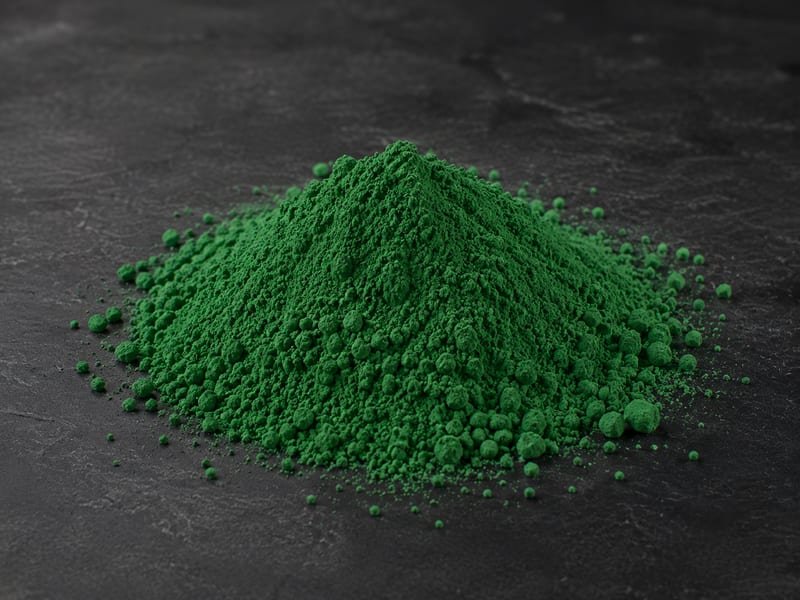
Chromium Oxide (Green Pigment)
How chromium oxide green pigment is used in camouflage coatings, and what peer-reviewed research shows about how closely its natural reflectance spectrum matches real foliage.
Overview
Chromium oxide green owes its long history in camouflage coatings to a genuine resemblance with natural foliage color, and research measuring its actual reflectance spectrum shows that resemblance isn’t perfect straight out of the furnace — the undoped pigment reflects noticeably more visible light than real plants do. This page covers that research and where chromium oxide fits in the broader chromium supply chain.
What is it?
Chromium oxide (Cr2O3) is a green pigment valued for high stability, strong tinting power, good migration resistance, and low cost. Per the U.S. Geological Survey’s Mineral Commodity Summaries 2025, one U.S. chemical company converts imported chromite ore into chromium chemicals; U.S. imports of chromium chemicals over 2020-23 came primarily from Kazakhstan (24%), China (18%), Germany (17%), and Italy (12%).
Why should I use it?
- It’s a documented, long-used pigment for camouflage coatings specifically because of its color resemblance to natural plants — see “How it’s used.”
- Its high stability, tinting strength, and low cost make it a durable, economical green pigment choice — see “What is it?” above.
How it’s used
In paints and coatings, chromium oxide has been used for a long time to manufacture camouflage coatings because of its resemblance to the color of natural vegetation.
Limitations — when it isn’t the right choice
- Undoped chromium oxide’s reflectance spectrum doesn’t perfectly match real foliage — it reflects noticeably more visible light than actual plants do. A 2020 peer-reviewed study measured the reflectance spectrum of chromium oxide pigment directly against natural plant spectra. Most plants show a reflectance peak of only 10% to 20% around 550 nanometers, but the study’s undoped chromium oxide sample showed a reflectance peak of over 30% at 540 nanometers — notably higher than real vegetation. Doping the pigment with cobalt brought that peak down to 22%, and combined titanium/cobalt/iron doping brought it down further to a range of 10% to 20%, closer to the natural plant range. This means that for applications where matching natural vegetation’s spectral signature closely matters — such as advanced camouflage — plain, undoped chromium oxide on its own may not be precise enough, and doped or modified grades should be considered instead.
Key Applications
The material's role changes by industry — click any industry to see its full page.

Physical Properties
| Property | Typical Value | Note |
|---|---|---|
| Chemical Formula | Cr₂O₃ | Definitional |
| Colour Index | Pigment Green 17 | Definitional |
| Specific Gravity | ≈ 5.1 | Typical published value — SpecialChem TDS (M100C Chromium Oxide Green) |
| Purity | ≈ 99% Cr₂O₃ | Typical published value — Nanographenex micron powder specification |
| Primary Particle Size (standard grade) | > 1.0 micron | Typical published value — industry supplier specifications |
These are typical published values for the material in general, not a certificate of analysis (COA) for a specific shipment. Actual per-batch values are set by the COA accompanying supply.
Grades
Grade and Specification Guide
These reference codes illustrate grade categories and specifications for comparison and selection. The commercial grade and final specification are determined by your application requirements, the technical data sheet and the batch certificate of analysis.
Standards & Technical References
Every claim on this page traces back to a verifiable reference:
- Tier 1Government PublicationUSGS — Mineral Commodity Summaries 2025, Chromium
- Tier 2University/ResearchPreparation and Reflectance Spectrum Modulation of Cr2O3 Green Pigment by Solution Combustion Synthesis, Materials (MDPI), 2020, Vol. 13, Issue 7, Article 1540
- Tier 3Supplier Technical Data SheetSpecialChem — M100C/G4099/G5099/G6099 Chromium Oxide Green TDS
- Tier 3Global SupplierNanographenex — Chromium(III) Oxide (Cr2O3) Micron Powder specification
- Tier 3Global SupplierNatural Pigments — Chromium Oxide Green product specification
Frequently Asked Questions
Why is chromium oxide used in camouflage coatings?
Because its green color resembles the color of natural vegetation — a long-used, documented application in paints and coatings.
What properties make chromium oxide a desirable pigment?
Its high stability, strong tinting power, good migration resistance, and low cost — which make it an economical, durable choice as a green pigment.
Does undoped chromium oxide match real foliage's reflectance spectrum?
Not perfectly. A 2020 peer-reviewed study found the undoped sample showed a reflectance peak of over 30% at 540 nanometers, versus only 10-20% for most plants around 550 nanometers — meaning it reflects noticeably more visible light than real vegetation.
How can chromium oxide's spectral match to natural vegetation be improved?
Through doping. Doping the pigment with cobalt brings the reflectance peak down to 22%, and combined titanium/cobalt/iron doping brings it down further to a 10-20% range, closer to natural vegetation.
Where does the US import chromium chemicals from?
Per USGS, US imports of chromium chemicals over 2020-23 came primarily from Kazakhstan (24%), China (18%), Germany (17%), and Italy (12%), and one US chemical company converts imported chromite ore into these chemicals.


