
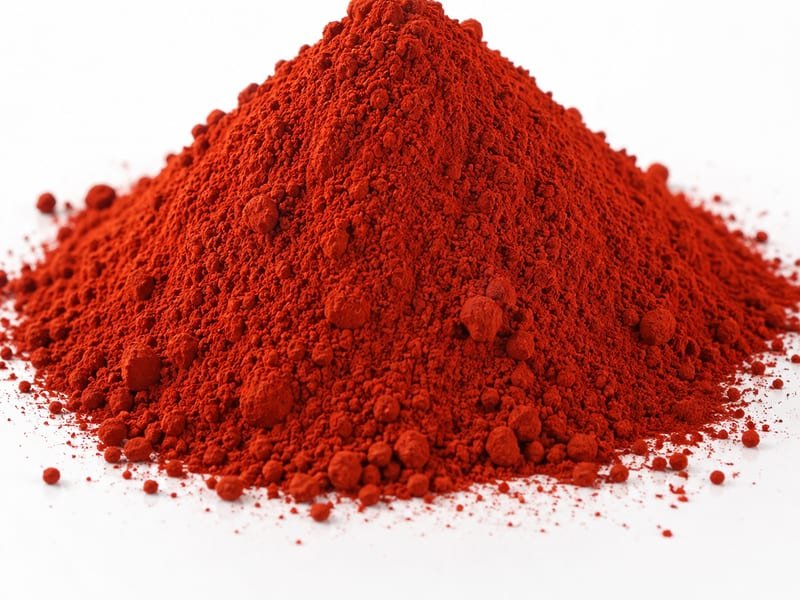
Iron Oxide
What Iron Oxide pigments are used for across paints, construction, and cosmetics, and what buyers need to know about grade selection and purity requirements.
Overview
Iron Oxide is a pigment used across several industries — paints, construction, and cosmetics — for a different reason in each, and in both natural and synthetic forms. The breakdown below covers what it actually does in each industry.
What is it?
Iron Oxide pigments are available as natural material (ground from mined ore, primarily in red and brown) or synthetic material (available in red, yellow, brown, and black) — synthetic red iron oxide is chemically synthetic hematite, synthetic yellow is synthetic goethite, and synthetic black is synthetic magnetite. ASTM D3721 sets a specification for synthetic red iron oxide pigment specifically. ASTM D3722 covers natural red and brown iron oxide pigments and their blends with synthetic material, including chemical analysis (total iron oxide content, sulfates, water-soluble matter) and color/tinting-strength requirements.
Why should I use it?
- Color stability that holds up outdoors. It resists fading from UV exposure and weathering, which is why it’s specified wherever long-term color retention matters — see the breakdown below.
- Available in forms qualified for very different end uses — see Limitations for why that distinction matters when choosing a grade.
How its role changes by industry
- Paints & Coatings: a colored pigment (red, yellow, brown, or black, natural or synthetic) valued for its color fastness under UV exposure and weathering. It’s not a hiding/whitening pigment — that role belongs to Titanium Dioxide or Zinc Oxide.
- Construction & Building Materials: used to integrally color concrete, qualified under ASTM C979, which tests for alkali resistance, light stability, and effects on the concrete’s setting time and compressive strength — a general paint-grade pigment isn’t automatically qualified for this use.
- Cosmetics & Personal Care: approved under US FDA regulation (21 CFR 73.2250) as a color additive safe for cosmetics generally, including products applied near the eye, provided it meets strict impurity limits (arsenic ≤3 ppm, lead ≤10 ppm, mercury ≤3 ppm) — industrial-grade material isn’t a substitute regardless of color match.
Limitations — when it isn’t the right choice
- It’s not a substitute for a hiding/whitening pigment. Where opacity or whiteness is the priority, Titanium Dioxide or Zinc Oxide is what actually provides that — Iron Oxide’s role is color, not coverage.
- A grade qualified for one industry isn’t automatically qualified for another. Paint-grade material meeting ASTM D3721/D3722 isn’t necessarily qualified for colored concrete (ASTM C979) or, especially, for cosmetic use (21 CFR 73.2250’s strict impurity limits) — grade selection has to match the specific end use, not just the color.
Key Applications
The material's role changes by industry — click any industry to see its full page.


Physical Properties
| Property | Typical Value | Note |
|---|---|---|
| Total Iron Oxide Content (standard grade) | ≥ 95% Fe₂O₃ | Typical published value — rawchemicalmart.com industry guide |
| Specific Gravity (synthetic red, Pigment Red 101) | ≈ 5.0-5.5 | Typical published value — Epsilon Pigments / Fineland Chem TDS |
| Oil Absorption | ≈ 15-25 g/100g | Typical published value — rawchemicalmart.com TDS comparison guide |
| Tinting Strength (standard grade) | ≈ 95-105% (relative to reference standard) | Typical published value — rawchemicalmart.com industry guide |
These are typical published values for the material in general, not a certificate of analysis (COA) for a specific shipment. Actual per-batch values are set by the COA accompanying supply.
Grades
Grade and Specification Guide
These reference codes illustrate grade categories and specifications for comparison and selection. The commercial grade and final specification are determined by your application requirements, the technical data sheet and the batch certificate of analysis.
Standards & Technical References
Every claim on this page traces back to a verifiable reference:
- Tier 1StandardASTM D3721-05(2019) — Standard Specification for Synthetic Red Iron Oxide Pigment
- Tier 1StandardASTM D3722-05(2019) — Standard Specification for Natural Red and Brown Iron Oxide Pigments
- Tier 1StandardASTM C979/C979M — Standard Specification for Pigments for Integrally Colored Concrete
- Tier 1Government/RegulatoryUS FDA — 21 CFR 73.2250, Iron Oxides (Cosmetics)
- Tier 3Industry Technical Guiderawchemicalmart.com — Iron Oxide Red: Technical Guide to Properties, Grades & Applications; TDS Comparison Guide
- Tier 3Supplier Technical Data SheetEpsilon Pigments / Fineland Chem — Iron Oxide Red (Pigment Red 101) TDS
Frequently Asked Questions
What forms do iron oxide pigments come in?
Natural (ground from mined ore, primarily red and brown) or synthetic (available in red, yellow, brown, and black) — synthetic red is synthetic hematite, synthetic yellow is synthetic goethite, and synthetic black is synthetic magnetite.
What do ASTM D3721 and D3722 cover?
ASTM D3721 sets a specification for synthetic red iron oxide pigment specifically, while ASTM D3722 covers natural red and brown iron oxide pigments and their blends with synthetic material, including chemical analysis and color/tinting-strength requirements.
Why is iron oxide specifically valued in paints?
For its color stability outdoors — it resists fading from UV exposure and weathering, which is why it's specified wherever long-term color retention matters.
Is iron oxide a hiding or whitening pigment?
No. Its role is color, not coverage — where opacity or whiteness is the priority, Titanium Dioxide or Zinc Oxide is what actually provides that.
Is paint-grade material automatically qualified for cosmetic use?
No. Cosmetic use requires separate approval under 21 CFR 73.2250, with strict impurity limits (arsenic ≤3 ppm, lead ≤10 ppm, mercury ≤3 ppm) — paint-grade material meeting ASTM D3721/D3722 isn't automatically qualified for that use.


