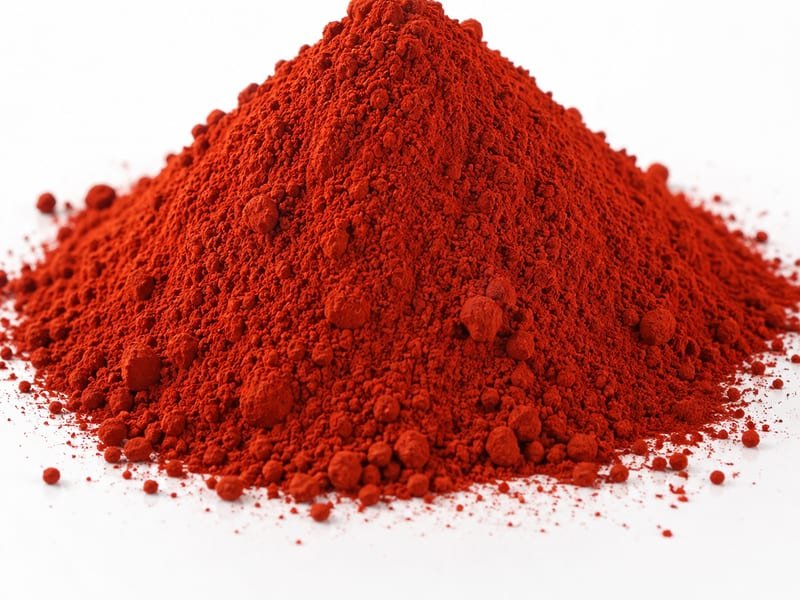
Two drums of the same iron oxide grade name can produce visibly different paint shades — not because one is off-spec in a way a basic composition check would catch, but because the crystal phase and particle size that actually determine color can drift within what a supplier still calls the same product.
Root Causes
Iron oxide’s color is governed by which crystalline phase it forms, not just its chemical composition: goethite is documented as imparting a greenish shade of yellow, while lepidocrocite gives a reddish yellow hue — two phases that are both “iron oxide yellow” by name but produce visibly different color. Manufacturing conditions determine which phase forms and how it develops: pH, concentration, temperature, and reaction rate during synthesis are documented as the key parameters governing the pigment’s exact color, dispersibility, and transparency, and downstream processing compounds the effect — calcination can convert goethite’s original acicular (needle-like) crystal structure into more elliptical or spherical forms, while also causing particle aggregation and inter-particle sintering that increases effective particle size.
Particle size itself is a direct color lever, independent of phase: as the seeding ratio in production is reduced and particle size increases, red iron oxide shade is documented as shifting gradually from “yellow-shade” red toward “blue-shade” red, and for yellow iron oxide, fine particles give bright, clean color with strong dispersion characteristics while coarser particles give deeper, more golden shades with better opacity and weathering performance. Slight variation in particle morphology, size distribution, or crystal structure between production runs is documented as a primary driver of the color consistency concerns that make iron oxide notoriously harder to hold tight batch to batch than a synthetic organic pigment.
What This Means for Raw Material Selection
Because shade is governed by crystal phase and particle size rather than bulk chemistry, a certificate of analysis confirming iron content doesn’t confirm color consistency — a supplier can hold composition steady while phase or particle size distribution drifts enough to shift the visible shade.
The practical points for a buyer are: request colorimetric data (not just chemical composition) per batch when tight color matching matters, since phase and particle-size drift is invisible to a standard composition check but directly visible in a spectrophotometer reading; recognize that manufacturing process control (pH, temperature, reaction rate, and any calcination step) is what actually determines shade stability, so a supplier’s process consistency matters as much as its raw material sourcing; and specify particle size range explicitly for shade-sensitive applications, since the documented yellow-to-blue-shade-red drift with particle size, and the fine-versus-coarse yellow-oxide trade-off, mean particle size is a color specification in its own right, not just a texture or opacity parameter.
Sources: PatSnap Eureka technical report on optimizing iron oxide for pigment applications; ScienceDirect peer-reviewed research on red iron oxide pigment synthesis, process optimization, and color prediction; Kerke Extruder technical guide on iron oxide color masterbatch pigment stability and color performance, documenting particle-size-driven shade differences in yellow iron oxide grades.