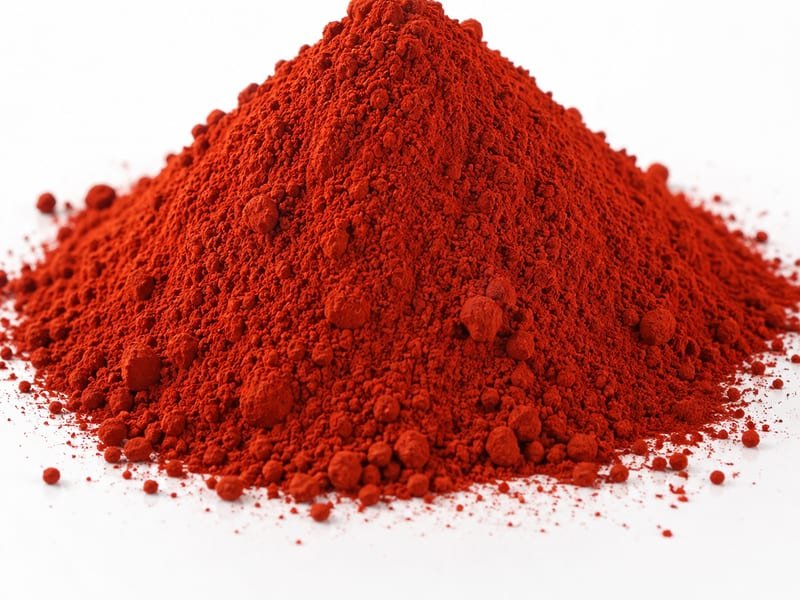
A block, paver, or precast panel that comes out visibly darker or lighter than the rest of the run at the same pigment dosage is not a rare occurrence in colored concrete — it’s a predictable outcome whenever pigment quality or mix-design consistency isn’t controlled as tightly as the pigment dosage itself.
Root Causes
Iron oxide pigments are the standard colorant for integral concrete color, and their performance in cementitious systems is governed by a documented standard: ASTM C979 requires that pigments used in concrete be lightfast, insoluble, and alkali-resistant, so they don’t fade, leach, or react with cement’s high-pH environment over the product’s service life. That standard sets a performance floor, but it doesn’t by itself guarantee batch-to-batch color uniformity — that depends on the pigment’s tinting strength and particle size consistency, which are documented to vary between pigment sources and grades. High-purity synthetic iron oxides with consistent tinting strength and particle size are specifically required to ensure that every block in a run, and every batch after it, produces the same color at the same dosage — a natural or lower-purity iron oxide source can carry the same nominal iron oxide content while delivering measurably different tinting strength.
Pigment quality is only half the equation. Documented guidance for consistent integral color concrete calls for holding the entire mix design constant between batches — the same cement source, the same aggregate types, the same water-to-cement ratio, and precisely weighed pigment dosage — because color development in concrete is a function of the whole mix system, not the pigment alone. A cement source change, an aggregate substitution, or water-ratio drift can shift the finished color even when the iron oxide pigment dosage and grade are held exactly constant, because these other mix variables affect how the pigment disperses and how the finished surface reflects light.
What This Means for Raw Material Selection
Because tinting strength and particle size are what actually determine color yield per unit of pigment, specifying iron oxide purely by nominal iron oxide content or by color name is not a sufficient purchasing specification for color-critical decorative concrete work. A buyer needs a pigment source whose tinting strength and particle size are documented and held consistent lot to lot — precisely the property that separates a reliable synthetic iron oxide supply from an inconsistent one, even when both carry a similar bulk chemical assay.
The practical control points for a buyer are: source iron oxide pigment tested to ASTM C979 for lightfastness, insolubility, and alkali resistance, and request tinting-strength and particle-size data as part of supplier qualification rather than relying on color-name matching alone; keep pigment dosage weighing precise and documented per batch, since dosing drift is an independent source of color variation on top of pigment quality; and hold the rest of the mix design (cement source, aggregate, water-cement ratio) constant when color consistency across a production run matters, since a pigment-only specification can’t compensate for a shifting mix design around it.
Sources: ASTM C979, Standard Specification for Pigments for Integrally Colored Concrete; Solomon Colors, industry technical documentation on iron oxide pigments for concrete color consistency; Concrete Decor, “Pigments for Integrally Colored Concrete” and related technical articles on batch-to-batch color control in block, paver, and precast production.