
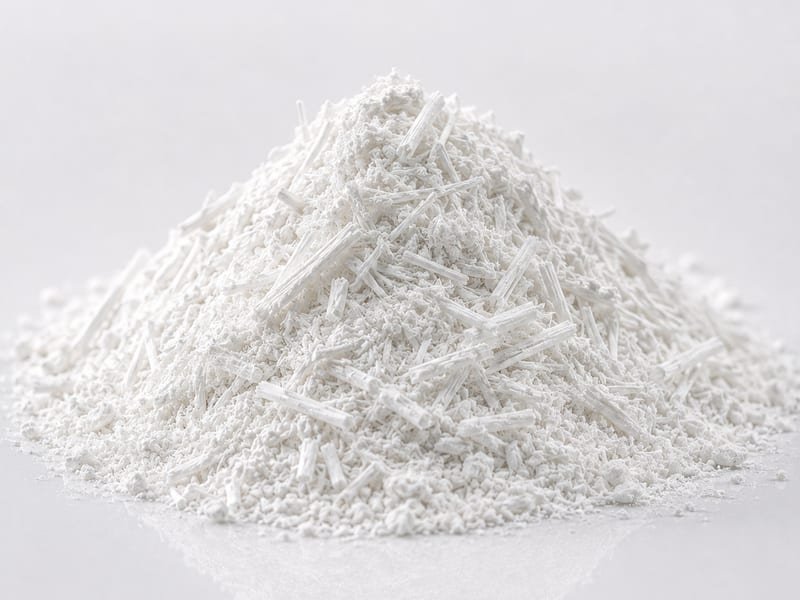
Wollastonite
How wollastonite is used as a needle-like filler in plastics, and what research on polypropylene fiber composites shows about what actually drives strength improvement.
Overview
Wollastonite, a needle-like calcium silicate mineral, has historically had plastics and rubber as its largest end-use category among its commercial applications. This page covers that role and what fiber-composite research shows about what actually drives the mechanical improvement it provides.
What is it?
Wollastonite is used as a needle-shaped (acicular) filler. Per 2013 U.S. Geological Survey data, plastics and rubber accounted for an estimated 30–35% of U.S. wollastonite sales — the largest single end use — followed by ceramics (20–25%), metallurgical applications (10–20%), and paint, friction products, and miscellaneous uses (10–15% each).
Why should I use it?
- It’s historically the largest end use among wollastonite’s commercial applications, per U.S. government data — see “What is it?” above.
- Research has directly measured what actually drives its mechanical benefit in a plastic composite — and it isn’t just the filler itself — see Limitations.
How it’s used
In Plastics & Polymers, wollastonite is used as a needle-like filler, most directly documented in polypropylene fiber composites.
Limitations — when it isn’t the right choice
- Assuming wollastonite content alone drives strength improvement overlooks a bigger factor: processing. A 2022 peer-reviewed study on polypropylene fiber composites with 0–4 wt% unmodified wollastonite (needle-like particles, D50 = 3 µm) found tensile strength ranging from 291 to 535 MPa across tested samples, with the drawing ratio (a fiber-processing parameter) identified as the most important factor for tensile strength improvement — more important than filler content, which produced only a mild improvement on its own. Onset thermal decomposition temperature did improve, from 271°C for neat polypropylene to 302°C in an optimized composite. This was documented for one specific fiber-drawing composite system at low filler loadings (up to 4 wt%); it should not be assumed that filler content alone explains strength gains in every wollastonite-filled plastic without checking how the material was processed.
Key Applications
The material's role changes by industry — click any industry to see its full page.

Physical Properties
| Property | Typical Value | Note |
|---|---|---|
| Chemical Formula | CaSiO₃ | Definitional |
| Hardness (Mohs) | ≈ 4.5–5 | Typical published value — NYCO Minerals; Digitalfire |
| Specific Gravity | ≈ 2.86–3.09 | Typical published value — NYCO Minerals; Digitalfire |
| Aspect Ratio | ≈ 3:1 to 20:1 (acicular/needle-like particles; high-aspect-ratio fibrous grades up to 20:1) | Typical published value — NYCO Minerals |
| Whiteness | The only pure white acicular (needle-shaped) mineral extender | Typical published value — NYCO Minerals |
These are typical published values for the material in general, not a certificate of analysis (COA) for a specific shipment. Actual per-batch values are set by the COA accompanying supply.
Grades
Grade and Specification Guide
These reference codes illustrate grade categories and specifications for comparison and selection. The commercial grade and final specification are determined by your application requirements, the technical data sheet and the batch certificate of analysis.
Standards & Technical References
Every claim on this page traces back to a verifiable reference:
- Tier 1Government PublicationUSGS — Mineral Resource of the Month: Wollastonite (Virta & Van Gosen, 2015), 2013 end-use distribution data
- Tier 2University/ResearchOptimization of Thermal and Mechanical Properties of Polypropylene-Wollastonite Composite Drawn Fibers Based on Surface Response Analysis, Polymers (MDPI), 2022, Vol. 14, Article 924
- Tier 3Global SupplierNYCO Minerals — Wollastonite technical brochure (PCI Mag virtual brochure)
- Tier 3Educational ReferenceWikipedia; Digitalfire — Wollastonite physical property data
Frequently Asked Questions
What is wollastonite?
It's an acicular (needle-shaped) calcium silicate mineral (CaSiO₃), and its largest single end use has historically been plastics and rubber (30-35% of U.S. sales).
What actually improves tensile strength in wollastonite-polypropylene composites?
The drawing ratio (a fiber-processing parameter), not filler content — a 2022 peer-reviewed study identified it as the most important factor for tensile strength improvement, more important than wollastonite content itself, which produced only a mild improvement on its own.
How is wollastonite used in plastics?
As a needle-like filler, most directly documented in polypropylene fiber composites.
Does adding wollastonite improve thermal stability?
Yes, in the studied formulation — onset thermal decomposition temperature improved from 271°C for neat polypropylene to 302°C in an optimized composite.


