
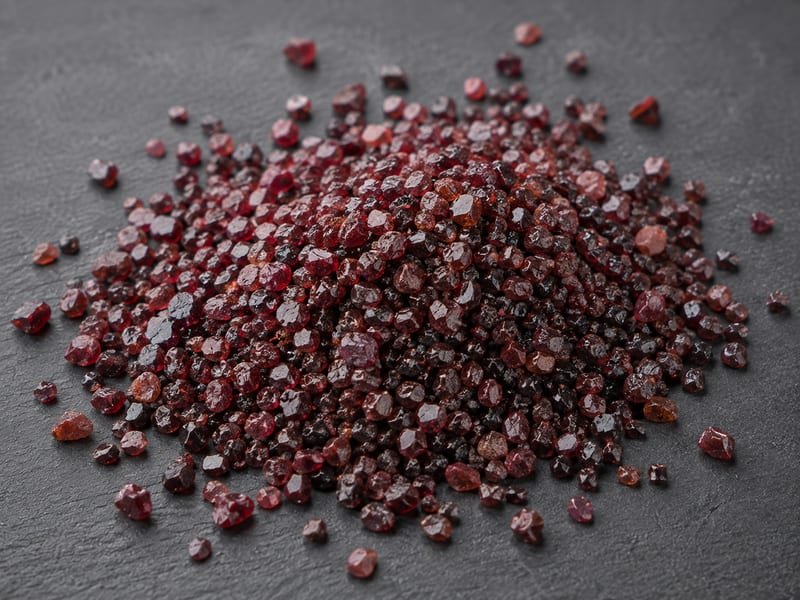
Garnet (Industrial)
How industrial garnet is used across abrasive blasting, water filtration, and waterjet cutting, and what research shows about its recycling advantage over olivine and corundum.
Overview
Industrial garnet’s largest documented U.S. uses are abrasive blasting, water filtration, and waterjet-assisted cutting, and research directly measuring abrasive breakdown shows garnet holds up to reuse better than the other two common blasting abrasives it’s often compared against. This page covers that end-use ranking and what the recycling research found.
What is it?
Garnet is a hard mineral used mainly as an abrasive and filtration media. Per the U.S. Geological Survey’s Mineral Commodity Summaries 2025, U.S. garnet end uses are led, in descending order of consumption, by abrasive blasting, water-filtration media, and waterjet-assisted cutting, with other uses including abrasive powders, nonslip coatings, and sandpaper making up the remainder. In 2024, U.S. apparent consumption was an estimated 160,000 tons, with import reliance at 48%, sourced mainly from South Africa (54%), Australia (21%), and India (11%) over 2020-23.
Why should I use it?
- Abrasive blasting, water filtration, and waterjet cutting are all documented, ranked end uses in a substantial domestic market — see “What is it?” above.
- Research measuring actual particle breakdown during use found garnet holds up to reuse better than olivine and corundum, two other common abrasives — see Limitations.
How it’s used
In water treatment, garnet is used as a filtration media. It’s also widely used for abrasive blasting and for abrasive waterjet-assisted cutting, where it’s mixed into a high-pressure water stream to cut hard materials.
Limitations — when it isn’t the right choice
- Garnet abrasive particles measurably shrink and shift in size distribution with repeated use — recycled material isn’t the same as fresh material. A 2021 peer-reviewed study tested four abrasives during abrasive waterjet machining: fresh alluvial garnet, an already-recycled garnet product, olivine, and corundum. Fresh alluvial garnet averaged 244.6 micrometers in grain size, dropping to 103.1 micrometers after use at a 25% abrasive concentration. For reuse potential, the study calculated a recycling coefficient — a measure of how much expended abrasive could still be reused — of 0.61 for the recycled-garnet product specifically, versus 0.46 for olivine and 0.39 for corundum; the fresh alluvial garnet scored the second-highest of the four, which the study describes as making it possible to reuse over half of the expended abrasive. In other words, both garnet variants held up to reuse better than olivine or corundum in this testing. This means recycled garnet can still be used effectively, but its finer, shifted particle-size distribution should be checked against the specific cutting or blasting application rather than assumed to perform identically to fresh material.
Key Applications
The material's role changes by industry — click any industry to see its full page.

Physical Properties
| Property | Typical Value | Note |
|---|---|---|
| Composition (abrasive-grade, almandine) | Fe₃Al₂(SiO₄)₃ | Definitional |
| Hardness (Mohs) | 7-8 (almandine ≈ 7.5-8.0) | Typical published value — Target Products; OMAX Waterjet |
| Specific Gravity | ≈ 3.75-4.30 (alluvial grades ≈ 4.0-4.2) | Typical published value — Target Products; OMAX Waterjet |
| Abrasive Mesh/Grit Range | 12/20 to 240 mesh, application-dependent | Typical published value — Target Products |
These are typical published values for the material in general, not a certificate of analysis (COA) for a specific shipment. Actual per-batch values are set by the COA accompanying supply.
Grades
Grade and Specification Guide
These reference codes illustrate grade categories and specifications for comparison and selection. The commercial grade and final specification are determined by your application requirements, the technical data sheet and the batch certificate of analysis.
Standards & Technical References
Every claim on this page traces back to a verifiable reference:
- Tier 1Government PublicationUSGS — Mineral Commodity Summaries 2025, Garnet (Industrial)
- Tier 2University/ResearchResearch into the Disintegration of Abrasive Materials in the Abrasive Water Jet Machining Process, Materials (MDPI), 2021, Vol. 14, Issue 14, Article 3940
- Tier 3Global SupplierTarget Products — GARNET Data Sheet
- Tier 3Industry ReferenceOMAX Waterjet — The Gem That Makes the Cut: Garnet's Role in Abrasive Waterjet
Frequently Asked Questions
What are garnet's main industrial uses in the U.S.?
In descending order per USGS: abrasive blasting, then water-filtration media, then waterjet-assisted cutting, with other uses including abrasive powders, nonslip coatings, and sandpaper.
How import-dependent is U.S. garnet supply?
Import reliance was 48% in 2024, sourced mainly from South Africa (54%), Australia (21%), and India (11%) over 2020-23.
How much does garnet grain size shrink with use?
Fresh alluvial garnet averaged 244.6 micrometers in grain size, dropping to 103.1 micrometers after use at a 25% abrasive concentration, per a 2021 peer-reviewed study.
Does garnet hold up to reuse better than other abrasives?
Yes. The same study calculated a recycling coefficient of 0.61 for the recycled-garnet product specifically, versus 0.46 for olivine and 0.39 for corundum.
Can recycled garnet be used as effectively as fresh material?
It can be reused effectively, but its finer, shifted particle-size distribution should be checked against the specific cutting or blasting application rather than assumed to perform identically to fresh material.


