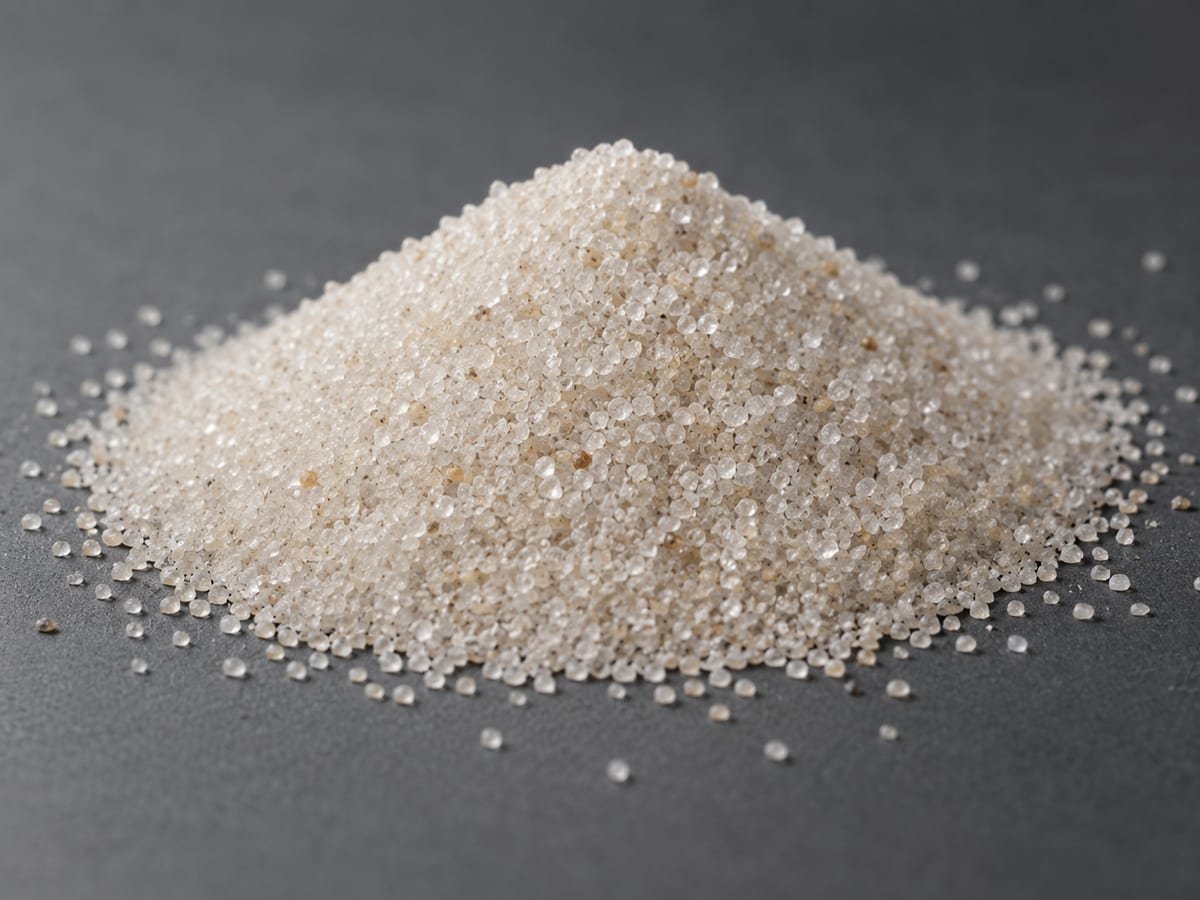
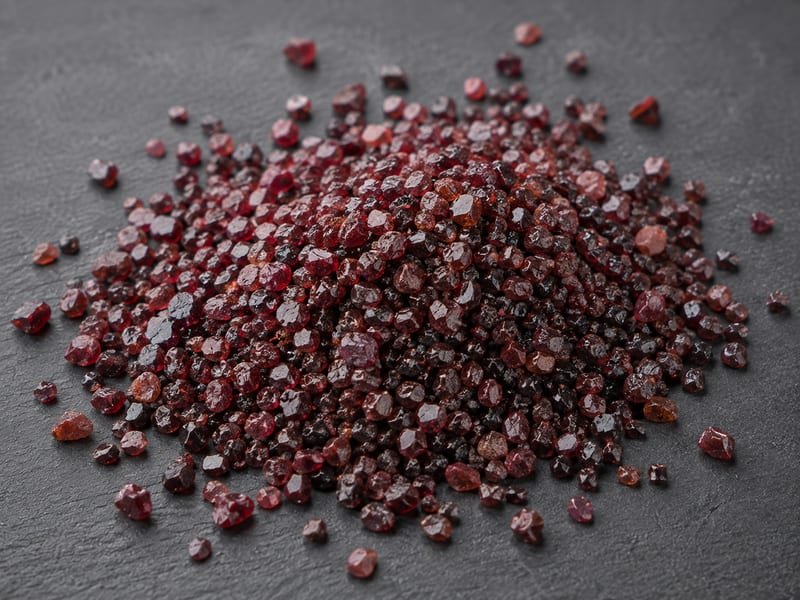
A rapid sand or multimedia water filter that starts requiring backwash noticeably more often than its design run length usually hasn’t developed a new problem — it’s revealing that the filter media’s particle size distribution isn’t what the filter was designed around, whether from the original grade specification or from drift introduced during service.
Root Causes
Multimedia filter beds work by layering media of different density and particle size, coarsest on top, finest at the bottom, so that larger suspended particles are captured first and progressively finer particles are captured deeper in the bed — a design that extends run length compared with a single-media bed by distributing the filtration load through the full bed depth rather than concentrating it at the surface. Garnet, with a high specific gravity around 4.0, is used specifically as the dense bottom layer in multimedia beds; its fine effective size — commonly specified in the range of roughly 0.25-0.35 mm for standard multimedia applications, with finer grades available for polishing duty capable of filtering down to the 10-20 micron range — lets it capture the smallest suspended particles that pass through the coarser sand and anthracite layers above it.
Two specification numbers govern how well a given media grade actually performs this role: effective size (the particle size at which 10% of the sample by weight is finer, a standard sieve-analysis measure) and uniformity coefficient (the ratio describing how narrow or wide the particle size distribution is around that effective size). A lower uniformity coefficient means more uniform particles and is documented to produce better filtration performance and more predictable backwash behavior; media specified with a uniformity coefficient above roughly 1.8, or an effective size that doesn’t match the bed’s design gradation, disrupts the layering the filter design depends on. Iron and manganese oxides accumulating within the media over service life compound this: they progressively reduce effective pore space regardless of media quality, which is why documented filter operation calls for regular backwashing based on effluent turbidity monitoring rather than a fixed schedule alone.
What This Means for Raw Material Selection
Because a filter’s clogging behavior and run length depend on effective size and uniformity coefficient holding to the bed’s original design specification, sourcing silica sand or garnet filter media on a generic “filter grade” description, without confirming these two numbers against the specific bed design, is a documented way to under-perform the filter’s intended run length even with chemically pure media. A garnet or sand shipment that’s mineralogically correct can still disrupt bed layering and shorten filter runs if its particle size distribution has drifted from what the original design specified.
For a buyer specifying or re-supplying filter media, the practical points are: request effective size and uniformity coefficient data specific to the grade being sourced, matched against the filter bed’s original design gradation, rather than relying on a general material description; treat garnet’s role as the fine bottom layer as dependent on both its density and its effective size being held within specification, since either drifting independently can change filtration performance; and track backwash frequency over time as a practical indicator that media condition — not just raw water quality — may be shifting, since progressively shorter filter runs at consistent raw water quality point toward media grade or fouling issues rather than an upstream water-quality change.
Sources: general water treatment engineering literature and filter media technical references (Veolia Water Handbook, filtration chapter) on multimedia filter bed design, effective size, and uniformity coefficient; industrial filter media supplier technical documentation (Clack Corporation, Carbotecnia) on garnet specific gravity, effective size grades, and multimedia bed layering; general water treatment operations literature on backwashing practice and iron/manganese oxide accumulation in filter media.