
Magnesium Hydroxide
How magnesium hydroxide works as a flame-retardant filler alongside calcium carbonate in polypropylene, and what research shows about its LOI improvement and non-linear effect on tensile strength.
Overview
Magnesium hydroxide is a flame-retardant filler, and research adding it to a calcium-carbonate-filled polypropylene composite shows its fire-performance benefit rises with loading — but its effect on tensile strength doesn’t follow a simple straight line. This page covers that research and where magnesium hydroxide is sourced from.
What is it?
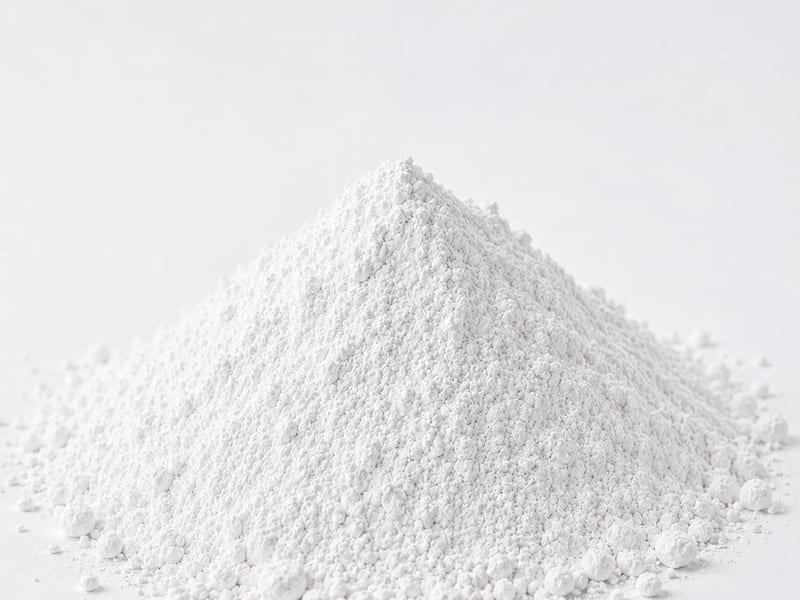
Magnesium hydroxide (Mg(OH)2) is a filler used mainly as a non-halogenated flame retardant in polymer compounds. Per the U.S. Geological Survey’s Mineral Commodity Summaries 2025, magnesium compounds in the U.S. are recovered from seawater (by companies in California and Delaware), from well brines (in Michigan), and from lake brines (in Utah). U.S. imports of magnesium hydroxide specifically were sourced primarily from Mexico (59%), the Netherlands (14%), and Israel (13%) over 2020-23.
Why should I use it?
- Magnesium hydroxide’s flame-retardant action comes from a genuine chemical mechanism (endothermic decomposition releasing water vapor), backed by direct thermal testing — see “How it’s used.”
- Adding it to a filled polypropylene composite measurably raises the limiting oxygen index (LOI), a standard flammability measure, in a dose-dependent way — see Limitations.
How it’s used
In plastics and construction-related polymer compounds, magnesium hydroxide works as a flame retardant by decomposing endothermically at high temperature, releasing water vapor that dilutes combustible gases while leaving a residue that limits heat transfer. A 2024 peer-reviewed study found this dehydration step occurs across a decomposition range of 309°C to 409°C.
Limitations — when it isn’t the right choice
- Adding magnesium hydroxide raises flame resistance with loading, but its effect on mechanical strength doesn’t follow a simple pattern — it needs to be checked at the specific loading level used, not assumed. The same 2024 study tested magnesium hydroxide added to a polypropylene composite already containing 50 wt% calcium carbonate. The limiting oxygen index rose steadily with more magnesium hydroxide: 17.9% for neat PP, 19.7% for PP with calcium carbonate alone, 21.2% with 5 wt% added magnesium hydroxide, and 23.1% with 10 wt%. Tensile strength, however, was not straightforward: it dropped from 31.4 MPa (neat PP) to 23.4 MPa (PP/calcium carbonate) to 21.2 MPa at 5 wt% magnesium hydroxide — its lowest point — before recovering slightly to 22.3 MPa at 10 wt%. This means a higher magnesium hydroxide loading isn’t automatically worse for mechanical strength than a lower one, and these exact figures are specific to this particular calcium-carbonate-filled polypropylene system; they should not be assumed to hold in a different resin or filler combination without separate testing.
Key Applications
The material's role changes by industry — click any industry to see its full page.

Physical Properties
| Property | Typical Value | Note |
|---|---|---|
| Chemical Formula | Mg(OH)₂ | Definitional |
| Decomposition Temperature | ≈ 340–490°C (endothermic dehydration) | Typical published value — ScienceDirect Topics |
| Specific Gravity | ≈ 2.36–2.40 (brucite) | Typical published value — Mindat.org; Wikipedia |
| Particle Size (flame-retardant grade) | ≈ 0.5–10.0 microns average, ultrafine/nano grades down to ≈ 130–230 nm | Typical published value — flame-retardant Mg(OH)₂ literature |
These are typical published values for the material in general, not a certificate of analysis (COA) for a specific shipment. Actual per-batch values are set by the COA accompanying supply.
Grades
Grade and Specification Guide
These reference codes illustrate grade categories and specifications for comparison and selection. The commercial grade and final specification are determined by your application requirements, the technical data sheet and the batch certificate of analysis.
Standards & Technical References
Every claim on this page traces back to a verifiable reference:
- Tier 1Government PublicationUSGS — Mineral Commodity Summaries 2025, Magnesium Compounds
- Tier 2University/ResearchBoosting Flame Retardancy of Polypropylene/Calcium Carbonate Composites with Inorganic Flame Retardants, Materials (MDPI), 2024, Vol. 17, Issue 18, Article 4553
- Tier 3Reference DatabaseScienceDirect Topics — Magnesium Hydroxide flame retardant decomposition temperature overview
- Tier 3Mineralogical DatabaseMindat.org; Wikipedia — Brucite (Mg(OH)₂) mineral data (specific gravity)
Frequently Asked Questions
Why does magnesium hydroxide work as a flame retardant?
Because it decomposes endothermically at high temperature, releasing water vapor that dilutes combustible gases while leaving a residue that limits heat transfer. A 2024 study found this dehydration step occurs across a decomposition range of 309°C to 409°C.
How does magnesium hydroxide raise the limiting oxygen index (LOI)?
It rises steadily with more loading: 17.9% for neat PP, 19.7% for PP with calcium carbonate alone, 21.2% with 5 wt% added magnesium hydroxide, and 23.1% with 10 wt%, per a 2024 study.
Is a higher magnesium hydroxide loading always worse for tensile strength?
No. Tensile strength dropped from 31.4 to 21.2 MPa at 5 wt% — its lowest point — before recovering slightly to 22.3 MPa at 10 wt%, meaning the effect doesn't follow a simple straight line.
Where are magnesium compounds sourced from?
From seawater (companies in California and Delaware), from well brines (in Michigan), and from lake brines (in Utah), per USGS.


