
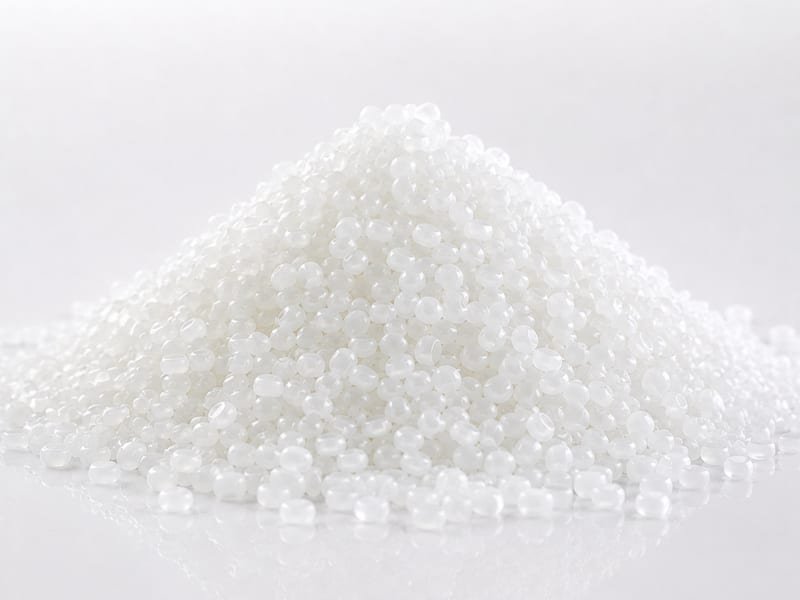
TPE (Thermoplastic Elastomer, SEBS/PP)
How SEBS/PP thermoplastic elastomer is used for soft-touch, recyclable parts, and what research shows about the real trade-off between softness and wear resistance from paraffin oil content.
Overview
SEBS/PP thermoplastic elastomer is valued for its soft touch and recyclability, and research on its formulation shows a genuine trade-off worth knowing: the same paraffin oil that makes it softer to process also measurably reduces its wear resistance. This page covers that trade-off and how compression resistance is measured for elastomers generally.
What is it?
TPE (thermoplastic elastomer) in this class is a blend of SEBS (styrene-ethylene-butylene-styrene block copolymer) and PP (polypropylene). A 2023 peer-reviewed study describes SEBS/PP-blended TPE as having “not only… characteristics of soft touch, but also… low odor, low VOC, and other environmentally friendly characteristics,” along with “excellent elasticity, aging resistance, weather resistance, wide range temperature stability, and recyclability.” Resistance to permanent deformation under sustained pressure — a key elastomer property — is generally measured using ASTM D395, a standard covering three test methods: Method A (constant force), Method B (constant deflection in air), and Method C (constant deflection accounting for material hardness). Method B is not suitable for vulcanizates harder than 90 IRHD; Method C was developed to extend testing to harder materials by varying the compression percentage with hardness.
Why should I use it?
- It combines a soft touch with recyclability and resistance to aging and weathering, documented properties that make it popular for interior surfaces — see “What is it?” above.
- Its SEBS-to-PP ratio is the single most influential formulation factor for hardness, melt flow, and wear resistance, giving real control over the final part’s performance — see “How it’s used.”
How it’s used
In plastics and polymer applications, SEBS/PP TPE is used for soft-touch surfaces such as automotive interior skins, where a 2023 study identified an optimal formulation reaching a melt flow rate of 92 g/10 min, a hardness of 76.9 Shore A, and the lowest wear (0.13 mg mass loss in Taber abrasion testing) among the formulations tested.
Limitations — when it isn’t the right choice
- Adding paraffin oil to improve softness and processability comes at a measurable cost to wear resistance. The same 2023 study found that “increasing the oil content filled in SEBS led to an increase in the surface stickiness degree of the prepared TPE, resulting in increased adhesive wear, leading to a decrease in overall wear resistance.” In other words, the softer and easier-flowing a formulation becomes through added oil, the more prone its surface is to sticky, adhesive wear. This means formulators need to weigh softness and processability against durability rather than assuming more oil is simply better; these findings are specific to the SEBS/PP system and automotive-interior-skin formulations tested in this study and shouldn’t be assumed to hold for other TPE types like TPV, TPO, or SBS without separate verification.
Key Applications
The material's role changes by industry — click any industry to see its full page.
Standards & Technical References
Every claim on this page traces back to a verifiable reference:
- Tier 1StandardASTM D395-18 — Standard Test Methods for Rubber Property—Compression Set
- Tier 2University/ResearchEffect of SEBS Molecular Structure and Formula Composition on the Performance of SEBS/PP TPE for Automotive Interior Skin, Polymers (MDPI), 2023, Vol. 15, Issue 12, Article 2753


