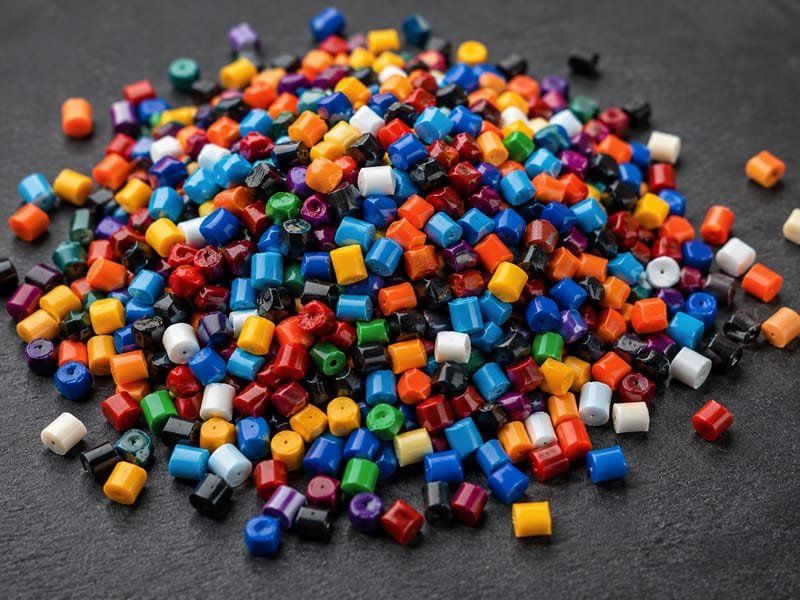
A masterbatch dosed to hit a specific color standard on an injection molding line doesn’t automatically hit the same standard on a blow molding or extrusion line running the same nominal formula — because different processes expose the same masterbatch to different shear histories, and shear exposure is what actually finishes the pigment dispersion.
Root Causes
Masterbatch is pre-dispersed using high-shear mixing during manufacture specifically so that downstream processing only needs to redistribute an already-fine pigment concentrate through the base resin — but that redistribution step still has to happen correctly at the converter’s machine, and it’s documented as particularly consequential in high-shear-force processes like injection molding, blow molding, and extrusion, where inconsistent dispersion produces visible defects: speckles, streaks, or mottling in the finished part.
Color matching itself is performed against a physical or digital standard sample, and batch-to-batch consistency depends on the masterbatch supplier’s own process control holding steady — but even a masterbatch that matches its standard on the loading dock can shift in apparent color if the buyer’s machine doesn’t fully complete dispersion, since incomplete dispersion changes how pigment particles scatter light in the finished part versus how they scattered light in the standard sample. This is a distinct mechanism from feedstock composition drift — the masterbatch formula can be unchanged while the finished-part color still varies because the dispersion step downstream wasn’t equivalent.
What This Means for Raw Material Selection
Because color match depends on both the masterbatch’s own consistency and how completely a given process disperses it, a masterbatch qualified against one process (say, injection molding on a particular machine) isn’t automatically validated for a different process running the same nominal dosage — the shear profile, screw design, and cycle parameters of blow molding or extrusion can leave the same masterbatch less completely dispersed, producing a visible color or surface difference even though the raw masterbatch itself is identical.
The practical points for a buyer are: requalify color match specifically for each process the masterbatch will run on, rather than assuming a single qualification transfers across injection molding, blow molding, and extrusion; treat visible defects like speckling, streaking, or mottling as a dispersion diagnostic first, checking process shear parameters before assuming the masterbatch itself is off-spec; and specify masterbatch carrier resin and pigment loading with the actual production process in mind, since a masterbatch engineered for easy dispersion on one machine type may need a different carrier or loading to disperse equally well on another.
Sources: LyondellBasell technical materials on custom performance color masterbatch; Kerke Extruder guide to masterbatch for injection molding covering color uniformity and flowability; industry technical references on plastic colorants and pigment dispersion mechanisms across injection, blow molding, and extrusion processes.