
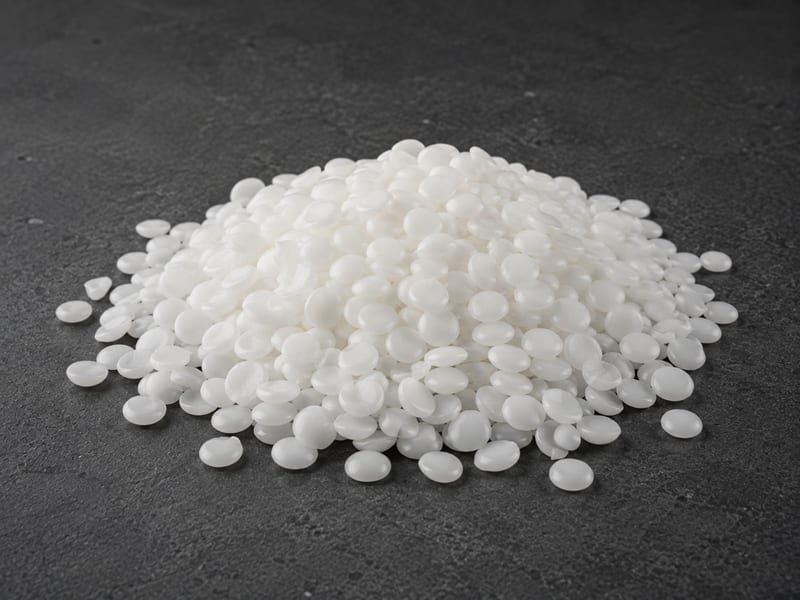
Waxes (Specialty Chemicals)
How the type of wax used in a rubber compound governs how much protective film migrates to the surface, but not necessarily what that film is made of once it gets there.
Overview
Choosing a wax type for rubber ozone protection changes how much of it ends up on the surface — but research tracking that migration found the chemistry of what actually gets there is a different question entirely.
What is it?
Waxes used in this context are additives that migrate (“bloom”) to the surface of a rubber compound over time, forming a protective film that helps shield the rubber from ozone attack. Because waxes soften gradually rather than melting at a sharp point, the industry-standard way of characterizing this behavior is ASTM D3954, which defines a standardized dropping-point test method for waxes.
Why should I use it?
- The type of wax used directly governs how much protective film accumulates on the rubber’s surface — see “How it’s used.”
- That doesn’t mean different wax types produce differently protective films — the chemistry of what migrates turns out to be similar either way — see Limitations.
How it’s used
A 2023 peer-reviewed study tracked wax migration in a model rubber sidewall formulation using three wax types at equal loading — neat paraffinic wax, a 1:1 paraffinic/microcrystalline blend, and neat microcrystalline wax — monitoring the compound’s surface over time by attenuated total reflectance Fourier-transform infrared spectroscopy (ATR-FTIR). The amount of wax detected on the surface was governed by the type of wax included in the formulation, and this was corroborated by each vulcanizate’s performance under static ozone aging.
Limitations — when it isn’t the right choice
- Picking a different wax type mainly changes how much surface film forms, not necessarily its underlying chemistry. The same study used gas chromatography to analyze the composition of the migrated wax itself, and found it was remarkably similar regardless of which wax type had been used in the formulation. The study attributes this to wax migration being governed by competing effects of solubility and mobility of alkane chains within the rubber matrix — meaning migration is selective based on the chemical properties of the chain itself, not simply the source wax chosen. This means a formulation decision based on wax type should be evaluated as a question of how much protective film will form and how quickly, rather than assuming that switching wax types also changes the fundamental chemistry doing the protecting. This finding is specific to a model rubber sidewall formulation tested with these three wax types; other rubber compounds or wax chemistries would need separate verification.
Key Applications
The material's role changes by industry — click any industry to see its full page.

Standards & Technical References
Every claim on this page traces back to a verifiable reference:
- Tier 1Industry StandardASTM D3954-15(2022) — Standard Test Method for Dropping Point of Waxes
- Tier 2University/ResearchAnalytical Investigation of Wax Migration in Rubber Compounds, Kritkausky, Adas, Ortmann & Saxena, Rubber Chemistry and Technology, 2023, Vol. 96, Issue 1, pp. 149-161
Related Materials


