
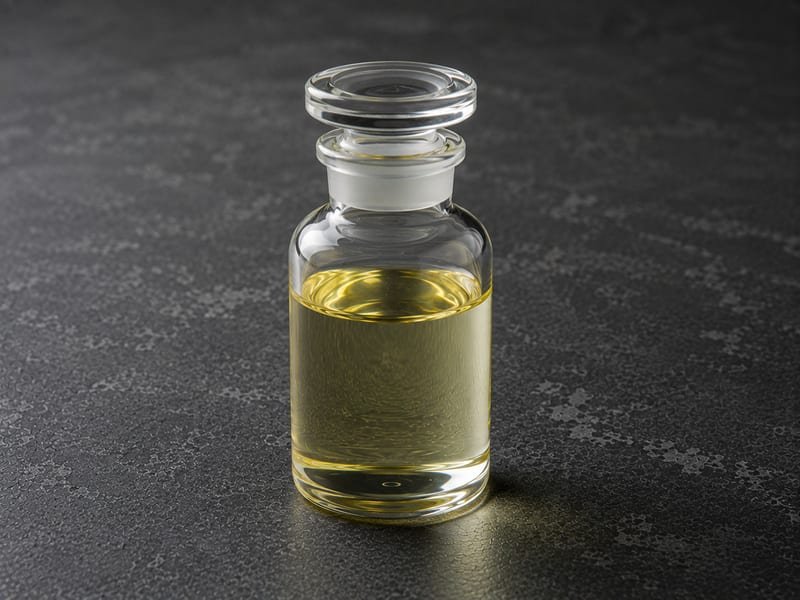
Lubricants (Specialty Chemicals)
How internal and external lubricants interact during PVC processing, and why pairing an internal lubricant with a polar external wax can cause worse phase separation than using either alone.
Overview
Combining an internal and an external lubricant sounds like it should always help PVC processing — but research tracking how these additives actually distribute during extrusion found a case where the combination backfires, leaving the formulation worse off than either lubricant used alone.
What is it?
Lubricants are additives used to control how PVC compounds flow and release from metal surfaces during processing. The industry-standard way of evaluating their performance is ASTM D2538, which measures a PVC compound’s fusion characteristics — fusion time, fusion torque, melt torque, and melt viscosity — using a torque rheometer, directly showing how a given lubricant package affects the speed and quality of PVC fusion.
Why should I use it?
- An internal lubricant can act as a compatibilizer, helping an external lubricant that otherwise has no affinity for PVC actually associate with it — see “How it’s used.”
- That same pairing doesn’t work the same way for every external lubricant chemistry — with the wrong combination, it can actively work against you — see Limitations.
How it’s used
A 2020 peer-reviewed study tracked the migration and distribution of lubricants through three stages simulating single-screw extrusion of unplasticized PVC (uPVC), using scanning electron microscopy coupled with energy-dispersive spectroscopy (SEM-EDS). The study found that a nonpolar external wax on its own showed no affinity for PVC at all, but adding calcium stearate (an internal lubricant) to the mixture facilitated the nonpolar wax’s association with the PVC, acting as a compatibilizer and producing a smooth, homogeneous distribution throughout the material.
Limitations — when it isn’t the right choice
- Pairing an internal lubricant with a polar external wax doesn’t produce the same beneficial effect — it can instead create a competition that leaves the formulation worse than either additive alone. The same study found that when a polar external wax was combined with calcium stearate, a competing affinity emerged: the polar wax preferentially associated with the calcium stearate rather than with the PVC itself, resulting in a fully phase-separated morphology that was worse than either the PVC/calcium stearate or PVC/polar wax binary blends on their own. This means the common assumption that combining internal and external lubricants is always additive or synergistic doesn’t hold universally — the specific polarity match between the internal lubricant and the chosen external lubricant determines whether the pairing helps or actively hurts. These findings are specific to a calcium stearate/wax lubricant system in unplasticized PVC under simulated single-screw extrusion conditions; other lubricant chemistries (such as amide or ester waxes) or polymer systems would need separate verification.
Key Applications
The material's role changes by industry — click any industry to see its full page.
Standards & Technical References
Every claim on this page traces back to a verifiable reference:
- Tier 1Industry StandardASTM D2538-25 — Standard Practice for Fusion of Poly(Vinyl Chloride) (PVC) Compounds Using a Torque Rheometer
- Tier 2University/ResearchTracking Lubricants During Single Screw Extrusion of uPVC, Barnard, Robertson & van Reenen, Polymer Testing, 2020, Vol. 87, Article 106523
Related Materials


