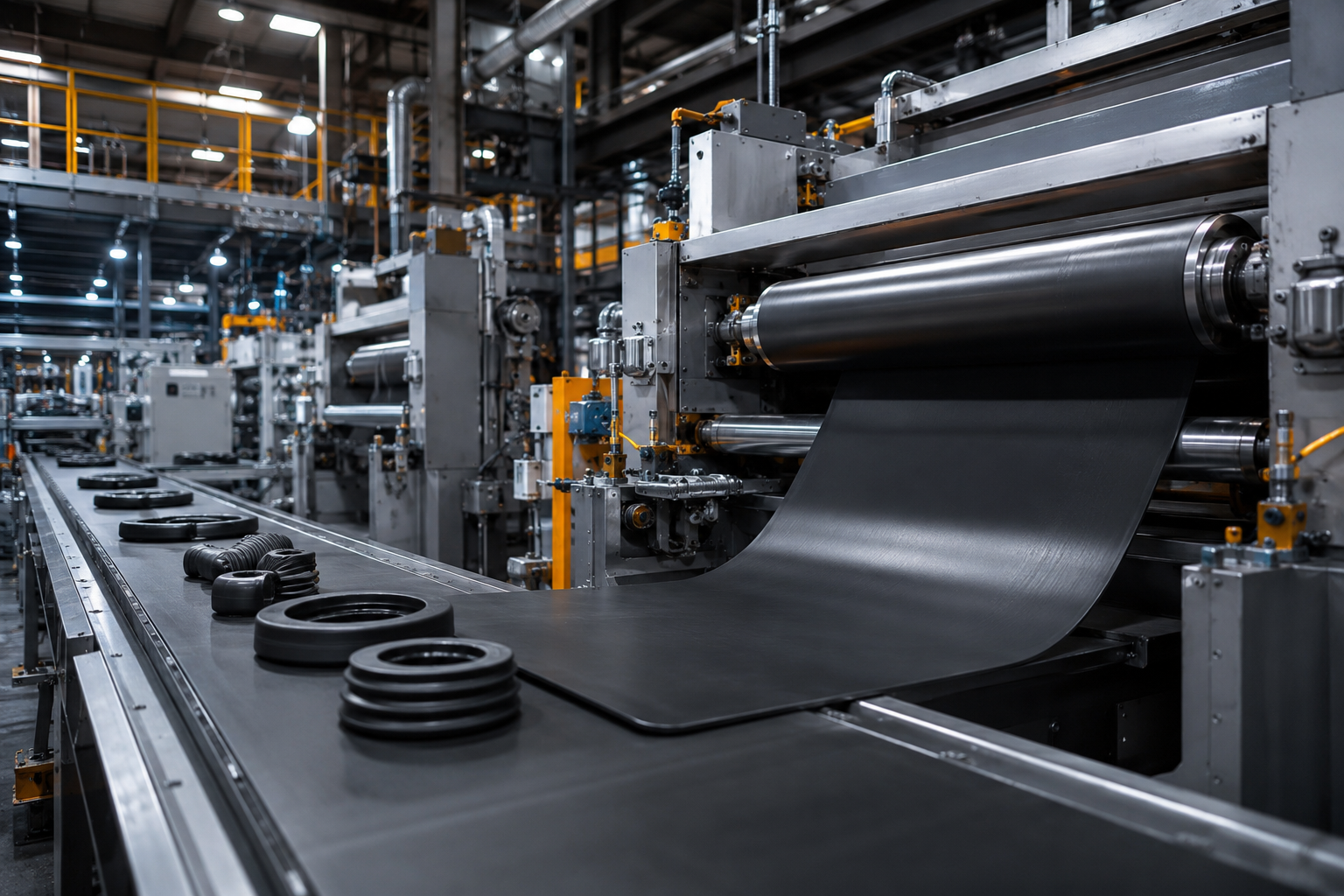
Surface cracking after outdoor exposure is one of the most recognizable failure modes in rubber goods — seals, hoses, and roofing membranes that look fine off the shelf but craze and split within months of service, well before any mechanical overload would explain it. For unsaturated diene rubbers this is rarely a mechanical defect; it’s a specific, well-characterized chemical attack that raw material selection can and does mitigate.
Root Causes
Ozone cracking is a chemical reaction, not general wear: atmospheric ozone attacks the carbon-carbon double bonds present in the backbone of unsaturated diene rubbers — natural rubber (NR), styrene-butadiene rubber (SBR), and polybutadiene (BR) — cleaving the chain at the point of attack. This is why saturated or largely-saturated elastomers such as EPDM and butyl rubber are inherently far more ozone-resistant: they simply lack the reactive double bonds in the main chain that ozone attacks.
Ozone attack alone does not produce visible cracks. Classic work by Braden and Gent, published as “The Mechanics of Ozone Cracking” in Rubber Chemistry and Technology (1962), established that cracking requires the rubber to be under tensile strain above a critical threshold — the chain scission has to be accompanied by strain sufficient to pull the cut surfaces apart and expose fresh, unreacted polymer to further attack. Above that threshold, crack growth proceeds at a rate that is largely independent of the applied stress once the critical condition is exceeded, and cracks propagate perpendicular to the direction of strain. This is precisely why static seals held under constant compression and dynamically flexing hoses or roofing membranes are both vulnerable, but for different reasons: static parts hold a constant strain that never lets a protective film rest, while dynamic parts repeatedly reopen any barrier that does form.
What This Means for Raw Material Selection
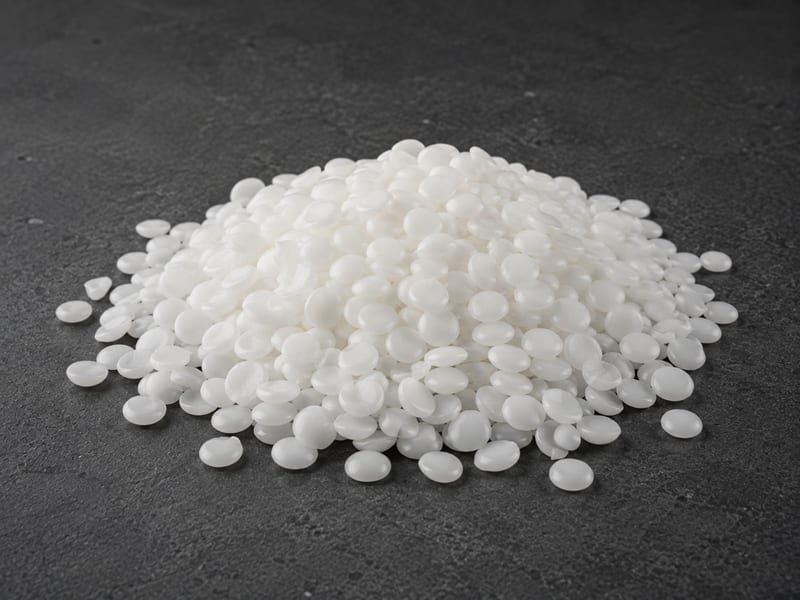
Two distinct protection strategies exist, and they are not interchangeable. Chemical antiozonants — principally para-phenylenediamine (PPD) derivatives — migrate to the rubber surface and react preferentially with ozone before it reaches the polymer backbone, at the cost of a visible surface film. Wax antiozonants work differently: paraffinic and microcrystalline waxes are formulated into the compound below their solubility limit so that they bloom to the surface over time, forming a physical barrier that blocks ozone diffusion into the rubber. The critical limitation, well documented in rubber technology literature, is that wax protection is effective mainly under static or low-flex conditions — under dynamic flexing the wax film repeatedly cracks open, exposing fresh rubber, so wax alone is a weaker choice for parts that flex continuously in service.
This is where wax grade selection becomes a genuine engineering decision rather than a commodity purchase. A wax blend’s bloom behavior is governed by its melting characteristics, standardly measured via dropping point (ASTM D3954), and a blend has to be matched to the part’s service temperature range: a wax with too low a melting point can bloom too quickly and deplete before the part’s service life is over, while one with too high a melting point may not bloom adequately at the ambient temperatures the part actually sees. Blends of paraffinic wax (faster bloom, lower cost) and microcrystalline wax (slower, longer-lasting bloom, better low-temperature flexibility) are used specifically to broaden the effective bloom temperature range and service life. Whatever wax/antiozonant package is chosen, ASTM D1149 — the standard ozone-chamber test using statically strained specimens — is the qualification method the industry uses to confirm a formulation actually resists cracking before it goes into an outdoor seal, hose, or roofing membrane application; buyers should treat consistent, correctly characterized wax supply, validated against this test, as the practical lever available on the raw-material side, and should expect dynamically flexed parts to need a combined wax-plus-chemical-antiozonant strategy rather than wax alone.
Sources: Braden, M. and Gent, A.N., “The Mechanics of Ozone Cracking,” Rubber Chemistry and Technology, 1962, Vol. 35; ASTM D1149-18, Standard Test Methods for Rubber Deterioration—Cracking in an Ozone Controlled Environment; ASTM D3954-15(2022), Standard Test Method for Dropping Point of Waxes; general rubber-science literature on chemical (PPD) versus physical (wax) antiozonant protection mechanisms.