
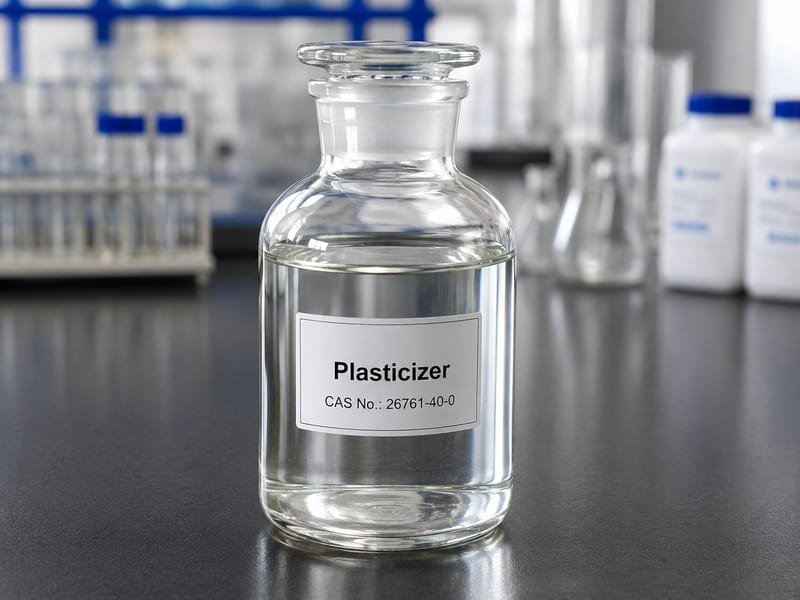
Plasticizers (Specialty Chemicals)
How plasticizer molecular weight controls migration speed from UV-aged PVC films, and why even the slowest-migrating plasticizers eventually show measurable surface loss.
Overview
Picking a “low-migration” plasticizer doesn’t mean picking one that never migrates — research tracking plasticizer loss from UV-aged PVC films over two weeks shows the difference is mostly a matter of timing, not permanence.
What is it?
Plasticizers are additives used to soften PVC and other polymers by reducing hardness and increasing flexibility. The industry-standard way of measuring how effectively a plasticizer has softened a material is ASTM D2240, which measures indentation hardness using a durometer; in plasticized PVC compounding, a lower hardness reading at a given loading is commonly used to judge higher plasticizing efficiency.
Why should I use it?
- Choosing a higher molecular weight plasticizer can substantially slow down and delay surface migration compared to shorter-chain alternatives — see “How it’s used.”
- Even the slowest-migrating plasticizers aren’t migration-free — they just take longer to show it, which matters if testing is done over too short a timeframe — see Limitations.
How it’s used
A 2026 peer-reviewed study tracked the migration of six plasticizer species from UV-aged PVC films over 14 days. Short-chain phthalates showed rapid surface enrichment, reaching a migration plateau within about a week in one formulation. Medium-chain plasticizers (the DEHP group) showed minimal detectable migration over the full 14-day period, attributed to their lower volatility and stronger affinity for the polymer matrix. High molecular weight plasticizers (DINP and DIDP) showed the slowest pattern of all, with migration only becoming evident after about two weeks.
Limitations — when it isn’t the right choice
- A “low-migration” plasticizer can still migrate — the difference from a faster one is mainly how long it takes to show up, not whether it happens at all. The same study found that even the high molecular weight plasticizers (DINP and DIDP), despite their much slower migration pattern, showed statistically significant migration once the observation window extended to the two-week mark. This matters because a plasticizer that looks stable in a short-duration migration test could still show meaningful surface loss over a longer service life — the absence of migration in a two- or three-day test doesn’t guarantee the same result at two weeks or beyond. This finding is specific to UV-aged PVC films observed over a 14-day period; longer timeframes or different aging conditions (heat, water exposure) would need separate verification.
Key Applications
The material's role changes by industry — click any industry to see its full page.

Standards & Technical References
Every claim on this page traces back to a verifiable reference:
- Tier 1Industry StandardASTM D2240-15(2021) — Standard Test Method for Rubber Property—Durometer Hardness
- Tier 2University/ResearchRapid Detection of Plasticizer Migration From UV-Aged PVC Films by DART-HRMS, Leite-Barbosa et al., Rapid Communications in Mass Spectrometry, 2026, Vol. 40, Issue 10, Article e70048
Related Materials


