
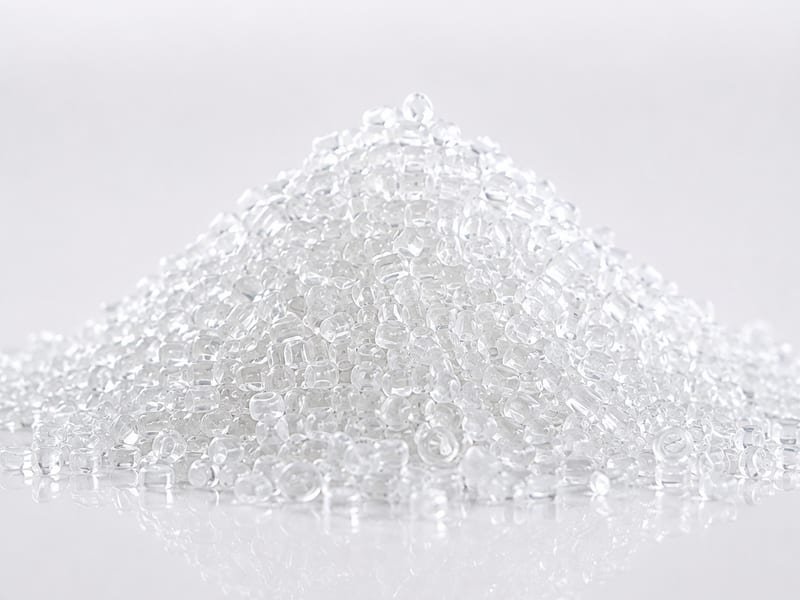
TPU (Thermoplastic Polyurethane)
How TPU is graded across a wide Shore hardness range, and what research shows about the real mechanical performance gap between ester-based and ether-based TPU after heat and humidity exposure.
Overview
TPU is graded across an unusually wide hardness range, and research directly comparing its two main chemical bases — ester and ether — after heat and humidity exposure shows the choice between them has a real, measurable effect on how much strength the material retains. This page covers that comparison and how TPU hardness is measured.
What is it?
TPU (thermoplastic polyurethane) is a flexible engineering plastic graded across a wide hardness range, typically measured using ASTM D2240, the durometer hardness test method covering twelve scale types (including the Shore A and Shore D scales commonly used for TPU). This test method is used broadly for rubber and elastomeric materials to measure indentation hardness.
Why should I use it?
- Its hardness can be precisely specified across a wide range using a standard, widely used test method — see “What is it?” above.
- Choosing between its two main chemical bases — ester and ether — gives you real, measurable control over how it holds up to heat and humidity — see Limitations.
How it’s used
TPU is used across plastics and polymer applications wherever a specific level of flexibility is needed, with the target hardness specified using the Shore A/D durometer scale.
Limitations — when it isn’t the right choice
- Ester-based and ether-based TPU are not interchangeable when heat and humidity are involved — ester-based grades lose substantially more strength. A 2025 peer-reviewed study on bio-based TPU measured tensile strength retention after 14 days of combined storage at 80°C and 80% relative humidity: an ester-based TPU at 75A hardness lost 36.66% of its tensile strength, while an ester-based grade at 95A hardness lost 19.57%. Ether-based TPU performed better in both cases tested — an 85A ether-based grade lost 14.31%, and a 95A ether-based grade lost only 11.63%. That said, ether-based TPU isn’t immune to humidity effects either: in a separate test measuring adhesive bond strength under 23°C/80% relative humidity storage, even the 95A ether-based grade still lost about 40% of its bond strength. This means ether-based TPU is the more resistant choice under heat and humidity, but it should still be evaluated for the specific exposure conditions expected, not assumed to hold up indefinitely; these figures come from bio-based TPU formulations specifically and shouldn’t be assumed to transfer directly to conventional petroleum-based TPU grades.
Key Applications
The material's role changes by industry — click any industry to see its full page.

Standards & Technical References
Every claim on this page traces back to a verifiable reference:
- Tier 1StandardASTM D2240 — Standard Test Method for Rubber Property—Durometer Hardness
- Tier 2University/ResearchA Comparison of Ester- and Ether-Based Bio-TPUs With Regard to Their Resistance to Environmental Influences in Terms of Their Mechanical and Adhesive Properties, Biopolymers, 2025


