
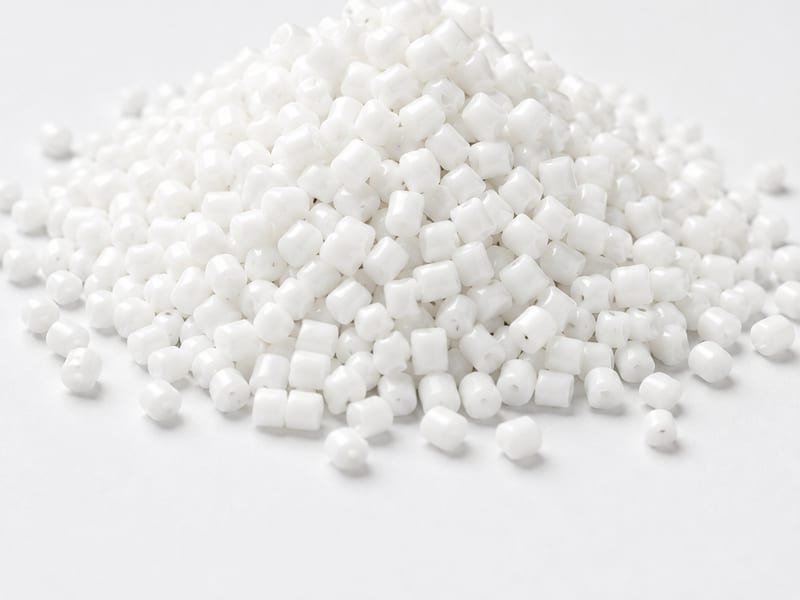
POM (Polyoxymethylene / Acetal)
How POM is classified for molding and extrusion, and what research shows about the exact sliding-condition limit where neat POM stops performing as a self-lubricating engineering plastic.
Overview
POM is valued as a self-lubricating engineering plastic for gears and bearings, and research testing it under increasingly severe sliding conditions found the exact point where neat POM simply stops behaving predictably — a limit worth knowing before specifying it for a demanding application. This page covers that research and how POM materials are classified.
What is it?
POM (polyoxymethylene, also called acetal) is an engineering thermoplastic classified for molding and extrusion under ASTM D6778, a standard classification system covering unreinforced, reinforced, filled, and lubricated POM grades. The classification is based on measured properties including flow rate, melting point, tensile strength, tensile modulus, Charpy impact resistance, and deflection temperature, tested on injection-molded specimens.
Why should I use it?
- It’s valued for good wear resistance, chemical stability, good mechanical properties, and self-lubricity — properties documented in components like gearboxes and flywheel rotor bearings — see “How it’s used.”
- Fiber-reinforced POM composites can extend its usable operating range well beyond where neat POM breaks down — see Limitations.
How it’s used
In plastics and polymer applications, POM’s combination of wear resistance and self-lubrication makes it a common choice for gears, bearings, and similar sliding-contact components.
Limitations — when it isn’t the right choice
- Neat POM has a hard operating limit under severe sliding conditions — beyond it, the material simply fails to behave predictably. A 2024 peer-reviewed study tested POM against a steel countersurface across a range of pressure-velocity (p·v) combinations in dry sliding, using pin-on-disc testing over a 20-kilometer sliding distance. At the highest tested severity (p·v = 5 MPa·m/s), no stabilization of the friction curve was obtained for neat or standard-processed POM, meaning no steady-state coefficient of friction could even be measured under that condition. Reinforcing POM with cellulose fiber changed this: composites at 20% and 30% by weight achieved stable friction behavior at this same severity, while a 10% by weight composite came close to a stable value without fully stabilizing over the full 20-kilometer distance. That 10% loading did, however, cut wear by up to 69% compared to standard-processed POM under these harsh conditions, even without achieving full friction stability. This means that for applications operating near or beyond this pressure-velocity range, neat POM is unlikely to be suitable, and a fiber-reinforced grade — with the reinforcement level chosen based on whether stable friction or reduced wear matters more — should be evaluated instead; these exact figures are specific to this test setup (a 100Cr6 steel countersurface, cellulose fiber reinforcement) and shouldn’t be assumed to transfer directly to every POM grade or reinforcement type.
Key Applications
The material's role changes by industry — click any industry to see its full page.

Standards & Technical References
Every claim on this page traces back to a verifiable reference:
- Tier 1StandardASTM D6778-20 — Standard Classification System and Basis for Specification for Polyoxymethylene Molding and Extrusion Materials (POM)
- Tier 2University/ResearchImproving the Tribological Performance of POM through the Incorporation of Bio-Based Materials, Polymers (MDPI), 2024, Vol. 16, Issue 16, Article 2310


