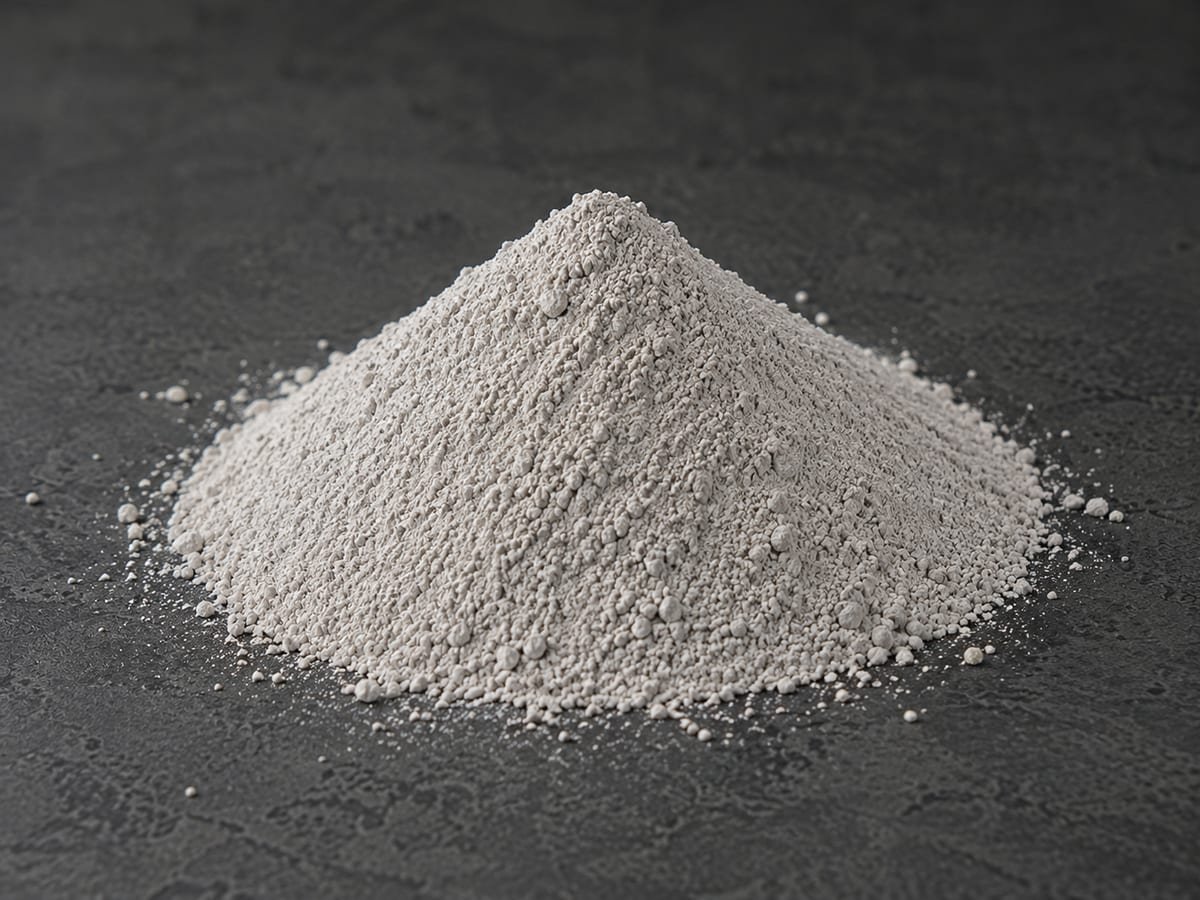
Agricultural dolomite is quarried rock, and the same geological deposit that supplies calcium and magnesium carbonate also carries whatever clay and silica occurs alongside it — impurities that don’t react with soil acid and that directly reduce the delivered material’s real neutralizing power below what the label mineral would suggest.
Root Causes
Dolomite deposits are rarely chemically pure CaMg(CO₃)₂; most carry some fraction of acid-insoluble material — clay minerals and silica — intermixed with the carbonate rock. Because calcium carbonate equivalent (CCE) is a measure of acid-reactive content, insoluble clay and silica simply don’t contribute to it: a shipment with a meaningful insoluble fraction will test at a correspondingly lower CCE than a purer lot from the same general deposit, which is one of the primary reasons commercial agricultural liming materials typically run in the 90-98% CCE range rather than at the near-109% theoretical maximum of stoichiometric dolomite.
This impurity fraction is a standard, named analytical category, not an incidental defect. ASTM C25, the standard chemical analysis method for limestone, quicklime, and hydrated lime, includes dedicated procedures for “Insoluble Matter Including Silicon Dioxide,” “Insoluble Matter Other Than Silicon Dioxide,” and a specific free-silica determination applicable once silica content exceeds 0.05% — meaning insoluble residue is a routinely tested, quantifiable specification, not a qualitative judgment call.
What This Means for Raw Material Selection
For a buyer, insoluble residue (clay plus silica) is effectively the flip side of the CCE number on a certificate of analysis, and it’s worth requesting explicitly rather than accepting CCE alone as proof of purity — two shipments with similar-looking CCE can carry different insoluble fractions with different practical consequences: beyond the direct loss of neutralizing capacity, elevated free silica content also raises worker exposure considerations during crushing, screening, and handling, since it shifts the applicable occupational dust standard from a general nuisance-dust threshold to the stricter respirable crystalline silica limit.
The practical specification to request is an ASTM C25 insoluble-matter and free-silica breakdown alongside CCE, particularly when sourcing from a new deposit or supplier, rather than assuming that a passing CCE number by itself rules out a meaningful clay or silica fraction.
Sources: ASTM C25, Standard Test Methods for Chemical Analysis of Limestone, Quicklime, and Hydrated Lime; Minnesota Department of Agriculture, “Agricultural Liming Material Analysis — Determining Quality and Effective Neutralizing Value”; geology.com and Encyclopaedia Britannica, “Dolomite,” on natural deposit composition and impurities.