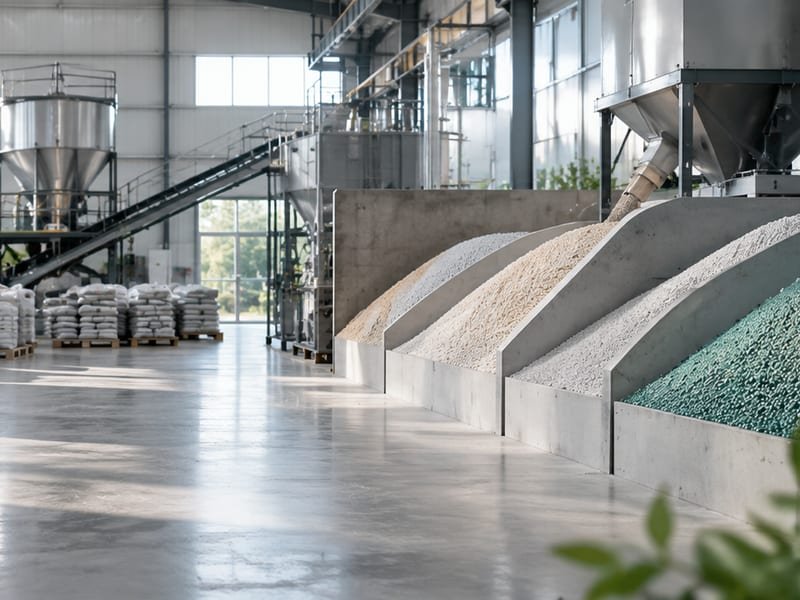
Agricultural dolomite is a low value-per-ton bulk mineral, and in that category of product transportation cost — not the price of the mineral at the quarry gate — is typically the largest and most volatile component of what a buyer actually pays, which makes sourcing distance a more important lever than most procurement processes treat it as.
Root Causes
Crushed stone and agricultural mineral products are heavy relative to their value, so freight cost per ton climbs quickly with distance and is sensitive to route (grade crossings, mountain ranges, state-line handling) in ways that base mineral pricing is not. USGS analysis of the U.S. crushed stone industry has documented haul cost as a large fraction of total delivered cost to the end user, and roughly 85% of aggregate and crushed stone tonnage in the U.S. moves by truck rather than rail or water — the more expensive mode per ton-mile for long distances. High-purity limestone and dolomite deposits are also geographically concentrated (in the U.S., mainly the central and eastern regions), which means many buyers are, by geology, never going to be close to a deposit and will always be paying a meaningful freight premium relative to a buyer situated near a quarry.
What This Means for Raw Material Selection
For a procurement manager, this reframes what “cost negotiation” should actually target. Because freight scales with distance and route difficulty rather than with the mineral’s intrinsic value, the sourcing decision that most affects delivered cost is which supplier and which quarry the material ships from — not squeezing a marginal discount on a base FOB mineral price that was never the dominant cost driver to begin with. A nominally cheaper quarry price from a distant source can easily lose to a higher quarry price from a nearby source once freight is added, and that comparison only becomes visible if delivered cost, not quarry-gate price, is the number being compared across suppliers.
The practical implication is to evaluate suppliers on total delivered cost per ton to the actual point of use, to weight proximity heavily in supplier qualification, and to treat route characteristics (not just straight-line distance) as part of that freight cost estimate before committing to a source.
Sources: USGS, Mineral Commodity Summaries, Stone (Crushed); USGS periodicals on crushed stone industry transportation and haul-distance economics, including documented truck-dominated (approximately 85%) modal share for aggregate transport and regional concentration of high-purity limestone/dolomite resources in the central and eastern United States.