
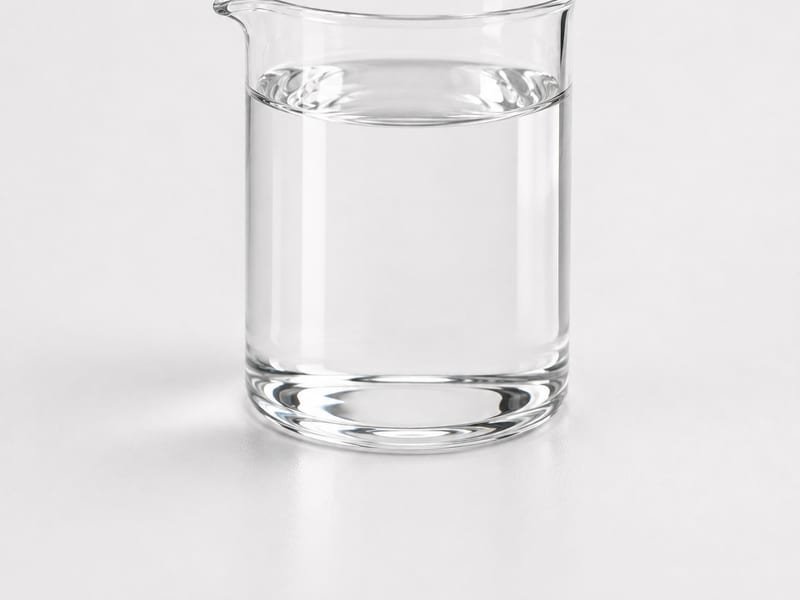
Epoxy Resin
How epoxy resins are classified under ASTM D1763, and a documented finding on how hardener ratio shapes mechanical performance after curing.
Overview
Epoxy Resin is a totally reactive resin supplied as a liquid or solid, used across castings, coatings, tooling, potting, adhesives, and reinforced applications. This page covers its classification and a documented finding on how hardener ratio shapes its cured mechanical performance.
What is it?
Epoxy Resin is classified under ASTM D1763 as a totally reactive resin, supplied without hardeners, in six types grouped by chemical nature. It requires a separate hardener to cure into its final form.
Why should I use it?
- A single specification covers six chemically distinct resin types — see “What is it?” above.
- Its cured mechanical properties are directly tied to hardener ratio — see Limitations for the trade-off this creates.
How it’s used
In Plastics & Polymers, Epoxy Resin is used across the full range of applications covered by ASTM D1763.
Limitations — when it isn’t the right choice
- There is no single hardener ratio that optimizes every mechanical property at once. A 2021 peer-reviewed study on a base epoxy diane resin (ED-20) cured with an L-20 hardener at varying mass-fraction ratios found that a 1:0.9 (hardener:resin) ratio produced the highest hardness, tensile strength, compressive strength, and bending strength — but impact toughness peaked at a different ratio, 1:0.8. Getting the hardener ratio wrong for the intended application is a real, measured trade-off. This was documented for one specific resin-hardener system; the exact optimal ratios should not be assumed identical across every commercial epoxy resin and hardener combination.
- Epoxy Resin isn’t the cheapest thermosetting option for composite/FRP applications, and it also cures more slowly than the alternatives — a real selection factor. A 1991 National Research Council assessment of wind turbine rotor materials found epoxy resin’s mechanical properties ranked at the top of the three main thermoset resin classes, but also that it was the most expensive (about $1.80/lb) and had the longest cure time of the three. Unsaturated Polyester Resin, at about $1.00/lb, was the cheapest and most widely used of the three, credited in the same assessment to its low cost and short cure time. Vinyl Ester Resin, at about $1.60/lb, was described as a cost/performance compromise — curing in a comparably short time to polyester, with mechanical properties closer to epoxy’s. The assessment explicitly cautions that resin selection should weigh cost alongside mechanical performance, not properties alone. These figures are specific to a single 1991 wind-turbine-blade assessment and reflect relative cost/cure-time positioning at that time, not current market pricing across composite applications generally.
Key Applications
The material's role changes by industry — click any industry to see its full page.
Standards & Technical References
Every claim on this page traces back to a verifiable reference:
- Tier 1StandardASTM D1763-00(2021) — Standard Specification for Epoxy Resins
- Tier 2University/ResearchMechanical properties of cured epoxy resin, Modern Physics Letters B, 2021
- Tier 1Government PublicationNational Research Council (The National Academies Press) — Assessment of Research Needs for Wind Turbine Rotor Materials Technology, 1991


