
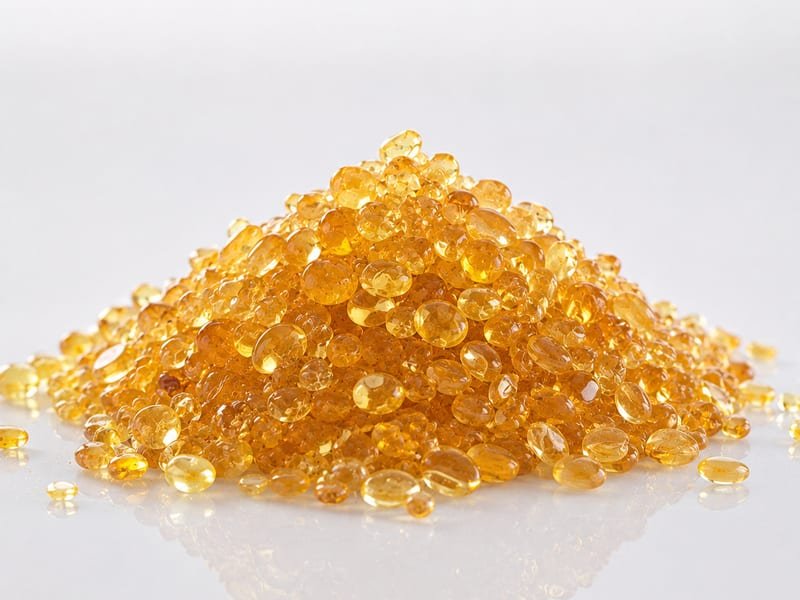
Tackifiers (Adhesives & Sealants)
How tackifiers affect pressure-sensitive adhesives beyond just "stickiness" — changing fibrillation behavior so adhesion force actually increases at higher release velocities.
Overview
A tackifier’s real effect on a pressure-sensitive adhesive isn’t just that it feels stickier — research shows it changes the actual mechanics of how the adhesive lets go, which is why a tackified adhesive can behave completely differently depending on how fast it’s being peeled or pulled away.
What is it?
Tackifiers are additives used to increase the tack — the initial stickiness — of pressure-sensitive adhesives and other adhesive systems. The industry-standard way of quantifying this is ASTM D3121, a rolling-ball test method most appropriate for low-tack adhesives; it’s fast to run, needs little equipment or operator training, and is primarily used for quality control since it reliably detects batch-to-batch variation when adhesive film thickness is held constant.
Why should I use it?
- A tackifier can make an adhesive’s bond strength actually improve at higher release velocities, rather than staying constant — see “How it’s used.”
- This effect comes from a real change in detachment mechanics, not simply “more stick” — so it’s specific to the tackifier-and-adhesive system tested, not a universal guarantee — see Limitations.
How it’s used
A 2021 peer-reviewed study compared intermediate stages of an acrylic pressure-sensitive adhesive’s manufacturing (an acrylate copolymer solution, then a cross-linked copolymer) against the final product containing a tackifier, using dynamic mechanical analysis and atomic force microscopy. The untackified intermediate products showed adhesion forces that were almost independent of release velocity, while the final tackified product showed adhesion force that increased significantly at higher release velocities, due to viscoelastic effects — along with a marked increase in storage and loss moduli at high angular velocities.
Limitations — when it isn’t the right choice
- The velocity-dependent strength boost comes from a specific change in how the adhesive detaches, not a generic “stickier is better” effect — and it’s tied to the exact system tested. The same study found that during detachment, the untackified copolymer’s contact area with the test probe steadily shrank until it separated completely, while the tackified product instead maintained a nearly constant contact area, with necking forming just below the probe surface — this sustained contact was what allowed the adhesive to stretch (fibrillate) enough to build up the extra strength seen at higher velocities. This was demonstrated with a hydrogenated rosin ester tackifier in one specific acrylic PSA system, so it shouldn’t be assumed to transfer automatically to other tackifier chemistries (such as terpene resins or hydrocarbon resins) or other adhesive systems (such as hot-melt EVA adhesives) without separate verification.
Key Applications
The material's role changes by industry — click any industry to see its full page.
Physical Properties
| Property | Typical Value | Note |
|---|---|---|
| Ring & Ball Softening Point (general range) | ≈ 70-150°C | Typical published value — tackifier resin patent literature |
| Ring & Ball Softening Point (preferred hot-melt range) | ≈ 95-110°C | Typical published value — tackifier resin patent literature |
| Acid Value (rosin ester, water-dispersible) | ≈ 40-55 mg KOH/g | Typical published value — Foreverest Resources; rosin ester patent literature |
| Gardner Color | ≈ 4-6 (pale amber) | Typical published value — Foreverest Resources RE4105 TDS |
| Composition Type | Aliphatic (C5), aromatic (C9), or mixed C5/C9 hydrocarbon; or rosin ester | Definitional — Kuraray Elastomer |
These are typical published values for the material in general, not a certificate of analysis (COA) for a specific shipment. Actual per-batch values are set by the COA accompanying supply.
Grades
Grade and Specification Guide
These reference codes illustrate grade categories and specifications for comparison and selection. The commercial grade and final specification are determined by your application requirements, the technical data sheet and the batch certificate of analysis.
Standards & Technical References
Every claim on this page traces back to a verifiable reference:
- Tier 1Industry StandardASTM D3121-25 — Standard Test Method for Tack of Pressure-Sensitive Adhesives by Rolling Ball
- Tier 2University/ResearchSticking Effect of a Tackifier on the Fibrillation of Acrylic Pressure-Sensitive Adhesives, Takahashi et al., Langmuir (ACS), 2021, Vol. 37, Issue 39, pp. 11457-11464
- Tier 3Patent LiteratureRosin ester tackifiers for pressure-sensitive adhesives, WO2014200567A1 / US20160122607A1 (Arizona Chemical) — softening point, acid value ranges
- Tier 3Supplier Technical Data SheetForeverest Resources — Pentaerythritol Hydrogenated Rosinate (RE4105) TDS (Gardner color)
- Tier 3Industry Technical ReferenceKuraray Elastomer — What is a tackifier? (hydrocarbon resin composition types)
Frequently Asked Questions
How is initial tack quantified industrially?
Via ASTM D3121, a rolling-ball test method most appropriate for low-tack adhesives; fast to run and used primarily for quality control since it reliably detects batch-to-batch variation.
What is a tackifier's real effect on an adhesive's bond strength?
It can make bond strength actually improve at higher release velocities, rather than staying constant as in the untackified product, due to viscoelastic effects.
What mechanism explains this velocity-dependent improvement?
During detachment, the tackified product maintains a nearly constant contact area with necking forming just below the surface, while the untackified product's contact area steadily shrinks until complete separation — this sustained contact is what allows the adhesive to stretch (fibrillate) and build extra strength.
Do this study's findings apply to every tackifier system?
No. This was demonstrated with a hydrogenated rosin ester tackifier in one specific acrylic PSA system, so it shouldn't be assumed to transfer automatically to other tackifier chemistries (such as terpene or hydrocarbon resins) or other adhesive systems without separate verification.