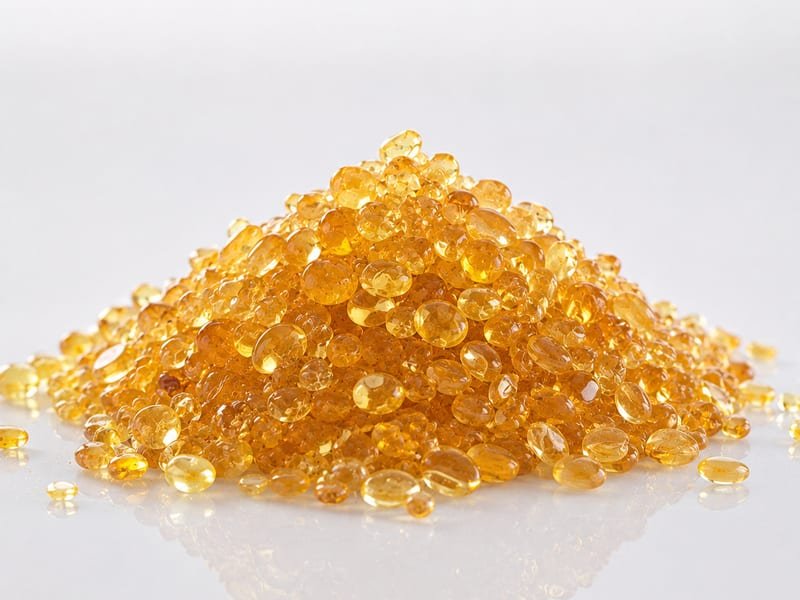
A procurement team qualifying a hot-melt or pressure-sensitive adhesive rarely specifies tackifier color and odor as a headline requirement — until a lighter-colored label stock or a fragrance-sensitive product line starts rejecting shipments that pass every mechanical test. Color and odor drift in tackifiers is a real, measurable batch-consistency problem, not a cosmetic afterthought, and it traces back to specific, well-documented chemistry rather than random supplier variability.
Root Causes
Rosin-based tackifiers (gum rosin, wood rosin, and tall oil rosin esters) are complex mixtures of abietic-type and pimaric-type resin acids, and those acids contain conjugated double bonds that are inherently reactive toward oxygen and UV light. Industry literature on rosin ester chemistry documents that this unsaturation is the source of the color instability early, unmodified rosin tackifiers became known for: exposure to oxygen, heat, and light drives further conjugation and oxidation of the resin acids, which darkens the material and is understood as the mechanism behind color drift in storage and in-service aging. The same reactive sites are also linked to the development of resinous, slightly acrid odor notes as the rosin acids oxidize, distinct from the odor of the fresh material.
Because rosin is a natural product derived from pine sources (gum, wood, or crude tall oil from kraft pulping), the starting resin-acid composition and pre-existing oxidation state already vary by feedstock lot before any esterification or hydrogenation step is applied. Hydrocarbon tackifiers (C5 aliphatic, C9 aromatic, and DCPD-based resins built from steam-cracker co-product streams) have a different but parallel exposure: residual unsaturation and trace aromatic content left over from the polymerization step affect both color and the characteristic hydrocarbon odor of the finished resin, and how thoroughly that resin is hydrogenated afterward determines how much of that reactivity remains.
What This Means for Raw Material Selection
The practical control point is hydrogenation and esterification level, not just nominal resin type. Industry technical sources on rosin ester formulation report that hydrogenated rosin derivatives show significantly improved color stability, UV resistance, and reduced odor development compared with unmodified or partially modified rosin esters, because hydrogenation removes much of the reactive unsaturation responsible for oxidative darkening — a real chemistry-level distinction, not a marketing grade name. The same logic applies to hydrocarbon resins: more fully hydrogenated grades are documented as offering better aging resistance and can be produced nearly colorless, versus less-hydrogenated grades that retain more color and odor potential.
Color itself is not a subjective call — it is graded on the Gardner color scale (ASTM D6166 for instrumental determination, ASTM D8515 for rosin in solution), a numeric scale running from 1 (lightest) to 18 (darkest amber-brown), which means a buyer can specify and verify a maximum Gardner value per shipment rather than relying on visual inspection against a prior batch. For a buyer, the actionable takeaway is twofold: confirm the hydrogenation/esterification grade behind a given tackifier product name rather than treating “rosin ester” or “hydrocarbon resin” as a single undifferentiated category, and require Gardner color data (and, where odor is process-critical — fragranced hygiene products, food-adjacent packaging tapes — supplier odor specification) against a stated maximum per lot, since color and odor variation between shipments is the visible symptom of underlying oxidation-state differences that a mechanical spec sheet alone will not catch.
Sources: ASTM D6166, Standard Test Method for Color of Pine Chemicals and Related Products (Instrumental Determination of Gardner Color); ASTM D8515, Standard Test Method for Color of Rosin in Solution (Instrumental Determination of Gardner Color); “A sustainable approach to produce light-colored rosin and rosin esters during processing using natural antioxidants,” ScienceDirect, 2025; “Using Hydrogenated Rosin Resins to Optimize Adhesive Formulations,” Adhesives & Sealants Industry; general tackifier industry literature (SpecialChem, Kuraray Elastomer) on hydrogenation and hydrocarbon resin feedstock chemistry.