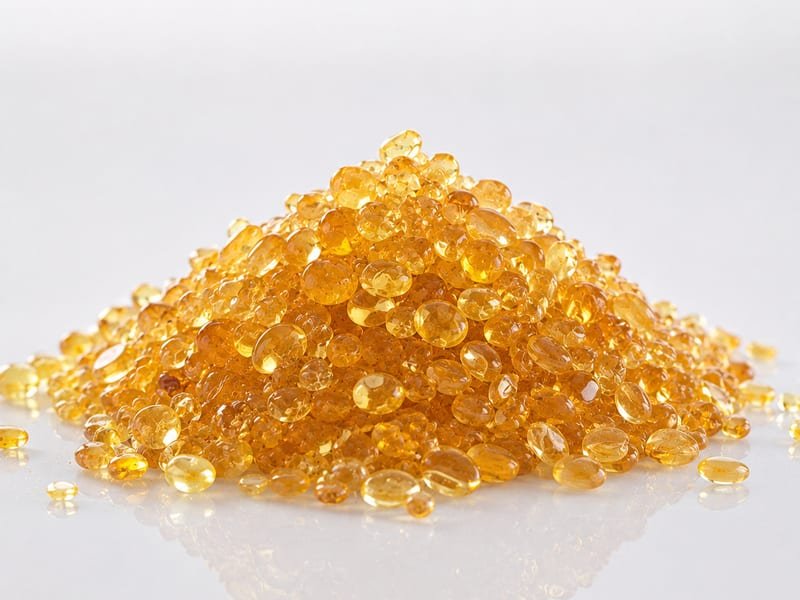
Hot-melt adhesive lines are built around a specific processing window, and the tackifier’s softening point is one of the parameters that window is designed around. A buyer who searches for “tackifier softening point consistency” after a run of application-temperature problems has usually already discovered that a resin passing its nominal spec on paper can still drift enough between lots to change how the adhesive behaves at the coating head.
Root Causes
Softening point in rosin- and hydrocarbon-based tackifiers is a function of average molecular weight and molecular weight distribution, not a fixed physical constant of the resin type — it is measured, not simply stated, using the ring-and-ball method under ASTM E28, the standard test method for softening point of resins derived from pine chemicals and hydrocarbons. Because these resins are complex mixtures rather than single compounds, they do not melt sharply at one temperature; the ring-and-ball value is the temperature at which a ball, resting on a resin disc suspended in a ring, causes the softened resin to sag a defined distance, which is a practical, standardized proxy for the resin’s real-world flow behavior rather than a true melting point.
That average molecular weight, and therefore softening point, depends on how tightly the polymerization or esterification reaction is controlled during manufacture. Feedstock variability (in rosin acid composition for rosin esters, or in the C5/C9 monomer stream for hydrocarbon resins) and normal batch-to-batch process variation both shift the resulting molecular weight distribution slightly, which shows up downstream as a softening point that sits within, but moves around inside, the nominal grade range — commonly specified in adhesive formulation literature in bands such as 70-150°C, with narrower bands like 95-110°C common for hot-melt PSA-grade resins.
What This Means for Raw Material Selection
A softening point that drifts even a few degrees within its nominal range changes the resin’s melt viscosity and flow behavior at a given application temperature, which is why hot-melt lines running close to their process limits are the first to see the effect — as coating weight variation, stringing, or incomplete wet-out — even when every incoming lot technically passes its certificate of analysis. Because ASTM E28 is a standardized, repeatable test, it gives a buyer a concrete verification tool rather than a trust-based spec: requesting the actual ring-and-ball result per lot (not just confirmation that it falls “within range”) lets a formulator see how much room a given supplier’s process leaves before quietly re-optimizing around a resin that has moved to one edge of its stated band.
For a buyer sourcing tackifiers for a hot-melt or PSA line with a narrow operating window, the practical control points are: specify the softening point range tightly enough to match the actual process window rather than accepting a wide nominal grade band, request ASTM E28 data with each shipment rather than a pass/fail attestation, and treat softening point consistency — not just the nominal grade number — as a supplier qualification criterion, since two resins with the same stated grade can carry materially different amounts of real-world lot-to-lot variation depending on how tightly the upstream process is controlled.
Sources: ASTM E28, Standard Test Methods for Softening Point of Resins Derived from Pine Chemicals and Hydrocarbons, by Ring-and-Ball Apparatus; general hot-melt and pressure-sensitive adhesive formulation literature (SpecialChem, “Selecting Tackifiers for Adhesives and Sealants”) on tackifying resin softening point grade ranges and their role in processing.