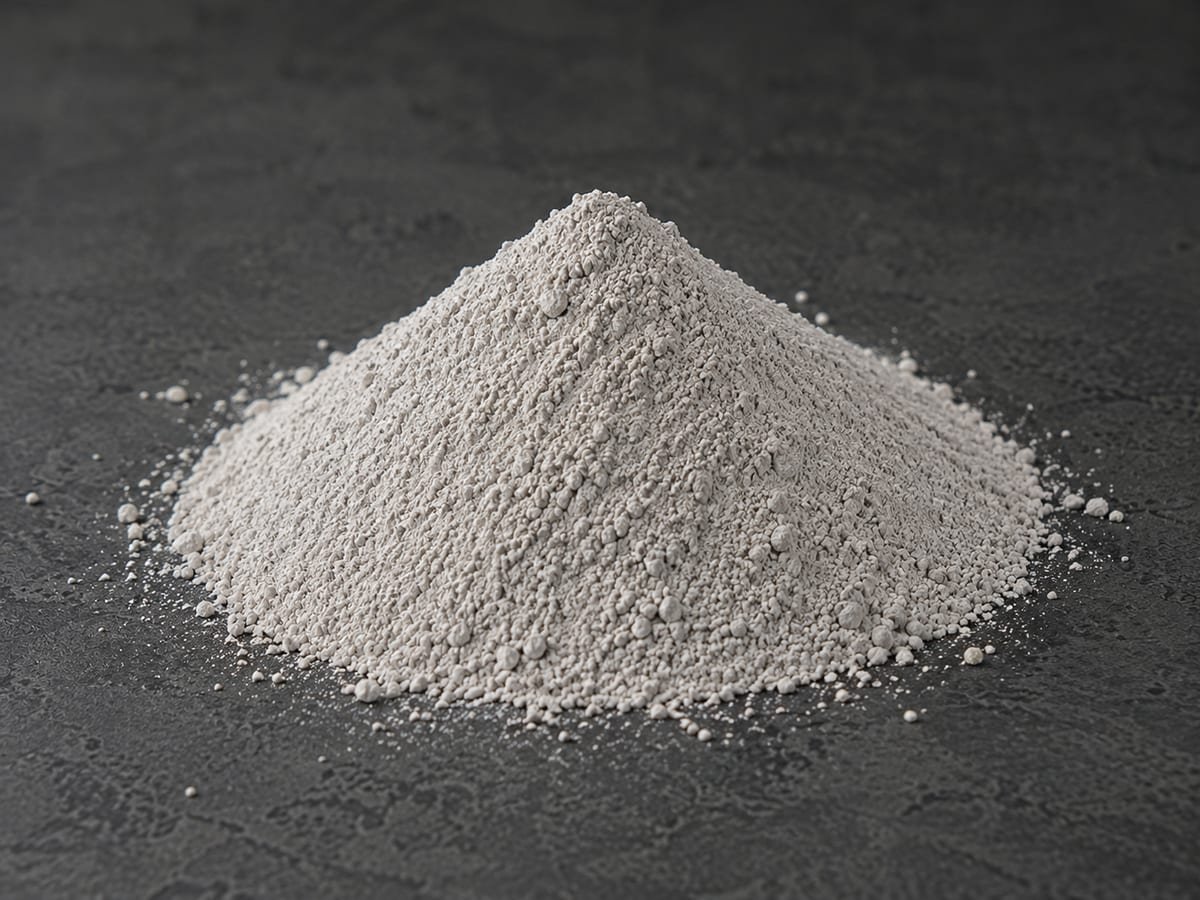
Finely ground agricultural dolomite is bought specifically for its reactive fine fraction — the particle sizes that dissolve and neutralize soil acidity within a single season — but that same fine, high-surface-area material is the fraction most prone to caking into hardened lumps during bulk storage, degrading flowability and spreader dosing accuracy before it ever reaches the field.
Root Causes
Caking in granular and powdered mineral products is driven primarily by moisture rather than by the material’s chemistry alone. Peer-reviewed reviews of caking in industrial mineral and fertilizer products describe the mechanism as moisture absorption leading to localized dissolution at particle contact points, followed by recrystallization as conditions change — effectively welding adjacent particles together into bridges. Each material has a critical relative humidity above which it begins absorbing moisture from the surrounding air; above that threshold, caking risk rises sharply with storage time, compaction pressure from stacked bags or silo depth, and temperature cycling.
Fine agricultural dolomite is more exposed to this mechanism than coarse aggregate-grade material precisely because its reactive fine fraction has more surface area and more particle-to-particle contact points per unit volume — the same property that makes it agronomically effective also makes it more susceptible to moisture-driven bridging in storage.
What This Means for Raw Material Selection
For a buyer, caking risk is a storage and handling specification issue, not just a supplier quality issue. Moisture content at the point of loading, packaging integrity during transit and storage (particularly under high-humidity Gulf coastal conditions), and warehouse humidity control all interact with the fine particle size that gives the product its agronomic value in the first place. A shipment can meet its CCE and fineness specification at the point of dispatch and still arrive caked if storage conditions along the supply chain allowed moisture uptake.
The practical implication is to treat moisture content as a tracked receiving specification alongside CCE and fineness, not an afterthought, and to size storage and bagging for the actual humidity conditions the product will sit in — since caked material has to be re-processed or under-doses through a spreader calibrated for free-flowing lime, undermining the same particle-size specification the buyer paid for.
Sources: peer-reviewed literature review, “Understanding Caking Phenomena in Industrial Fertilizers: A Review”; International Fertilizer Association (IFA), technical conference proceedings on physical quality of fertilizers, Marrakech, 1998; general mineral and fertilizer handling literature on critical relative humidity and moisture-driven particle bridging.