
Matting Agents (Paint & Coating Chemicals)
How matting agents reduce gloss by roughening a coating's surface at microscopic scale, and why oversized particles can compromise film integrity instead of improving the matte effect.
Overview
Achieving a deep matte finish isn’t simply a matter of using bigger particles to rough up the surface more — research on silica matting agents shows there’s a real limit where bigger stops being better and starts threatening the coating film itself.
What is it?
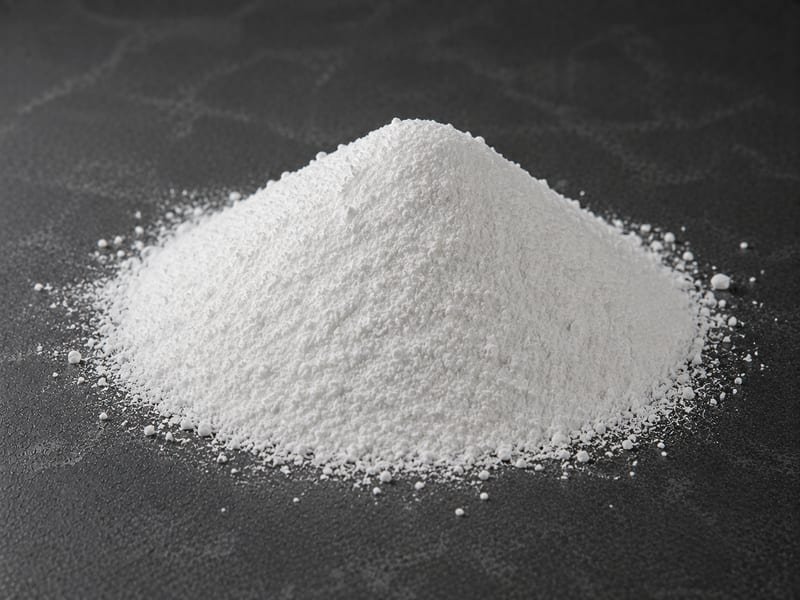
Matting agents are additives used to reduce the gloss of a paint or coating, giving it a flat or satin appearance instead of a shiny one. The industry-standard way of quantifying gloss is ASTM D523, which measures specular gloss on nonmetallic surfaces at defined angles (60°, 20°, and 85°) by comparing a specimen’s specular reflectance to that of a black glass standard — correlating with how shiny a surface visually appears at roughly the corresponding viewing angle.
Why should I use it?
- A well-chosen matting agent can reduce gloss to a specific, targeted level rather than an all-or-nothing effect — see “How it’s used.”
- Using larger particles for a stronger matte effect has a real limit — beyond a certain point it risks the coating film itself — see Limitations.
How it’s used
Per a 2026 peer-reviewed review, a matte appearance results from microscale surface roughness that scatters light diffusely instead of reflecting it in one direction, and the resulting gloss level depends on the matting agent’s particle size and its particle volume concentration (PVC) in the formulation. Concrete examples from the review illustrate the range achievable: silica modified with amino-silane (around 6.1 μm particles) achieved a gloss below 5 units at 60°, while silica modified with acrylate (12.9 μm particles) achieved 13.6 gloss units at 60° — demonstrating that both particle chemistry and size shift the achievable gloss level.
Limitations — when it isn’t the right choice
- Making particles bigger to push gloss lower isn’t free — past a certain size, it can compromise the coating film itself. The same review notes that larger particles increase surface roughness (and so reduce gloss further), but explicitly cautions that “excessively large particles can compromise film integrity.” This means matting agent selection isn’t simply “use the biggest particle available for the flattest finish” — the particle size needs to stay within a range the film can structurally tolerate. The review also found that loadings of 3-10% of modified silica delivered better matting efficiency than some commercial agents, indicating that dosage, not just particle size, is part of getting the balance right. Because this review draws on data from several different silica surface-modification chemistries (amino-silane, acrylate, HMDS) rather than one single controlled comparison, the exact particle size or loading needed for a specific target gloss level would need separate, formulation-specific verification.
Key Applications
The material's role changes by industry — click any industry to see its full page.

Standards & Technical References
Every claim on this page traces back to a verifiable reference:
- Tier 1Industry StandardASTM D523-25 — Standard Test Method for Specular Gloss
- Tier 2University/ResearchRecent Progress in Organically Modified Silica and Self-Matting Polymers for Coating Applications, Gharami & Patil, Sustainable Polymer & Energy, 2026, Vol. 4, Issue 1
Related Materials


