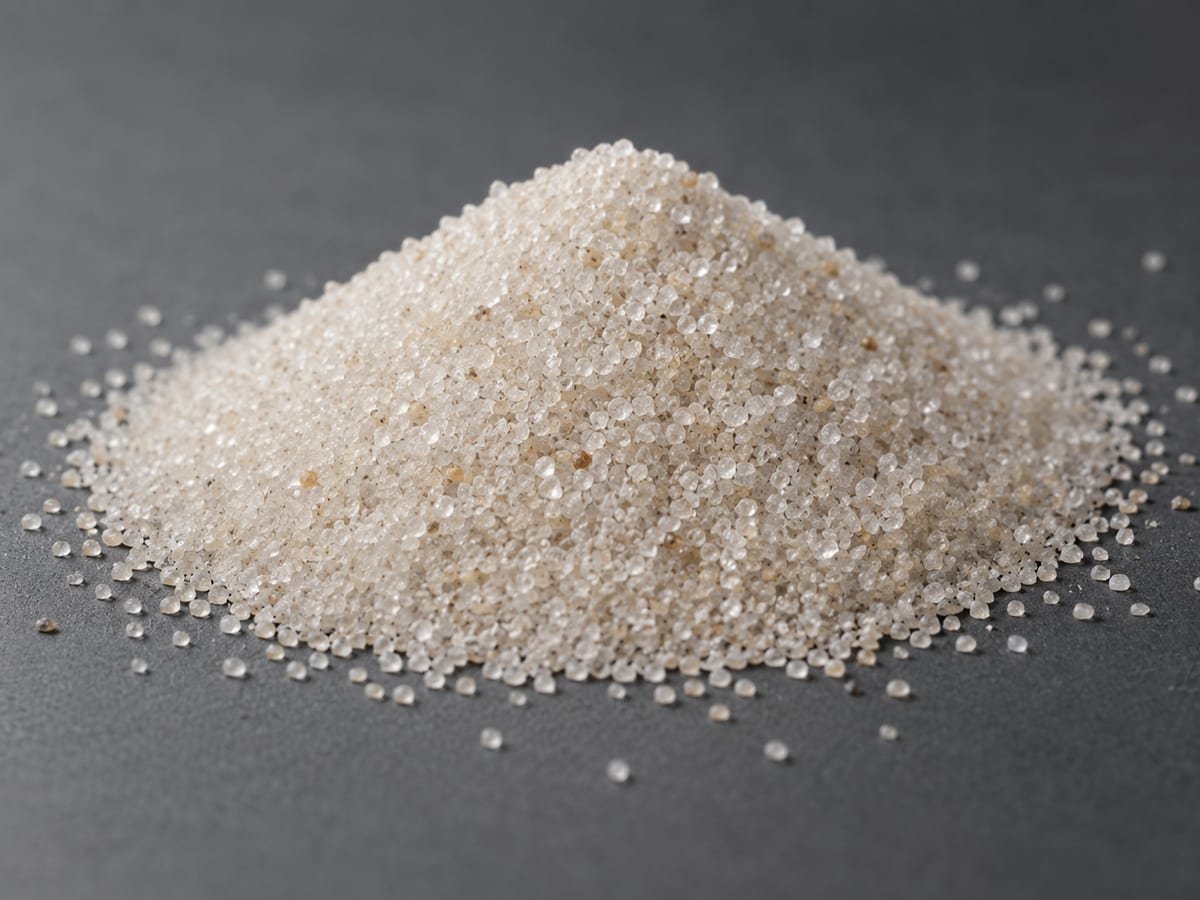
Proppant sand only does its job if the fracture it holds open stays permeable years after the frac crew leaves the site. That depends on two properties working together — a particle-size distribution tight enough to pack into a stable, permeable bed, and enough crush strength to resist breaking down under the closure stress the formation applies once pumping stops. A shipment can pass a basic purity or hardness check and still perform poorly downhole if either property is out of spec.
Root Causes
API RP 19C and ISO 13503-2 govern how proppant sand is classified and tested, and both start with sieve analysis. Proppant is sold under mesh designations — 20/40, 30/50, 40/70, 100-mesh and similar — and the standards require at least 90% of a sample to fall within the primary sieve range for its designation, with tight limits on oversize and undersize material. Distribution matters because it sets the porosity and pore-throat size of the proppant pack once the fracture closes on the sand: a batch skewed toward fines reduces pack permeability directly, while a batch with excess oversize grains raises the risk of bridging and screen-out during the pumping job itself.
Crush resistance is tested by loading a sieved, single-size-class sample into a crush cell and applying a fixed closure stress — commonly evaluated at graduated levels from around 4,000 psi up through 12,000+ psi depending on the intended well depth — then re-sieving to measure how much fine material was generated. A K-value or crush-resistance rating reflects the highest stress at which fines generation stays under the standard’s threshold (commonly cited around 10% by weight). Grain shape drives this result as much as mineral hardness does: API 19C and ISO 13503-2 both require sphericity and roundness scores of at least 0.6 on the Krumbein-Sloss visual comparison chart, because angular, poorly rounded grains concentrate stress at sharp contact points and shatter at lower closure stress than well-rounded grains of the same quartz composition. Two sands with identical Mohs hardness can carry meaningfully different crush ratings if one is naturally more rounded than the other.
What This Means for Raw Material Selection
Because sieve distribution and crush resistance depend on the source deposit’s natural grain shape and sorting, not just on being “silica sand,” a certificate of analysis needs to report both independently rather than a single hardness or purity figure. The practical specification points are: confirmed sieve distribution against the target mesh designation with the ≥90% primary-fraction requirement; sphericity and roundness scores at or above the 0.6 API 19C/ISO 13503-2 threshold; and crush-resistance (K-value) data measured at a closure stress that matches or exceeds the actual downhole stress the well will apply, not a generic industry-average figure.
This also affects sourcing decisions. Naturally well-rounded, well-sorted deposits — historically Northern White sands from the Upper Midwest — have supplied high sphericity and crush ratings at standard frac-sand cost, while some regional or in-basin deposits produce more angular grains that meet mesh-size specs on a sieve stack but carry a lower usable crush rating for the same closure stress. Fitness for a specific well is a function of matching the crush-resistance data on the certificate to the formation’s actual closure stress, not assuming any API-compliant proppant sand is interchangeable with any other.
Sources: API Recommended Practice 19C, Measurement of Properties of Proppants Used in Hydraulic Fracturing and Gravel-Packing Operations; ISO 13503-2, Measurement and Reporting of Proppant Properties; SPE and industry technical literature on proppant crush resistance, fines generation, and proppant pack conductivity.