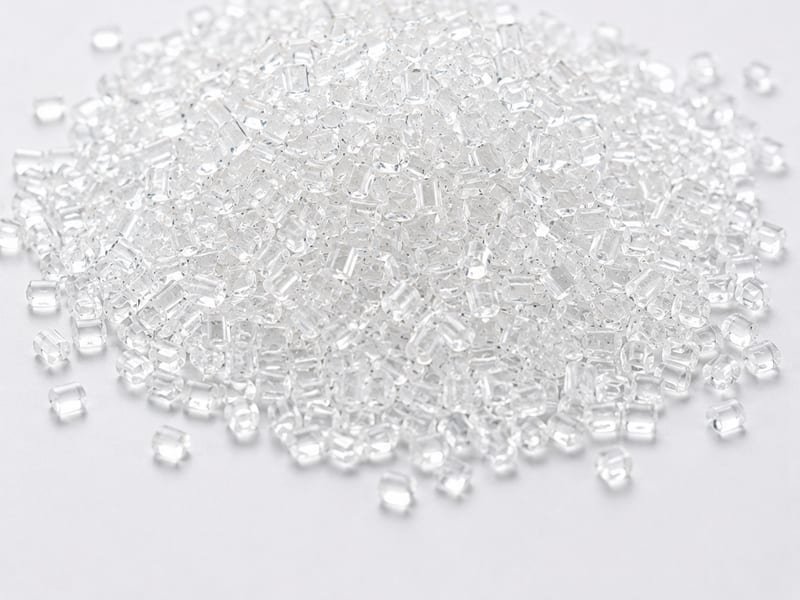
Uneven yarn, unexpected breakage on the spinning line, and patchy dye uptake often trace back to a single measurable property of the PET chip that fed the line — intrinsic viscosity — rather than to the spinning process itself.
Root Causes
Intrinsic viscosity (IV) is documented as a direct measure of the polymer’s molecular weight, and because molecular weight governs melting point, crystallinity, and tensile strength, IV serves as the practical, testable proxy for overall PET quality and the basis for setting spinning process conditions. Fiber-grade polyester chip intrinsic viscosity is typically documented around 0.645 dl/g as a baseline, but PET specifically optimized for textile spinning runs higher, in the roughly 0.72-0.98 dl/g range, with specialized high-speed spinning applications using polymer in the 0.8-1.5 dl/g range.
IV’s effect on the spinning process itself is direct and consequential: intrinsic viscosity affects the stability of the spinning operation, the uniformity of the resulting filament yarn, and the evenness of dyeing — and if IV is too low, the stretching (drawing) step during spinning becomes difficult or the polymer becomes effectively non-spinnable, leading to breakage on the line. Because IV directly affects molecular chain length and the mechanical strength of the final fiber, drawn fiber and technical applications like tire cord specifically use higher-IV polymer to achieve the tenacity those applications require — meaning IV isn’t just a quality-consistency parameter but a functional specification that should match the end application.
What This Means for Raw Material Selection
Because IV is a single measurable number that predicts spinning stability, yarn uniformity, and dyeing evenness all at once, it functions as the practical quality-control checkpoint for incoming PET chip — a lot testing out of the target IV range is a documented predictor of exactly the downstream problems (breakage, unevenness, uneven dye uptake) a spinner would otherwise diagnose after the fact.
The practical points for a buyer are: specify and verify IV per lot against the target range for the intended application (roughly 0.72-0.98 dl/g for general textile spinning, higher for high-speed or technical fiber applications), not just a generic “fiber-grade PET” designation, since the standard 0.645 dl/g baseline is documented as a different specification tier than textile-spinning-optimized grades; treat an out-of-range IV reading as a leading indicator to act on before a spinning run, given the documented link between low IV and non-spinnability or breakage; and match IV grade to the specific downstream use, since technical applications like tire cord are documented as requiring higher IV for tenacity than general apparel-fiber spinning needs.
Sources: AZoM technical article on the importance of intrinsic viscosity measurement throughout the PET supply chain; PatSnap Eureka technical report on polyester fiber grade molecular engineering and processing parameters; USPTO patent literature on polyester fiber preparation methods and tire cord applications documenting intrinsic viscosity ranges and their effect on spinning and mechanical properties.