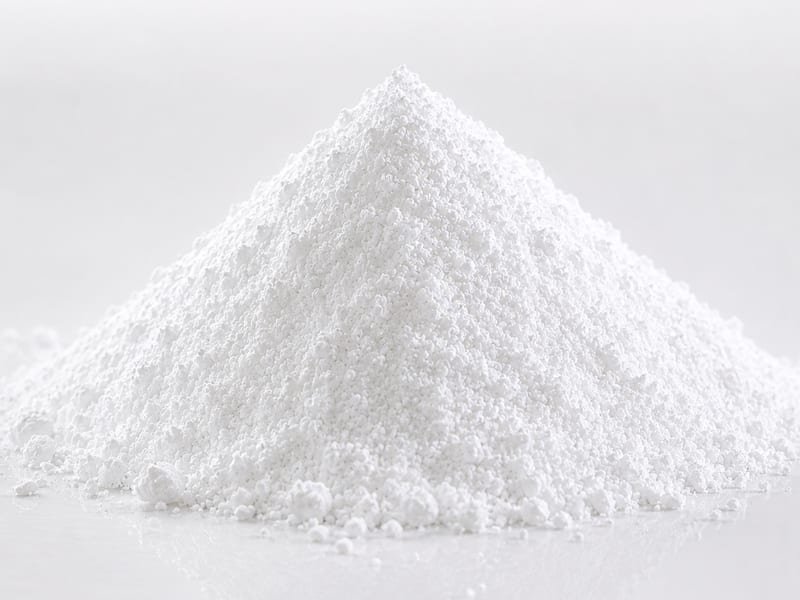
Synthetic fibers like polyester and nylon are naturally glossy, and titanium dioxide (TiO₂) is added specifically to scatter light within the fiber and reduce that shine to a target matte level. But two fiber batches dosed with the same nominal TiO₂ percentage can still come off the line with visibly different degrees of matting — because dosage alone doesn’t determine delustering outcome; particle size and dispersion quality do.
Root Causes
TiO₂’s delustering effect works by light scattering: particles embedded in the fiber interrupt the path of light passing through it, and the degree of matting scales with dosage in documented ranges — roughly 0.1-0.3% TiO₂ by weight produces semi-dull fiber, while 0.5-2.5% produces full-dull fiber. This dosage relationship is well established, but it assumes the TiO₂ is actually delivering its full scattering potential per particle, which depends on two further variables.
Particle size is the first: fiber-grade TiO₂ is specified in a fine range, commonly cited around 0.2-0.3 microns, because this size scatters visible light effectively without particles being large enough to weaken the fiber structurally. Dispersion quality is the second, and arguably the more variable one in practice: TiO₂ must be ground and thoroughly dispersed before spinning, because poorly dispersed particles clump instead of distributing evenly through the fiber matrix. Uneven dispersion produces two documented consequences — inconsistent delustering effect (visibly patchy or variable matting rather than uniform), and, more seriously, increased yarn hairiness and breakage risk during spinning, since agglomerated TiO₂ particles create structural weak points the fiber wasn’t designed around.
Because dosage, particle size, and dispersion quality are three separate variables that all affect the same visible outcome, batch-to-batch consistency in delustering depends on holding all three steady — a shipment can carry the correct nominal TiO₂ percentage and still produce inconsistent matting if particle size drifts or dispersion quality varies between lots.
What This Means for Raw Material Selection
For a buyer specifying TiO₂ for fiber delustering, dosage percentage alone is not a sufficient purchasing specification. The practical control points are: confirm the grade’s particle size falls within the range validated for fiber applications (fine enough for effective scattering without compromising fiber strength), and confirm the grade is a fiber-specific TiO₂ product engineered and pre-treated for dispersion in polyester or nylon melt, rather than a general-purpose pigment grade assumed to perform equivalently.
Because dispersion quality directly affects both visual matting consistency and spinning-process reliability (hairiness, breakage), verifying dispersion behavior — not just the certificate’s nominal dosage and particle size numbers — before committing to full production volume is the practical safeguard against a batch that looks correct on paper but underperforms on the spinning line or produces visibly inconsistent matte finish across a run.
Sources: general chemical fiber and titanium dioxide industry technical literature on TiO₂ dosage-to-matting-level relationships in polyester and nylon fiber (fiber-grade TiO₂ producer technical documentation); general textile fiber manufacturing literature on TiO₂ particle size, grinding, and dispersion requirements and their effect on delustering uniformity and yarn spinning performance.