
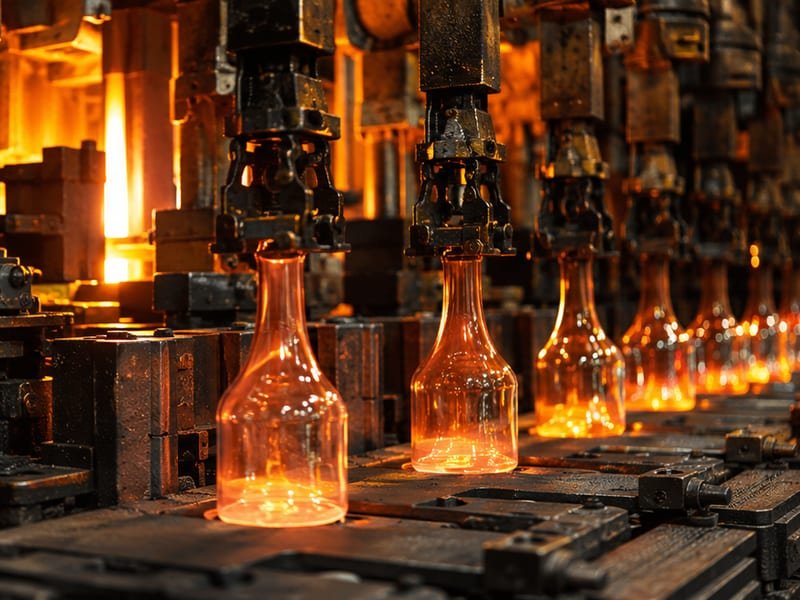
A glass furnace’s refractory lining is expected to survive a continuous campaign of several years at temperatures approaching 1,600°C in direct contact with molten glass; when it wears or corrodes faster than expected, the consequences are twofold — shortened, costlier furnace campaigns, and shed refractory material contaminating the melt as stones or compositional defects in the finished glass.
Root Causes
Refractory degradation in a glass tank is driven by a combination of chemical, thermal, and mechanical stresses acting together, not any single mechanism in isolation. In the glass-contact zone — sidewalls, throat, and dam blocks — fused-cast alumina-zirconia-silica (AZS) refractories are widely used because of their corrosion resistance, with higher zirconia content generally improving resistance to attack by the melt; even so, prolonged glass contact causes progressive dissolution of the refractory’s silica-rich matrix, with the most severe attack typically occurring near the glass line. In the furnace superstructure, silica brick is common for its high-temperature mechanical properties, but fused-cast AZS is sometimes used there too, and it carries a known drawback: exudation of a glass-forming phase from the refractory that drops into the melt and shows up as stones or striped defects in the product.
The regenerator section — where waste heat is recovered through refractory checker brick — has its own distinct wear mechanism. Magnesia-chrome brick is commonly specified there for its resistance to alkali vapor and chemical attack, but in the mid-temperature condensing zone (roughly 800-1,100°C), alkaline sulfates carried in the flue gas repeatedly condense and re-vaporize on the brick surface, penetrating it and causing powdering and spalling over time — a chemical wear mode distinct from the glass-contact corrosion happening elsewhere in the same furnace.
Underlying all of this, the refractory’s own manufacturing quality matters: how completely a magnesia refractory has been calcined and densified affects its resistance to slag and melt infiltration, and calcination behavior itself depends on the crystal structure of the source magnesite — different natural magnesite deposits (for example, macrocrystalline versus cryptocrystalline ore) show measurably different decomposition temperatures during calcination, meaning a process and product tuned for one ore source doesn’t automatically transfer to another without requalification.
What This Means for Raw Material Selection
This is the one challenge on this list where the connection to a specific PLAXRAW material is direct rather than incidental: magnesite is the raw material calcined into the dead-burned or fused magnesia used to make refractory brick for glass furnace linings, including the regenerator checkers most exposed to alkaline sulfate attack. Magnesite is not a batch ingredient here — it never enters the melt as a raw material — but the quality of the refractory made from it directly determines both furnace campaign life and how much refractory material ends up contaminating the melt as it wears.
Because calcination behavior and resulting refractory density are tied to the specific magnesite ore’s crystal structure and purity, buyers specifying refractory-grade magnesia should confirm it against the intended furnace zone’s actual exposure conditions (glass contact versus regenerator, alkali versus sulfate versus mechanical stress) rather than assuming a single magnesia grade performs identically across every zone of the furnace.