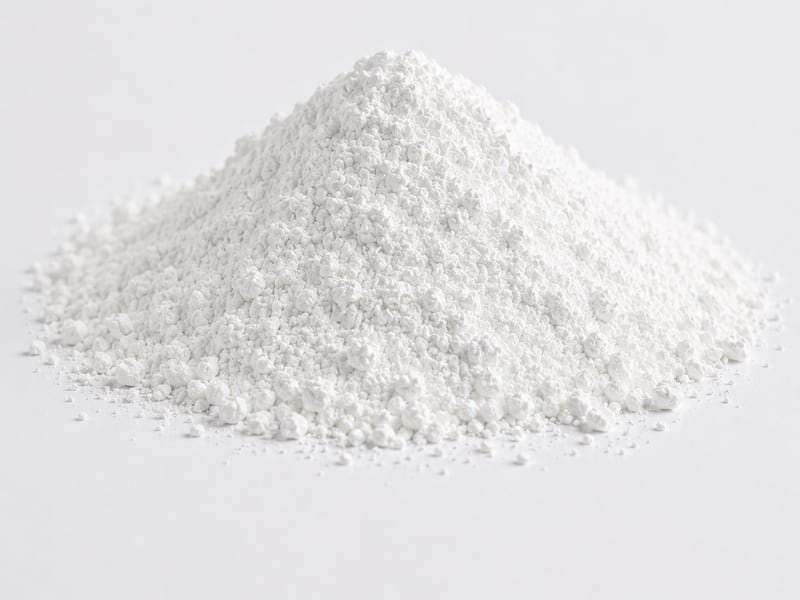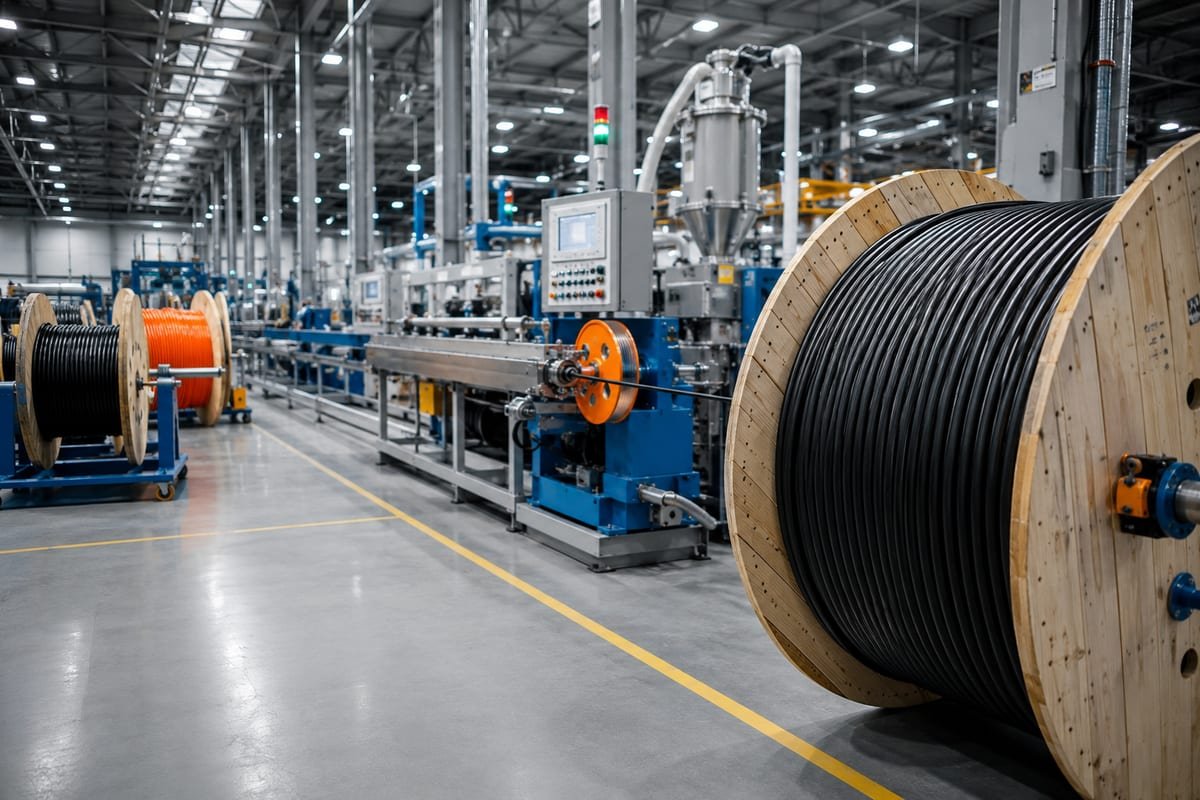
Aluminum trihydroxide (ATH) is added to cable compounds at high loading levels to meet flame-retardancy targets, but two ATH grades at the same loading and the same nominal chemistry can behave very differently on the extrusion line and in the finished insulation — because particle size and surface treatment, not just how much ATH is in the formula, govern both dispersion quality and flame performance.
Root Causes
ATH works as a flame retardant through thermal decomposition: heated above roughly 200°C, aluminum hydroxide breaks down endothermically into aluminum oxide and water vapor, a reaction that absorbs heat from the ignition source while the released water vapor cools the polymer surface and dilutes flammable gases. This mechanism is why ATH loadings in cable compounds are typically high — commonly in the range where ATH makes up a large share of the formulation by weight — since flame performance scales with how much decomposable material is present per unit volume.
Commercial ATH grades span a wide particle size range, roughly 0.5 to 80 microns median particle size (D50) depending on grade and intended application, and cable/wire covering compounds specifically call for finer material — grades built for electric wire and cable applications are commonly specified in the 0.5-2.5 micron D50 range with a BET specific surface area around 2.5-10 m²/g. Finer particle size increases the surface area available for the decomposition reaction and generally improves dispersion at high loading, but it also raises melt viscosity and can complicate extrusion processing if the resin system isn’t formulated to accommodate it — a genuine trade-off between flame performance and processability, not a case where finer is simply better.
Surface treatment addresses a separate problem: untreated ATH’s hydrophilic surface is poorly compatible with non-polar polyolefin resins used in many cable compounds, which limits how much can be loaded before mechanical properties and processability degrade. Documented surface treatment routes include fatty acid coating, phosphoric acid treatment, and titanate coupling, each altering surface polarity to improve resin compatibility and dispersion; phosphate treatment specifically is reported as the preferred route where electrical insulating performance is the priority, because it interferes less with the compound’s dielectric properties than some fatty-acid treatments can.
What This Means for Raw Material Selection
Because particle size and surface treatment affect different aspects of compound performance — size drives decomposition surface area, melt viscosity, and dispersion behavior; surface treatment drives resin compatibility and, for insulating applications, dielectric integrity — an ATH grade cannot be specified on flame-retardant loading percentage alone. A cable compound formulated and validated around one ATH grade’s particle size distribution and surface treatment cannot be assumed to perform equivalently with a substituted grade at the same nominal loading, even if both pass a general “ATH” description.
For a buyer, the practical specification points are: confirm D50 particle size and BET surface area for the specific grade against what the formulation was developed and tested with, not just a generic size range; confirm whether the grade is surface-treated and with which chemistry (fatty acid, phosphate, titanate), since this determines both dispersion at high loading and, for insulation-grade compounds, dielectric performance; and re-validate flame and mechanical performance whenever switching ATH grade or supplier, since particle size and surface chemistry differences that don’t show up in a bulk chemical assay can still measurably shift extrusion behavior and finished-cable performance.
Sources: peer-reviewed and industry technical literature on ATH thermal decomposition mechanism and flame-retardant loading in polymer compounds; Huber Advanced Materials and Wire Association International (WAI) technical references on metal hydroxide flame retardants for wire and cable; Pinfa (Phosphorus, Inorganic and Nitrogen Flame Retardants Association) technical documentation on aluminium tri-hydroxide; peer-reviewed literature on ATH surface modification (fatty acid, phosphate, titanate treatments) and its effect on polymer compound dispersion and dielectric properties.