Silo caking and clogged hoppers are usually blamed on humidity alone, but the mineral doing the anti-caking work in the ration matters just as much — and not every mineral performs the same job the same way.
Root Causes
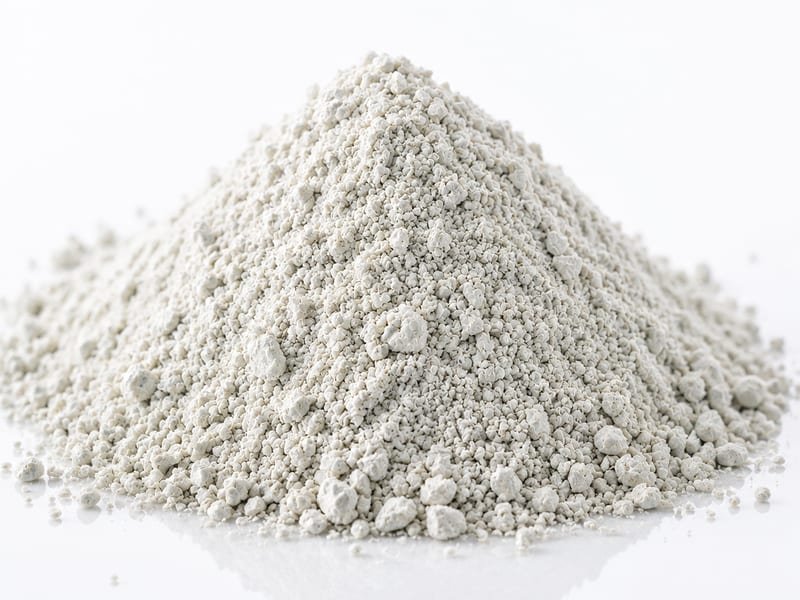
Zeolite functions in feed and storage applications as a flow agent and anti-caking treatment specifically because of its adsorption mechanism: it acts as a sponge that absorbs liquids while gases and suspended matter adhere to the surface of its internal pores, actively drying the material it’s mixed into rather than simply diluting the moisture problem. This drying effect is documented as measurably superior to alternatives in controlled testing: in accelerated caking tests, zeolite-bicarbonate compounds showed superior anti-caking performance specifically attributed to zeolite’s drying effect, and in flowability scoring (1 = free flowing, 10 = badly bridged) zeolite-treated material scored 4.0 compared with 6.0 for an untreated control and 5.5 for calcium carbonate — a documented, ranked performance difference between minerals rather than a uniform anti-caking effect across any mineral additive.
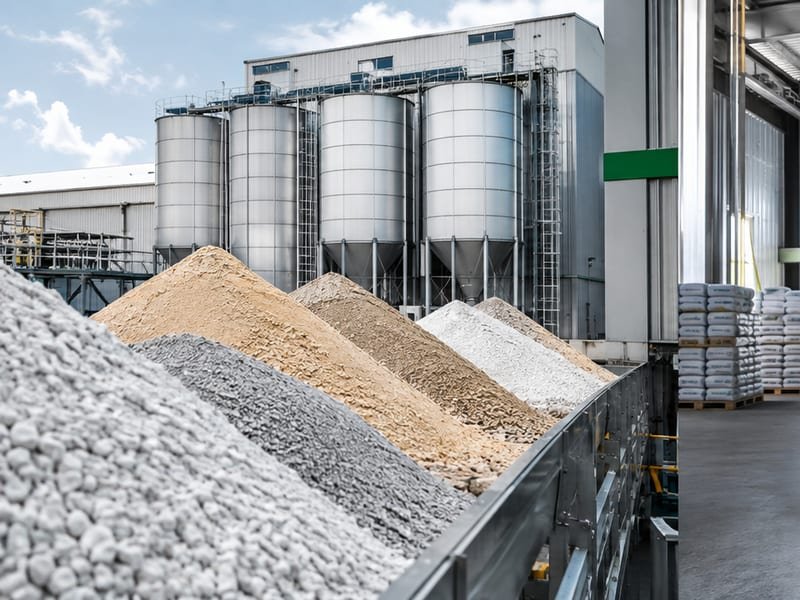
Moisture content itself remains the dominant variable regardless of which anti-caking mineral is used: moisture content at the time of loading was documented as the single most important predictor of flow rate, explaining roughly 70% of the variation in flowability — meaning the anti-caking mineral improves the picture but doesn’t override the underlying moisture problem if incoming material is already wet. Storage silos are documented as experiencing a specific set of flow failures — arching, ratholing, caking, and segregation — with moisture content and fine particles both significantly increasing the cohesive strength that drives these failures.
What This Means for Raw Material Selection
Because zeolite’s anti-caking performance is measurably better than calcium carbonate’s in the documented flowability comparison, but moisture content still accounts for the majority of flow-behavior variation, mineral selection and moisture control need to be addressed together rather than treating either alone as sufficient.
The practical points for a buyer are: select zeolite specifically over calcium carbonate when anti-caking and flowability performance is the priority for a given application, given the documented flowability score advantage (4.0 versus 5.5); don’t treat an anti-caking mineral as a substitute for controlling incoming moisture content, since moisture at loading is documented as explaining roughly 70% of flow-rate variation — the mineral improves the margin, it doesn’t eliminate the underlying variable; and diagnose specific silo flow failures (arching, ratholing, caking, segregation) against both moisture content and fine-particle fraction together, since the documented literature ties cohesive strength — the root cause of these failures — to both factors acting in combination, not either alone.
Sources: KMI Zeolite technical literature on zeolite’s role as a flow agent and odor-control mechanism in feed and bedding applications; ScienceDirect peer-reviewed research on zeolite anti-caking effects studied by 1H low-field NMR; National Hog Farmer and University of Minnesota Extension technical articles on DDGS flowability testing comparing zeolite, calcium carbonate, and control treatments, and on moisture content’s role in flow rate; general bulk-solids handling technical literature on silo flow failure modes (arching, ratholing, caking, segregation).