
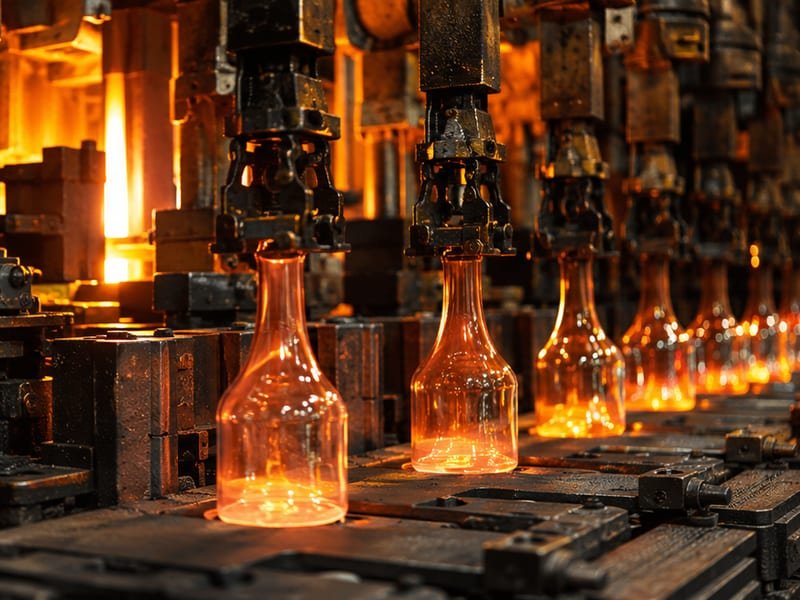
Surface defects — visible stones, wavy cord or ream lines, checks, or embedded particles — reduce the commercial value of glass even when the product is otherwise structurally sound, and in optical, container, and flat-glass applications a defect that fails visual inspection typically means the piece is downgraded or scrapped outright.
Root Causes
Several distinct, well-documented mechanisms produce surface and near-surface defects in glass, and they don’t share a single cause:
- Stones are opaque or partially melted particles of rock, refractory, or unmelted batch material embedded in the glass. They commonly originate either from raw material impurities that survive melting (unmelted or slow-dissolving mineral grains) or from refractory material shed into the melt from furnace walls or superstructure.
- Cord is a region of glass with a composition different from the surrounding bulk, visible as a streak or thread with different optical properties. It results from incomplete homogenization of the melt — caused by raw material composition variation, insufficient fining, melt viscosity that’s too high to allow diffusion to even out, or a cold spot in part of the melting tank.
- Ream, closely related to cord, appears as wavy, transparent lines running through the glass, again reflecting localized composition or density variation that wasn’t fully mixed out before forming.
- Checks are small, shallow surface cracks, typically originating at an edge or a point of mechanical or thermal stress rather than from the melt chemistry itself.
Undissolved sand grains are a specific and well-studied contributor to stones. Dissolution of silica sand grains is generally the slowest step in glass batch melting, and research on glass batch melting has documented that unusually coarse grains can form slowly dissolving clusters that persist well into the melting cycle rather than fully dissolving — leaving behind exactly the kind of unmelted inclusion that shows up as a stone in the finished product. This is why glass-grade silica sand specifications constrain the grain size distribution tightly (typically requiring the large majority of particles between roughly 0.1 and 0.5 mm) rather than simply specifying a minimum SiO₂ purity.
What This Means for Raw Material Selection
Silica sand’s grain size distribution is the raw-material variable most directly tied to stone defects, independent of its chemical purity. A sand that meets SiO₂ and iron oxide specifications on paper can still contribute to stone defects if its grading includes an unusual proportion of oversize particles, because those particles are the ones statistically most likely to survive the melting cycle without fully dissolving. Buyers should specify and verify grain size distribution as its own quality parameter, not assume it’s implied by a chemical assay.
Cord and ream, by contrast, are largely process and homogenization issues rather than raw-material-purity issues in the narrow sense — they point back toward batch mixing consistency, fining agent performance, and furnace temperature uniformity, which is a separate challenge in its own right. Checks are predominantly a downstream handling and annealing issue.
Where stones trace back to shed refractory material rather than raw material, the fix is on the furnace-lining side, not the batch recipe — a related but distinct challenge covered separately.