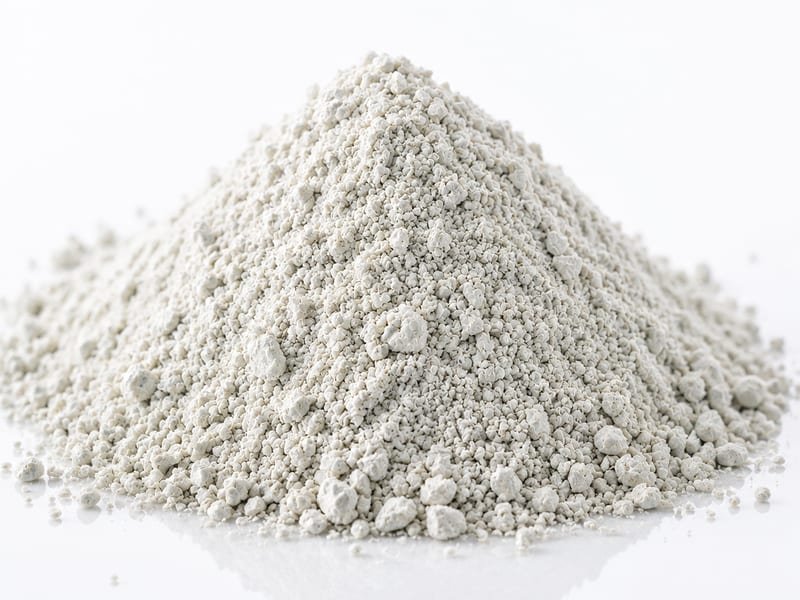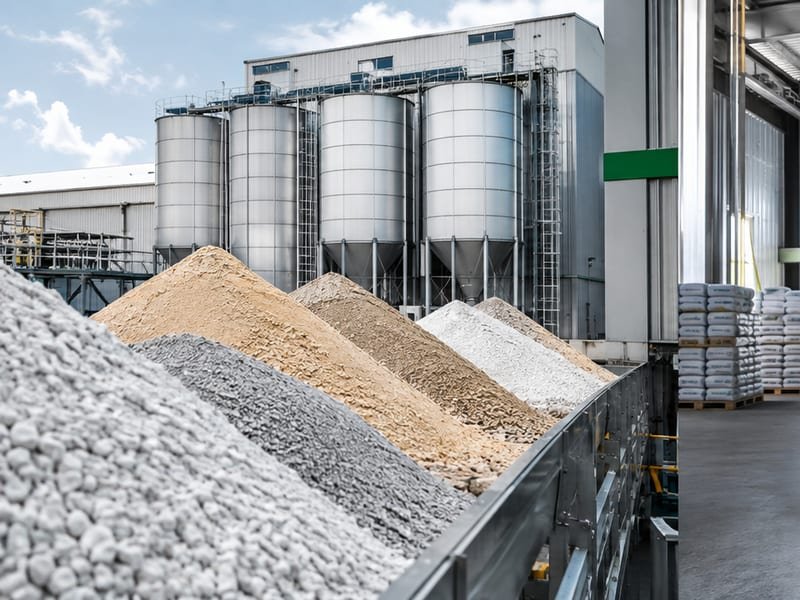
Segregation during transport and poor mixing uniformity at the mill aren’t two separate problems — they’re the same particle-size mismatch showing up at two different points in the supply chain, one at the mixer and one at the truck.
Root Causes
The particle size of calcium carbonate used in feed is documented as needing to be determined relative to the size of the other particles making up the ration: feed ingredient particle sizes must be approximately matched to avoid segregation, while staying fine enough to blend homogeneously but not so fine that it becomes dusty. This matching requirement is why particle size distribution (PSD) matters as much as bulk chemistry — a mineral that’s correctly analyzed for calcium or adsorption capacity can still cause processing problems if its particle size sits outside the range of the grain and protein components it’s blended with.
At the mixing stage, achieving homogeneity depends on matching not just size but effectively density: micro-ingredients are weighed against a carrier material with a density approximating the predominant micro-ingredient, and mixed for a manufacturer-specified duration to reach uniform distribution — a process that assumes the mineral’s particle characteristics are compatible with the carrier and other components from the start. When that compatibility isn’t there, the same mismatch that caused poor initial mixing is documented as reappearing later as segregation: fine mineral powder separating from coarser ration components during subsequent handling and transport, since particles of different size and density naturally sort themselves during vibration and movement rather than staying blended.
What This Means for Raw Material Selection
Because mixing uniformity and transport segregation are driven by the same particle-size-matching requirement, a buyer should treat calcium carbonate and zeolite particle size specification as a single compatibility question against the full ration, not two separate quality checks performed at different stages of production.
The practical points for a buyer are: specify mineral particle size distribution relative to the other ration components actually being blended, not as an isolated spec against a generic target, since the documented matching requirement is comparative rather than absolute; verify that a mineral passing the mill’s initial mixing-uniformity check is genuinely compatible in density as well as size, since density mismatch alone can cause post-mixing segregation even when the mix tests uniform immediately after blending; and treat any segregation complaint discovered during transport or at the point of use as a signal to re-examine incoming particle size specification, since it’s documented as the same underlying mismatch that would have shown up as a mixing problem if it hadn’t been caught at the mill.
Sources: FAO technical reference (Chapter 17-18, Feed Manufacturing Materials Flow and Milling Processes) on feed ingredient particle size matching and mixing homogeneity requirements; FEECO technical guide on material characteristics for pelletizing limestone documenting particle size distribution targets; general feed-milling technical literature on micro-ingredient carrier density and batch-mixer homogeneity practice.